For Alaska you need a US eSIM - there is no Alaska-only plan - and what matters is the network. Ours runs on AT&T in Alaska, which has its own network there, giving 4G LTE in Anchorage, Fairbanks and the main cruise ports of Juneau, Ketchikan, Sitka and Skagway. You scan a QR code before you leave home, and your phone connects once you switch off airplane mode on arrival.
Travelling from the UK? Alaska is charged as US roaming by every UK network, and you need an ESTA before you go - even if you arrive by cruise ship. Both are covered below, in Flying to Alaska from the UK. The eSIM is data-only: it gives you mobile internet, not a US phone number, and your UK number stays on your phone for bank texts.
One honest caveat up front, because most eSIM articles skip it: Alaska is enormous and mostly empty. Coverage is concentrated along the road system and in towns. It fades fast in the bush, on glaciers, and at sea. This guide tells you exactly where your eSIM will work, where it won't, and how to plan around the gaps.
Alaska eSIM Plans and Pricing
| Data | Duration | Price |
|---|---|---|
| 3GB Data | 15 Days | £3.60 |
| 5GB Data | 30 Days | £5.39 |
| 10GB Data | 30 Days | £9.71 |
| 20GB Data | 30 Days | £17.47 |
| 50GB Data | 30 Days | £39.32 |
| 1 Day | 1 Day | £2.59 |
| 2 Days | 2 Days | £5.19 |
| 3 Days | 3 Days | £7.78 |
| 4 Days | 4 Days | £10.20 |
| 5 Days | 5 Days | £12.93 |
| 6 Days | 6 Days | £15.67 |
| 7 Days | 7 Days | £18.41 |
| 8 Days | 8 Days | £19.78 |
| 9 Days | 9 Days | £21.83 |
| 10 Days | 10 Days | £23.20 |
| 11 Days | 11 Days | £25.25 |
| 12 Days | 12 Days | £27.30 |
| 13 Days | 13 Days | £28.67 |
| 14 Days | 14 Days | £30.04 |
| 15 Days | 15 Days | £32.09 |
| 16 Days | 16 Days | £33.46 |
| 17 Days | 17 Days | £34.15 |
| 18 Days | 18 Days | £35.51 |
| 19 Days | 19 Days | £37.57 |
| 20 Days | 20 Days | £38.94 |
| 21 Days | 21 Days | £40.30 |
| 22 Days | 22 Days | £40.99 |
| 23 Days | 23 Days | £41.67 |
| 24 Days | 24 Days | £42.36 |
| 25 Days | 25 Days | £43.04 |
| 26 Days | 26 Days | £43.73 |
| 27 Days | 27 Days | £44.41 |
| 28 Days | 28 Days | £45.09 |
| 29 Days | 29 Days | £45.78 |
| 30 Days | 30 Days | £47.15 |
All plans cover the entire United States, Alaska included. An "Alaska eSIM" is simply a US eSIM: Alaska is covered by US plans, at no extra cost.
Where an eSIM Actually Works in Alaska
First, which network you are actually on. Our US eSIM connects to AT&T and T-Mobile. In Alaska that difference matters: AT&T runs its own network there, with service in Anchorage, Fairbanks, Juneau, Ketchikan, Sitka and Skagway, and in 2024 it upgraded 11 sites in Juneau and Skagway to ease cruise-season congestion. T-Mobile has no network of its own in Alaska. So in Alaska, plan on AT&T's coverage.
Here is the honest coverage picture that makes or breaks an Alaska trip:
- Strong coverage: Anchorage, Fairbanks, and the cruise ports of Juneau, Ketchikan and Sitka, where AT&T runs its own network. Skagway is covered too, but can be very slow when several ships are in. Towns on the Kenai Peninsula and in the Matanuska-Susitna Valley (Palmer, Wasilla) are usually covered too.
- Usable coverage: The main highways - the Seward Highway, the Parks Highway between Anchorage and Fairbanks, and the Denali National Park entrance area around the visitor centre and Nenana Canyon hotels.
- No coverage: Denali park beyond Mile 4 of the Park Road, glacier flightseeing routes, most of the Dalton Highway, remote lodges, kayak trips, and open water. No network fixes this, not even local ones. Alaskans use satellite messengers in the backcountry for a reason.
The practical takeaway: an eSIM covers everywhere a typical cruise or road trip itinerary actually sleeps and eats. Download offline maps for the stretches in between and you are set.
Taking an Alaska Cruise? Read This Section Twice
Cruises are how most visitors see Alaska, and cruise connectivity is where travellers get burned the hardest. Three things to know:
Ship Wi-Fi is expensive. Ship internet packages typically cost about $20-40 per device per day on the big Alaska lines (2026 prices), which now mostly run on Starlink. It is faster than it used to be, but you still pay per device, per day.
At-sea roaming is a trap. Once the ship leaves port, your phone may latch onto the ship's own "mobile at sea" network. These maritime networks bill through your home network, and pay-per-use data on them can cost around $2 per MB or more - per megabyte, not gigabyte. Some home networks sell a cruise day pass instead - check yours before you sail. Either way, a single automatic photo backup can cost more than your whole trip's eSIM. The fix is simple: put your phone in airplane mode whenever the ship is sailing.
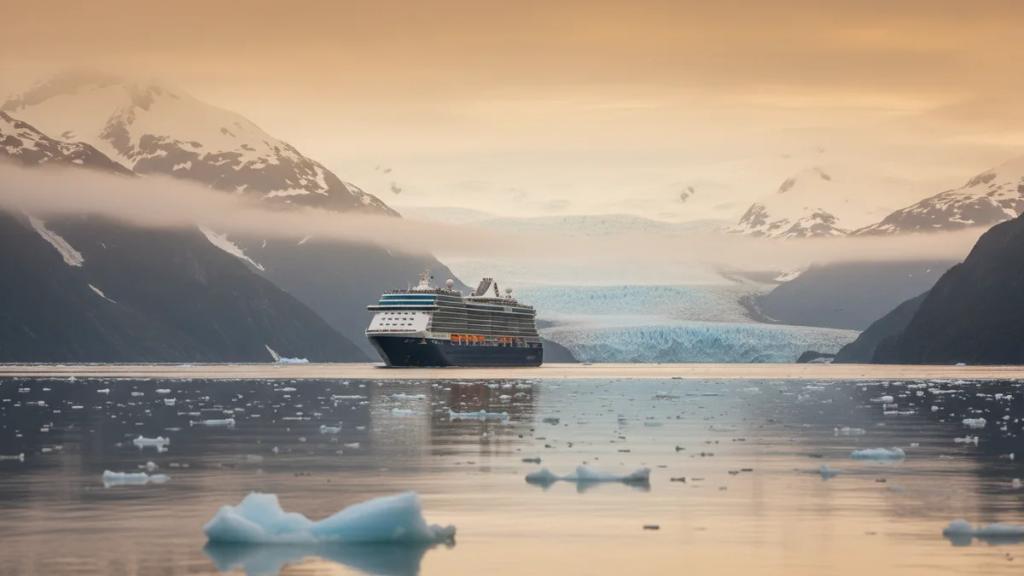
Port days are where your eSIM shines. Juneau, Skagway, Ketchikan and Sitka are normal American towns with 4G coverage. The moment you dock, turn airplane mode off, and your US eSIM connects for the port day - though Skagway can crawl on a multi-ship day - maps to the Mendenhall Glacier shuttle, WhatsApp calls home, uploading whale photos, checking your all-aboard time. Then airplane mode back on as you sail away.
That routine - eSIM in port, airplane mode at sea, ship Wi-Fi only if you truly need it - is the cheapest way we know to stay connected on an Alaska cruise.
Driving Alaska? The Road-Tripper's Playbook
The classic Alaska road trip runs Anchorage to Seward, Anchorage to Denali, and on to Fairbanks. Your eSIM handles it well with a little preparation:
- Anchorage to Seward (Seward Highway): Coverage in Anchorage, Girdwood, and Seward, with dead zones along Turnagain Arm and through the mountain passes. The drive is 2.5 hours; the gaps are 20-40 minutes each.
- Anchorage to Denali to Fairbanks (Parks Highway): Coverage in Wasilla, Talkeetna, the Denali park entrance area, Healy, and Fairbanks. Long quiet stretches in between.
- Download offline maps before you leave Anchorage. Google Maps saves offline areas of limited size, so for Anchorage-Seward-Denali-Fairbanks you will need several. GPS positioning works without any signal, so navigation keeps running through every dead zone.
One thing to know about the stretches in between: Alaska's own network, GCI, has the widest rural footprint in the state, and T-Mobile's customers roam on it. Your eSIM is built around AT&T's network in Alaska, which covers the towns, the cruise ports and stretches of the main highways, so expect the quiet sections between towns to be offline and plan around them with offline maps.
Flying in From Outside the US? One Extra Thing
If you are visiting from Europe, Australia, or Asia, an eSIM saves you the most: home-network roaming in the US is usually charged by the day, and Alaska counts as the US for roaming purposes.
But note one detail that catches cruise passengers out: most Alaska cruises leave from Seattle or Vancouver, and one-way cruises start or end in Vancouver too. A US eSIM does not cover the Canadian leg of your trip. If your itinerary includes a night in Vancouver before embarkation or a Victoria stop on the way back, add a Canada eSIM for those days. Both eSIMs can live on your phone at the same time; you just switch which one is active.
Flying to Alaska from the UK
There is no non-stop flight from the UK to Alaska. Most British cruise passengers fly to Seattle - British Airways flies there non-stop from Heathrow - or to Vancouver, the two main home ports for the Alaska season; Seattle to Anchorage is about three and a half hours on top if your trip starts on land. Anchorage is nine hours behind the UK for most of the year.
The ESTA applies at sea too. Under the US Visa Waiver Program you need an approved ESTA to enter the US by land, sea or air, so a cruise that starts in Vancouver still needs one before its first Alaskan port. It costs about 40 US dollars (the fee rises slightly on 16 October 2026) and is applied for online - only on the official US government site; look-alike sites charge extra for the same form. The Foreign Office adds that an older ESTA without the now-required selfie photo may need replacing, so check yours if it was issued some time ago. Starting in Vancouver by air? You also need a Canadian eTA for the flight in - not if you arrive in Canada by land or sea.
What UK networks charge there. Using your UK plan in Alaska costs the same as anywhere in the US: £6 a day on EE, £7 a day with O2 Travel, and £8 a day on Vodafone and Three for most plans started recently, according to each network's price guide checked on 8 October 2026. On a ten-day cruise that is £60 to £80 for data you will mostly use on port days, before any ship's satellite roaming if you forget airplane mode at sea. Every network and plan is compared in UK mobile roaming charges compared.
Plugs: the US uses flat-pin type A and B sockets at 120 volts, so pack an adaptor, and check your chargers say 100-240V - phone and laptop chargers almost always do, but check anything else with a plug before you pack it.
Sources: gov.uk USA and Canada entry requirements (updated 18 August and 2 June 2026), the US Federal Register ESTA fee notice of 1 October 2026, airline and port pages, all read on 8 October 2026.
Why You Need Mobile Data in Alaska
Alaska is not a destination where you can wing it offline:
- Safety alerts: Bear activity notices, sudden weather changes, and trail closures are pushed through park and borough alert systems. Alaska weather turns fast, and tour operators cancel by text or email.
- Tour logistics: Flightseeing, whale watching, glacier trips, and shuttle buses all confirm, delay, and reschedule by phone. Because the eSIM is data-only, give tour operators your email or WhatsApp, or keep your home line switched on to receive their texts (your network may charge for that).
- Tide tables: If you are walking beaches near Homer or Turnagain Arm, tides matter for safety, and the bore tide schedule is something you check online.
- Photo backup: Backing up over data in town means a lost or soaked phone doesn't take your glacier shots with it.
- Navigation: distances are huge and fuel stops are sparse. Live navigation plus offline fallback is the right setup.
How Much Data Do You Need for Alaska? What Our Customers Actually Used
Most guides guess. We checked how much data our own customers really used on their United States eSIMs. These figures cover all 154 of our US eSIMs that were used and have finished - US-wide, not only Alaska trips - checked on 2 October 2026:
- 1 GB / 7 days: the typical customer used all of it - more than half used every megabyte.
- 3 GB / 15 days: typical use about 1 GB; 1 in 4 ran out.
- 5 GB / 30 days: typical use about 2.7 GB; 1 in 4 ran out.
- 10 GB / 30 days: typical use about 5.3 GB; 1 in 5 ran out.
- 20 GB / 30 days: typical use about 9.7 GB; 1 in 8 ran out.
What that means for Alaska:
- Cruise passengers (data on port days only): skip the 1 GB plan - more than half of the people who chose it used every megabyte. On our 3 GB plan typical use was about 1 GB, though 1 in 4 ran out - so 3 GB fits a port-days-only cruise if you are careful, and 5 GB is the safe choice if you video-call home or back up photos in port.
- Road trippers (maps, messaging, photo sharing every day): 10 GB for one to two weeks - typical use on our 10 GB plan was about 5 GB.
- Heavy users (video calls, cloud photo backup, hotspot for a laptop): 10-20 GB - even on 10 GB, one in five of our customers used it all.
Get a personalised estimate:
Roaming, a Local SIM, or an eSIM?
Visitors from outside the US pay their home network's US roaming rates in Alaska, usually sold as a daily pass, so a two-week trip adds up quickly - and none of that includes the maritime "mobile at sea" rates if you forget airplane mode on the ship. A local SIM rarely makes sense either: you would have to buy and set one up after you land, which a cruise schedule or a short connection rarely leaves time for. An eSIM is installed before you leave home and charges once.
For cruisers: install the eSIM at home before you fly - installation needs an internet connection - then keep it switched off until your first port day. In port, turn on data roaming for the eSIM line and choose it as your mobile data line; it needs nothing but signal.
Sources, checked 2 October 2026: AT&T's Alaska network and 2024 Juneau/Skagway upgrade (attconnects.com), the National Park Service on Denali mobile signal (nps.gov), cruise lines' published Wi-Fi prices, AT&T's cruise roaming rates, and our own order and eSIM usage data.
Frequently Asked Questions
Does the eSIM work on the cruise ship?
Not while sailing. Ours, like every eSIM that runs on land networks, needs a mobile tower in range, and at sea there is only the ship's satellite Wi-Fi and its own "mobile at sea" network (keep airplane mode on when sailing). The eSIM works again the moment you dock in Juneau, Ketchikan, Sitka or Skagway.
A few providers sell maritime plans that connect through the ship's network instead. They cost far more per gigabyte, so they only make sense if you must be reachable on sea days.
Does it work in Denali National Park?
Near the entrance, yes. The National Park Service puts it plainly: mobile signal is available near the park entrance, but not beyond Mile 4 on the Park Road. Download offline maps and treat the park interior as offline, because for every network, it is.
Do I need a separate Canada plan for a Vancouver departure?
Yes, if you want data in Canada. A US eSIM does not cover Vancouver or Victoria. Add a Canada eSIM for your pre-cruise days or Canadian port calls; both plans can be installed side by side and switched in Settings.
Do I need an ESTA for an Alaska cruise from Vancouver?
Yes, if the ship calls at Alaskan ports. British passport holders need an approved ESTA to enter the US by sea as well as by air, according to gov.uk (updated 18 August 2026). Apply on the official US government site before you travel.
Is Alaska covered by a normal US eSIM?
Yes. Alaska is a US state, so a US plan includes it at no extra cost. In Alaska your eSIM uses AT&T's network, which covers the cities and the main cruise ports.
Will my phone work in Alaska?
Many phones since 2018 support eSIM, including iPhone XS and newer and most Samsung Galaxy S20 and Google Pixel 3 and newer models - check your settings for an "Add eSIM" option. Phones bought in mainland China, Hong Kong or Macau often lack eSIM. Your phone must also be network-unlocked.
Can I hotspot from the eSIM?
Yes, tethering works on plans with a fixed data allowance (not on unlimited plans), which is handy for sharing a connection with family in port or backing up a laptop's photos from a Fairbanks hotel. Just watch your data balance; hotspot use burns through GB quickly.
What about the Kenai Fjords or glacier tours?
Boat tours out of Seward and Whittier lose signal shortly after leaving the harbour, and flightseeing routes over the icefields are offline. Coverage returns as you approach town. Plan to be unreachable during the tour itself, which is arguably the point.
How fast is the data in Alaska?
In Anchorage, Fairbanks and the main cruise ports expect normal 4G LTE speeds, easily enough for video calls and streaming. When several ships are in port at once, the network in Juneau or Skagway can slow down. Speeds depend on the local towers, and at busy times visitors' roaming connections can be slower than local customers'.
Ready for Alaska without roaming fees or ship Wi-Fi bills?
Join 10,000+ travellers who chose eSIM Pass. One US plan covers Anchorage, the Denali entrance area and the main cruise ports. Instant QR delivery.
Get Your Alaska eSIM