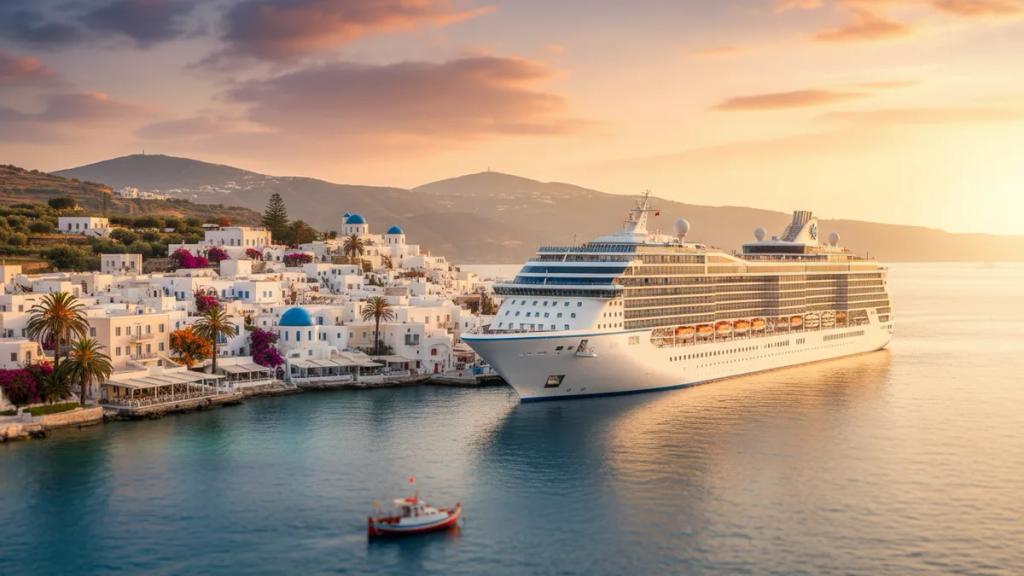
The best eSIM for a Mediterranean cruise is eSIMpass's Europe plan, starting at £2.59 and covering 31 European countries on a single QR code. One eSIM connects you the moment you step off the gangway in Barcelona, Marseille, Rome, Naples, Athens, Dubrovnik, and every other EU port your ship calls at - no juggling a different SIM for each country, no roaming bill shock, and no need to buy the ship's overpriced satellite Wi-Fi just to check WhatsApp.
Here is the honest part most cruise articles skip: at sea, in the open Mediterranean, there is no normal mobile coverage at all. No eSIM works mid-ocean, because there are no land towers in range. What you do instead is simple - keep your phone offline while sailing, and let your Europe eSIM come alive the instant you reach each port. This guide walks you through exactly how, port by port.
Mediterranean Cruise eSIM Plans and Pricing
| Data | Duration | Price |
|---|---|---|
| 3 GB Data | 7 Days | £2.92 |
| 5 GB Data | 15 Days | £4.63 |
| 10 GB Data | 30 Days | £8.31 |
| 20 GB Data | 30 Days | £14.68 |
| 1 Day | 1 Day | £2.59 |
| 2 Days | 2 Days | £5.19 |
| 3 Days | 3 Days | £7.78 |
| 4 Days | 4 Days | £10.20 |
| 5 Days | 5 Days | £12.93 |
| 6 Days | 6 Days | £15.67 |
| 7 Days | 7 Days | £18.41 |
| 8 Days | 8 Days | £19.78 |
| 9 Days | 9 Days | £21.83 |
| 10 Days | 10 Days | £23.20 |
| 11 Days | 11 Days | £25.25 |
| 12 Days | 12 Days | £27.30 |
| 13 Days | 13 Days | £28.67 |
| 14 Days | 14 Days | £30.04 |
| 15 Days | 15 Days | £32.09 |
| 16 Days | 16 Days | £33.46 |
| 17 Days | 17 Days | £34.15 |
| 18 Days | 18 Days | £35.51 |
| 19 Days | 19 Days | £37.57 |
| 20 Days | 20 Days | £38.94 |
| 21 Days | 21 Days | £40.30 |
| 22 Days | 22 Days | £40.99 |
| 23 Days | 23 Days | £41.67 |
| 24 Days | 24 Days | £42.36 |
| 25 Days | 25 Days | £43.04 |
| 26 Days | 26 Days | £43.73 |
| 27 Days | 27 Days | £44.41 |
| 28 Days | 28 Days | £45.09 |
| 29 Days | 29 Days | £45.78 |
| 30 Days | 30 Days | £47.15 |
One plan covers every port in a covered country. Whether your sailing is Barcelona to Rome, a Greek Isles loop out of Athens, or a western Mediterranean run through Spain, France, and Italy, the Europe eSIM works in every one of those port countries on the same data allowance. You buy it once, install it before you leave home, and it just keeps working as the ship moves from country to country. The plan covers the 27 EU states plus the UK, Norway, Iceland and Liechtenstein - so if your itinerary also calls outside the EU, for example at Kotor (Montenegro), Monaco, Gibraltar or a Turkish port, check that stop separately, because the Europe plan does not cover it.
Why an eSIM Beats Everything Else on a Cruise
Cruise connectivity is where travellers get burned the hardest, because there are three bad options fighting for your money:
Ship satellite Wi-Fi is slow and expensive. Onboard internet packages are billed per day per device, and speeds crawl when thousands of passengers all log on at once. It is fine for a quick message, painful for photos, maps, or a video call home. You are paying premium rates for economy performance.
Home-network roaming is a trap at sea. This is the big one. The moment your ship leaves port, your phone can latch onto the vessel's own maritime "mobile at sea" network. That connection bills through your home network at brutal rates - often several euros per megabyte, not per gigabyte. A single automatic photo backup or app update while you sleep can cost more than your shore excursions combined. Never leave roaming switched on while the ship is moving.
A Europe eSIM is the port-day fix. When you dock, your ship is sitting in a normal European city with normal 4G and 5G coverage. Your eSIM connects to a major local network the second you are in range of land, at full speed, with data you already paid a fair price for. Then you switch it off again as you sail away. That routine - eSIM in port, phone offline at sea - is the cheapest reliable way to stay connected on a Mediterranean cruise.
For a full breakdown of why prepaid data beats per-day roaming plans, see our guide on eSIM vs roaming.
The Golden Rule: Turn Roaming Off at Sea
If you remember one thing from this article, make it this. Before your ship leaves its first port:
- Open your phone settings and turn data roaming OFF on your home network line.
- Better yet, put the phone in airplane mode whenever the ship is sailing, then turn it back on in port.
- Only your Europe eSIM should carry data, and only when you are docked or close to shore.
This single habit protects you from the maritime-network billing trap completely. The ship's mobile-at-sea antenna cannot charge you if your phone never connects to it. Ship Wi-Fi (which you connect to deliberately) is separate and safe from surprise roaming charges - just slow.
One important clarification, because it confuses a lot of cruisers: the EU "Roam Like at Home" rule that lets Europeans use their phone freely across the EU does not help you at sea, and it does not help visitors from outside Europe at all. If you are travelling from the US, the UK (post-Brexit), Australia, or anywhere outside the EU/EEA, your home SIM has no free-roaming right in Europe - you pay your network's international rates. The eSIM is the fix for exactly that gap.
Port-by-Port: Where Your eSIM Comes Alive
The classic Mediterranean itineraries string together some of Europe's best-connected cities. Here is what to expect as you dock:
- Barcelona, Spain - Strong 4G/5G across the city and cruise terminal on networks like Movistar, Vodafone, and Orange. Your eSIM connects before you are even off the pier.
- Marseille, France - Solid coverage on Orange, SFR, and Bouygues throughout the Vieux-Port and out to the calanques.
- Rome (Civitavecchia), Italy - Civitavecchia is the port; Rome is about 80 km inland by train. Coverage is good the whole way on TIM, Vodafone, and WindTre, which matters for the long transfer.
- Naples, Italy - Reliable data right at the port for navigating to Pompeii, the Amalfi ferries, or the funicular up the hill.
- Athens (Piraeus), Greece - Piraeus and central Athens have strong coverage on Cosmote and Vodafone Greece - handy for metro tickets and Acropolis timed entries.
- Dubrovnik, Croatia - Good 4G across the old town. Croatia is covered on the Europe plan even though the walled city's thick stone can weaken indoor signal.
- Santorini, Mykonos, Palma, Villefranche - Smaller ports, but all sit in covered countries; expect usable data near the harbour and town, thinning out on remote clifftop trails.
- Kotor, Montenegro - A popular stop, but Montenegro is outside the EU and not covered by the Europe plan. Plan that port day on ship Wi-Fi, offline maps, or a separate plan for Montenegro.
The pattern is consistent: any port town in a covered country is a real European city with real coverage, so your eSIM works everywhere you actually shop, eat, and sightsee. It is the water in between that is the dead zone.
Be Honest: The eSIM Does Not Work Mid-Ocean
No travel eSIM - from any provider - gives you data in the open sea. There are no mobile towers on the water, so once the coastline drops below the horizon, your only options are the ship's satellite Wi-Fi or nothing. Anyone advertising an eSIM that "works on your cruise, everywhere" is either misleading you or quietly counting on ship Wi-Fi.
That is not a weakness of the Europe eSIM; it is physics. What the eSIM gives you is the thing you actually need: fast, cheap, ready-to-go data the moment you are back on land, in every covered country you visit, without a store visit or a new SIM per border. Plan your sea days as offline time - read, nap, watch the wake - and save the connected life for port.
Download Offline Maps Before You Sail
Because your data lives in port and dies at sea, a little prep makes port days smoother:
- Save offline maps of each port city in Google Maps or Maps.me before you leave home (or over the ship's Wi-Fi the night before). GPS positioning works with zero signal, so navigation keeps running even in a coverage dip inside a stone-walled old town.
- Screenshot your excursion details - meeting points, all-aboard times, tender schedules - so they are on your phone whether or not you have signal.
- Pre-download a translation pack and any transit apps for Italy, Spain, Greece, and Croatia while you have data.
With offline maps loaded and your eSIM handling live data in port, you get the best of both worlds: navigation that never quits and data that costs a fraction of ship Wi-Fi.
How Much Data Do You Need for a Cruise?
Because you are only online on port days, cruise passengers use less than land travellers:
- Light use (maps, messaging, a few photos uploaded in port): 1-3 GB for a 7-day sailing.
- Moderate use (daily WhatsApp calls, social posts, some browsing): 3-5 GB per week.
- Heavy use (video calls home from every port, hotspot for a partner's tablet): 5-10 GB per week.
Get a personalised estimate based on your habits:
eSIM vs Roaming vs Local SIM for a Cruise
eSIM vs Roaming vs Local SIM
Compare your options for Europe
| eSIMpass | Roaming | Local SIM | |
|---|---|---|---|
| Setup time | Instant | None | 30-60 min |
| Cost per GB | ~$2-5 | $10-50+ | ~$3-8 |
| Surprise fees | None | Likely | Unlikely |
| Buy before trip | Yes | Yes | No |
| Keep your number | Yes | Yes | No |
| Speed | 4G/5G | 4G/5G | 4G/5G |
A local SIM makes no sense on a cruise - you would need a new one in every country, bought during a few rushed hours ashore. Network roaming works on land but costs far more per GB, and risks the maritime-network trap at sea. The Europe eSIM wins on price, on covering all 31 countries at once, and on being installed before you ever leave home. Compare more options in our eSIM vs roaming breakdown, or read our full guide to the best eSIM for Europe for non-cruise trips.
How to Install Your Cruise eSIM (Under 3 Minutes)
- Buy the Europe eSIM and complete checkout.
- Receive your QR code by email instantly - no activation fee.
- Scan it at home: Settings > Mobile Service > Add eSIM > Scan QR code.
- Leave it switched off until your first port, keeping your home line for pre-cruise calls.
- Activate in port: turn on the eSIM and data roaming when you dock, and you are online at full speed.
Pro tip: installation needs an internet connection, so set it up on your home Wi-Fi before you fly. Activation in port needs nothing but a signal, which every Mediterranean port has in abundance.
Frequently Asked Questions
Does the eSIM work while the ship is at sea?
No. In the open Mediterranean there are no mobile towers in range, so no eSIM from any provider gives you data. It connects at full speed the moment you dock in Barcelona, Rome, Athens, Dubrovnik, or any port in a covered country. At sea, use the ship's Wi-Fi if you must, and keep your phone otherwise offline.
How do I avoid a huge roaming bill on a cruise?
Turn data roaming off on your home network line, and keep your phone in airplane mode while the ship is sailing. This stops it from connecting to the ship's expensive maritime "mobile at sea" network. Let only your Europe eSIM carry data, and only in port.
Does one eSIM cover every country my cruise visits?
For most Mediterranean itineraries, yes. The Europe plan covers 31 European countries on a single data allowance, including Spain, France, Italy, Greece, Croatia, Malta and Cyprus - plus the UK, which some EU-only plans leave out. You do not need a separate SIM for each of those ports. Stops outside the EU, such as Kotor (Montenegro), Monaco, Gibraltar or Turkey, are not covered, so check your itinerary against the country list.
I'm travelling from the US or UK - do EU roaming rules help me?
No. The EU "Roam Like at Home" benefit only applies to EU/EEA residents using their home SIM. Visitors from the US, UK (post-Brexit), Australia, and elsewhere pay their home network's international roaming rates. A Europe eSIM is the affordable fix for non-EU travellers.
Can I use ship Wi-Fi and the eSIM together?
Yes. They are independent. Use ship Wi-Fi at sea when you need to be online, and switch to your eSIM's fast, cheap data the moment you are docked. Ship Wi-Fi will not trigger surprise roaming charges - it is the maritime mobile network you must avoid.
Will my phone work with the eSIM?
Most phones from the last few years support eSIM, including iPhone XR and newer, Samsung Galaxy S20 and newer, and Google Pixel 3 and newer. Your phone must be network-unlocked. Install the eSIM over Wi-Fi before you travel.
Ready to cruise the Mediterranean without roaming bills?
Join 10,000+ travellers who chose eSIMpass. One Europe plan covers 31 countries and every EU port. Instant QR delivery.
Get Your Europe eSIM