Dia de Muertos 2026 in Mexico City: Dates & Staying Connected
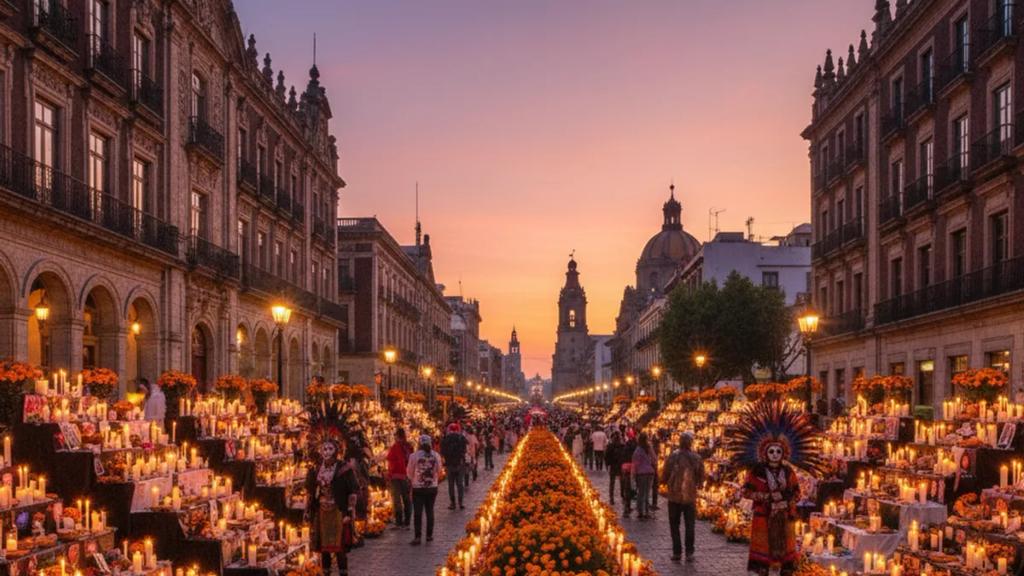
Dia de Muertos 2026 falls on Sunday 1 November and Monday 2 November - fixed dates every year - with Mexico City's Grand Parade typically held the preceding Saturday along Paseo de la Reforma. The holy days are set in the calendar (programme on mexicocity.cdmx.gob.mx); the parade date is announced closer to the time. Over a million spectators line Reforma, cemetery vigils in Mixquic run through the night, and the mobile network gets hammered exactly when you are trying to find your group in a sea of painted faces. Here is what to expect and the connectivity plan - a Mexico eSIM from £2.58 keeps the rideshares and live locations working.
When exactly is Dia de Muertos 2026 in Mexico City?
The core dates never move: 1 November (Dia de los Angelitos, honouring children) and 2 November (Dia de los Muertos proper, honouring adults) - in 2026, a Sunday and Monday. But the celebration in Mexico City is really a season:
- Late October: ofrendas (altars) appear in the Zocalo, museums, markets, and shopfronts days before the holiday itself.
- The Grand Parade: typically the Saturday before the holy days, running down Paseo de la Reforma towards the Zocalo. The exact date and route are confirmed a few weeks out - check the official site before booking flights around the parade specifically.
- Night of 1-2 November: the cemetery vigils. San Andres Mixquic, on the city's southern edge, hosts the most famous all-night candlelit vigil (La Alumbrada); Panteon de Dolores and other cemeteries fill through the night.
If you can only pick one window, arrive the Thursday or Friday before 1 November - you catch the parade weekend and both holy days.
What should a first-timer actually expect?
Something closer to a citywide family ritual than a party thrown for tourists. The ofrendas, the marigolds (cempasuchil), and the vigils are genuine acts of remembrance; visitors are welcome at most of it, but photographing grieving families up close is a bad look.
Practical realities:
- The parade is free and unticketed, but good kerbside spots on Reforma fill 2-3 hours early. Over a million people attend; arrive at start time and you are watching the backs of heads.
- Hotels sell out and prices spike for the holiday week - Centro Historico and Roma/Condesa book up months ahead.
- Mixquic is intense: roughly 1.5-2 hours from the centre, jammed solid on the night of 1-2 November, and getting back after midnight requires a plan (more below).
- Joining in is fine - street artists around the Zocalo will paint you as a catrina for a modest fee; agree the price first.
Why does your phone struggle during Dia de Muertos?
Because the Grand Parade concentrates over a million spectators along a few kilometres of Reforma, all uploading video of the same giant skeleton puppets at once. Mexican networks handle normal city load fine, but a parade crowd shares a fixed number of cell sectors, and data slows to a crawl right when your group gets separated. Out in Mixquic the problem inverts: a village network built for a few thousand residents suddenly hosts tens of thousands of visitors at midnight.
What actually helps:
- Agree a physical meeting point before the parade - the Angel de la Independencia is the classic choice and, for that reason, too crowded; pick a side-street corner instead.
- Texts and WhatsApp voice notes beat calls - small payloads squeeze through congestion; live calls drop.
- Start live location sharing early, while the network is still healthy - families here genuinely use it to regroup along the route, but the session has to start before the crowds peak.
- Download offline maps of Mexico City and the Tlahuac/Mixquic area - the 2am navigation home should not depend on signal.
- Upload later: post the parade footage from hotel Wi-Fi, not from the middle of Reforma.
What is the best connectivity setup for Dia de Muertos?
A Mexico eSIM installed before you fly. Roaming passes commonly bill 5-12 EUR per day for the same congested signal, and buying a local SIM on arrival means finding a network counter with your passport after a long-haul flight. A prepaid Mexico eSIM gives you a fixed data bundle on a Mexican host network at local rates:
| Data | Duration | Price |
|---|---|---|
| 1GB Data | 7 Days | £2.58 |
| 3GB Data | 15 Days | £6.78 |
| 5GB Data | 30 Days | £11.31 |
| 10GB Data | 30 Days | £20.63 |
| 20GB Data | 30 Days | £37.28 |
| 50GB Data | 30 Days | £114.54 |
| 1 Day | 1 Day | £4.04 |
| 2 Days | 2 Days | £6.09 |
| 3 Days | 3 Days | £8.14 |
| 4 Days | 4 Days | £10.20 |
| 5 Days | 5 Days | £12.93 |
| 6 Days | 6 Days | £15.67 |
| 7 Days | 7 Days | £18.41 |
| 8 Days | 8 Days | £19.78 |
| 9 Days | 9 Days | £21.83 |
| 10 Days | 10 Days | £23.20 |
| 11 Days | 11 Days | £25.25 |
| 12 Days | 12 Days | £27.30 |
| 13 Days | 13 Days | £28.67 |
| 14 Days | 14 Days | £30.04 |
| 15 Days | 15 Days | £32.09 |
| 16 Days | 16 Days | £33.46 |
| 17 Days | 17 Days | £34.15 |
| 18 Days | 18 Days | £35.51 |
| 19 Days | 19 Days | £37.57 |
| 20 Days | 20 Days | £38.94 |
| 21 Days | 21 Days | £40.30 |
| 22 Days | 22 Days | £40.99 |
| 23 Days | 23 Days | £41.67 |
| 24 Days | 24 Days | £42.36 |
| 25 Days | 25 Days | £43.04 |
| 26 Days | 26 Days | £43.73 |
| 27 Days | 27 Days | £44.41 |
| 28 Days | 28 Days | £45.09 |
| 29 Days | 29 Days | £45.78 |
| 30 Days | 30 Days | £47.15 |
Your home number stays live on dual SIM for calls, texts, and bank codes, while data runs on the Mexican network - and here that data is not optional, because Uber and DiDi are how you move at night and both are dead without it. Install the QR code at home on Wi-Fi, switch the line on when you land, and order the ride from arrivals.
A parade-and-cemeteries trip is data-hungry: rideshares, maps, translation, live location, and a lot of video. Estimate what you need:
How do you get around Mexico City during the holiday?
For the parade, the Metro is the move: fares are a few pesos and trains sidestep the street closures that make driving near Reforma hopeless on parade day. Stations near the route are crushed just after it ends - walking 15 minutes to a station further out is usually faster.
Everywhere else, rideshare is the transport reality, especially at night. Uber and DiDi both operate across the city and are the sane way back from evening events - but they need data at exactly the moments networks are weakest, which is the strongest practical argument for a local-rate data plan. For Mixquic, many visitors book a driver or tour, because the 1-3am return leg is the hard part; if you rideshare, walk away from the core crowd before requesting, and expect surge pricing. From the airport, official taxis and rideshares both work; MEX is 30-60 minutes from the centre in traffic, AIFA much further out.
Is it appropriate to join as a tourist?
Yes, and the city actively invites it - the Grand Parade exists largely as a public spectacle, the Zocalo ofrenda is built for visitors, and money spent with vendors and guides is welcome. The line to respect is at the cemeteries: the vigils are real mourning, not a show. Go quietly, buy marigolds and candles from the stalls outside, and keep the camera down unless invited. Dressing as a catrina is participation, not appropriation; it is drunk-and-loud-at-a-graveside behaviour that locals resent. One more honest note: November nights here get genuinely cold (the city sits at around 2,240m), so bring a real jacket for the vigils.
The bottom line
Dia de Muertos 2026 is 1-2 November - fixed dates, with the Grand Parade expected the preceding Saturday and confirmed closer to the time. Book the hotel early, stake out the parade spot early, agree a meeting point before the network jams, and land with connectivity sorted: a Mexico eSIM from £2.58 installed at home means the Uber from the airport, the live location on Reforma, and the 2am ride back from Mixquic all just work, without a roaming line on next month's bill.
What are the exact dates of Dia de Muertos 2026?
The holy days are fixed: 1 November (honouring children) and 2 November (honouring adults) - in 2026, a Sunday and Monday. The Grand Parade is typically the preceding Saturday on Paseo de la Reforma, with the official date and route announced a few weeks ahead on mexicocity.cdmx.gob.mx.
Is the Dia de Muertos parade free?
Yes - the Grand Parade is free and unticketed along the whole Reforma route. The trade-off is crowds: over a million spectators attend, so claim a kerbside spot 2-3 hours early, or book one of the paid hotel-terrace options that appear closer to the date.
Will my phone work during the parade?
Yes, but expect crawling data and failed calls at peak moments - a million-plus phones share the cell sectors along Reforma. Start live location sharing before the crowds peak, lean on texts and voice notes instead of calls, and keep offline maps downloaded for the trip home.
How much data do I need for a Dia de Muertos trip?
A 4-7 day trip built around rideshares, maps, translation, live location, and heavy photo and video sharing typically lands in the 3-8GB range. A fixed-data Mexico eSIM from £2.58 can be topped up if parade night produces more footage than planned.
Is Mixquic worth the trip from central Mexico City?
For many visitors it is the most moving part of the holiday - thousands of candles across the churchyard on the night of 1-2 November. But the logistics are real: roughly 1.5-2 hours each way, a village jammed solid, and a return leg past midnight. Book a driver or tour for the night, or accept surge pricing and a walk to meet your rideshare.
Land in Mexico City already online
A Mexico eSIM from eSIMpass installs before you fly - local-rate data for the airport Uber, live location on the parade route, and the late ride back from Mixquic, with your home number kept via dual SIM.
Get Your Mexico eSIM