Amman runs on Zain Jordan, Orange Jordan and Umniah, and your eSIM rides one of them as its host. Jordan is well covered for a country of its size - dense 4G across Amman and the main tourist corridor, with 5G in the capital. The gaps are in the desert and the wadis, which is exactly where you will be spending your best days.
This is the single most useful thing a first-time visitor to Jordan can know, and it has nothing to do with signal.
The Jordan Pass bundles your entry visa with admission to more than 40 sites, Petra among them. In 2026 it comes in three tiers, differing only in how many days at Petra you get:
- Wanderer - 1 day at Petra, 70 JOD
- Explorer - 2 days, 75 JOD
- Expert - 3 days, 80 JOD
The arithmetic is stark. A visa on arrival alone is 40 JOD, and a single day at Petra costs about 50 JOD. That is 90 JOD before you have seen anything else - so the cheapest pass saves you money on day one, and then throws in Jerash, Wadi Rum, the Amman Citadel and the Roman Theatre.
Two conditions that catch people:
- Buy it before you arrive. It is an online purchase, and it must be done before you land - you cannot buy it at immigration.
- You must stay at least three nights in Jordan for the visa waiver to apply. Shorter trips do not qualify.
Practically, this means your phone matters at the border: the pass is a QR code, and immigration scans it. Download it. Screenshot it. Print it if you are cautious. Arriving with a pass you cannot open is the same as arriving without one.
Amman itself is fine - a large, hilly, well-covered capital. The gaps are on the days out, and they are the reason you came.
Petra. The Siq - the 1.2 km slot canyon you walk in through - has sheer rock walls over 80 m high and very little signal. It opens out at the Treasury, and coverage improves across the main valley floor, then thins again on the climbs: the 800-odd steps up to the Monastery, and the High Place of Sacrifice. Petra is huge - people underestimate it badly - and you can easily be two hours' walk from the entrance with a bar or none.
Wadi Rum. Desert, and properly so. Camps have some connectivity, often via their own arrangements, and the open desert between them does not. If you are on an overnight camp trip, your pickup is arranged in advance and stays arranged.
The Dead Sea. At 430 m below sea level - the lowest land surface on earth - the resorts along the shore are covered, and the descent road from Amman drops through terrain that is patchier.
Dana, Wadi Mujib and the wadis off the King's Highway are canyon country and behave accordingly.
- Careem is the dominant ride-hailing app in Jordan and the one to install; Uber also operates. Amman is very hilly and spread out, and walking between neighbourhoods is harder than the map suggests - the city is built across a series of steep jebels.
- Your Jordan Pass QR, offline.
- Maps. Amman's addresses work by circle - First Circle through Eighth Circle along Zahran Street - and by landmark rather than street number.
- A translation app. English is widely spoken in the tourist sector and in Amman generally; Arabic is essential once you are off that track.
Queen Alia International (AMM) is about 35 km south of the city, 30-45 minutes by road. The Sariyah airport express bus runs into North Terminal cheaply and reliably; taxis and Careem cover the rest.
Immigration is where the Jordan Pass earns its keep - have the QR open before you reach the desk.
The dinar is strong and Jordan is not a cheap destination by regional standards. Cards work in Amman, hotels and larger restaurants; carry cash for taxis, small shops and anywhere outside the capital.
Moderate, front-loaded for the trips. Amman itself uses ordinary city amounts; Petra and Wadi Rum days are mostly spent somewhere your phone cannot reach.
For a week covering Amman, Petra and Wadi Rum, 1GB per 3 days is a fair baseline, with the downloads done in advance. Plans top up from your dashboard.
Amman is colder than people pack for. At around 1,000 m the evenings are cool even in summer, and winter is properly cold - Amman gets snow most years, and when it does the city stops.
Modest dress matters here more than in the Gulf resorts. Covered shoulders and knees for both men and women in the city, and especially downtown, which is more conservative than the western hills. Nobody will be rude about it; you will simply be more comfortable.
Petra demands proper shoes. It is a full day of walking on sand, rock and steps, often in heat, and people ruin their trip in inappropriate footwear. Hat, sunscreen, and more water than you think.
Wadi Rum is cold at night, even after a 35C day - the desert loses heat fast, and camps provide blankets for a reason.
The Treasury through the Siq, at the moment the canyon opens - the most anticipated reveal in travel, and it deserves the anticipation. Arrive at opening; by mid-morning it is crowded and the light has gone flat.
The Monastery (Ad Deir), 800 steps above the valley floor and considerably larger than the Treasury, with far fewer people.
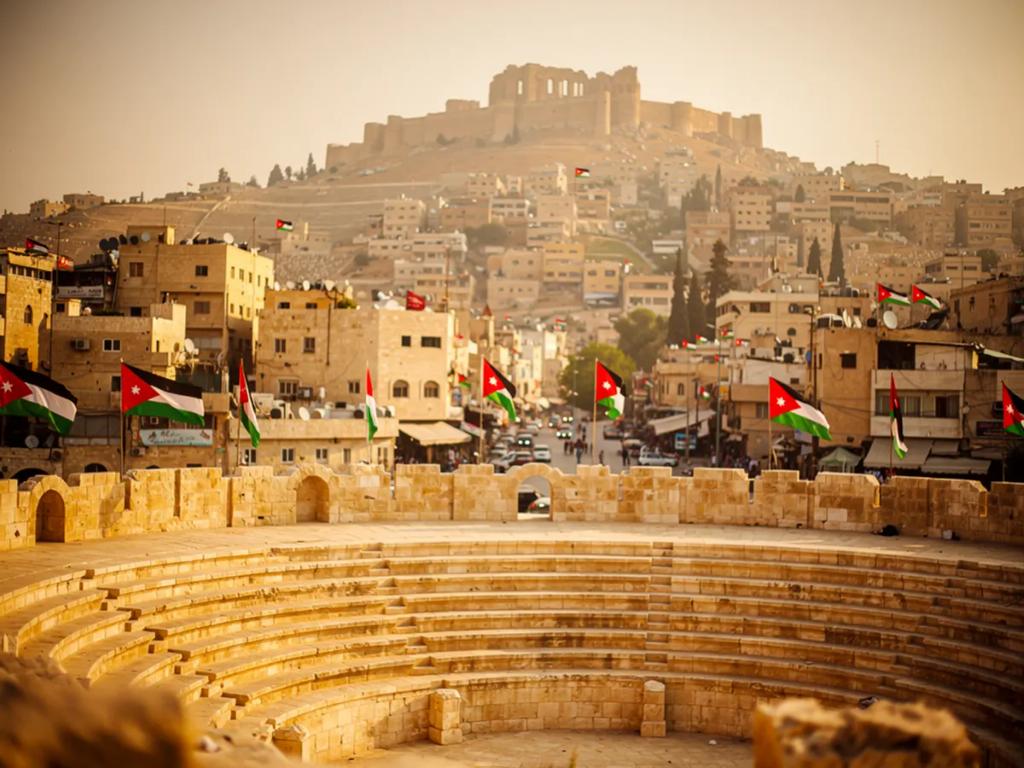
The Roman Theatre in central Amman, cut into the hillside and still seating 6,000.
The Citadel at sunset, with the Temple of Hercules columns and the whole white city stacked across the hills below.
Wadi Rum at dawn, from a camp, with the light coming across the sandstone.
The Dead Sea, floating - and be careful with the phone, because the salt is corrosive and getting it in your eyes ends the afternoon.
Amman was Philadelphia in the Roman period, named for Ptolemy II Philadelphus, and was one of the cities of the Decapolis.
The city is built across a series of hills - originally seven, now many more - which is why it has no real centre and why walking it is harder than it looks.
Petra was the capital of the Nabataeans, who controlled the incense trade and built a sophisticated water system in a desert - the channels along the Siq walls are the real engineering achievement, not the facades.
And the Dead Sea is dropping by around a metre a year, which means the shoreline in old photographs is now a long walk from the water.
Spring, March to May, and autumn, September to November, are the seasons - Petra and Wadi Rum in July are brutally hot.
The Jerash Festival in summer brings performance to the Roman city north of Amman.
Ramadan changes the rhythm entirely: daytime eating in public is not done, hours shift, and the evenings are lively. Petra and the tourist sites operate on reduced hours.
Winter is quiet, cheap and genuinely cold, with the occasional snow day that shuts the capital.
The love: Jordan packs an improbable amount into a small country - Petra, Wadi Rum, the Dead Sea, Jerash and the Roman remains, all within a few hours of each other. Amman is a comfortable, safe, well-fed base with a serious café culture and some of the best food in the region. Jordanians are exceptionally hospitable. And the Jordan Pass makes the logistics unusually simple.
The complaints are fair. It is expensive - Jordan is priced well above its neighbours, and Petra in particular is a significant outlay even with the pass. Amman is not a beautiful city: it is white limestone sprawl across hills, with the sights concentrated downtown and not much street life in between. Summer heat at Petra and Wadi Rum is punishing. And the region's wider situation affects visitor numbers and sometimes travel advice, which is worth checking close to departure.
Come in spring or autumn, buy the pass before you fly, and give Petra two days rather than one.
Yes. It must be purchased online before you land - you cannot buy it at immigration. It waives the 40 JOD visa fee provided you stay at least three nights, and covers Petra plus 40 other sites. The cheapest tier is 70 JOD against 90 JOD for a visa and one day at Petra alone. Download the QR code offline; immigration scans it.
Patchily. The Siq is a slot canyon with 80 m walls and very little coverage, the main valley is better, and the climbs to the Monastery and the High Place thin out again. Petra is much larger than people expect - assume you will be out of contact for stretches.
At the camps, often yes, sometimes through their own arrangements. In the open desert between them, no. Confirm your pickup before you go out.
Yes, in the capital, on the Jordanian networks, with dense 4G across the city and the main tourist corridor. The desert and the wadis are where coverage genuinely drops.