Germany's mobile coverage has a worse reputation than almost any rich country - "Funkloch" (dead zone) is practically a household word - but Berlin itself is the exception that props the average up. The three networks your eSIM can ride (Deutsche Telekom, Vodafone, O2) all run dense 4G and growing 5G across the city, from Mitte to the far ends of the S-Bahn ring. The gaps you may have read about live on rural Autobahns and train lines, not on Unter den Linden.
The famous weak spot used to be underground: for years the U-Bahn was patchy unless you were on the right network. That is genuinely fixed - a joint project by all three operators finished in May 2024, putting full 4G into every tunnel and station, with 5G now being added at major hubs. Today the U-Bahn is one of Europe's better-connected metros. What still eats bars above ground is Berlin's building stock: thick-walled Altbau apartments and deep courtyard (Hinterhof) cafes can knock you down to a trickle, and it recovers the moment you step back onto the street. The big open spaces - Tempelhofer Feld, Tiergarten - are no problem.
- The BVG app is your ticket machine. Berlin has no ticket gates - it runs on proof-of-payment with plain-clothes inspectors - so most visitors just buy single, 24-hour or 7-day tickets in the app seconds before boarding. That only works with data.
- The Deutschlandticket (63 EUR/month in 2026) covers all local transit nationwide, but it is a rolling subscription you must cancel, so it only makes sense for longer stays. A week in Berlin is usually cheaper on a normal BVG 7-day ticket.
- Ride apps are plural here: Uber works, but Bolt and FreeNow are just as established, and comparing the three is the local move on a rainy night.
- The cash reality: Berlin runs on cash to a degree no other Western capital does. Plenty of bars, clubs, doner shops and even proper restaurants are card-free, and the till will not warn you until you try. Your data earns its keep finding your own bank's ATM instead of a fee-heavy independent one.
- Club nights live online: door policies, lineups and ticket links sit on event pages and social accounts, and checking them before you queue is normal. Once inside the famous clubs, phones stay in pockets - places like Berghain sticker over your camera lenses at the door.
BER airport (yes, it opened in 2020, nine years late, and yes, it works fine now) connects to the centre by the FEX airport express and regional trains to Hauptbahnhof, or the S9 and S45 S-Bahn - roughly 30 minutes either way. You need an ABC-zone ticket before boarding; machines take cards, but having the eSIM live means buying it in the app while you walk to the platform, with maps and check-in messages already flowing.
Berlin is a maps-heavy city by sheer size - the city proper covers roughly eight to nine times the area of Paris, so you will navigate between neighbourhoods rather than stroll them all. Add event lookups at night, translation only occasionally (English is widely workable), and the usual photo uploads. For most visitors 1GB per 2-3 days is comfortable; budget more if you video-call home or post everything from Tempelhof at sunset. Top-ups from the dashboard cover the trip that runs long.
Nobody dresses up for dinner in Berlin, and all-black-everything makes you blend in rather than stand out. Summer days are warm but evenings can cool off fast, so carry a layer. Winter is the real test: 0-5C sounds mild but the damp grey cold gets into everything, so bring proper layers, a real coat and waterproof shoes. Club wear is comfortable and dark - trainers are fine, effortful glamour can actually work against you at some doors.
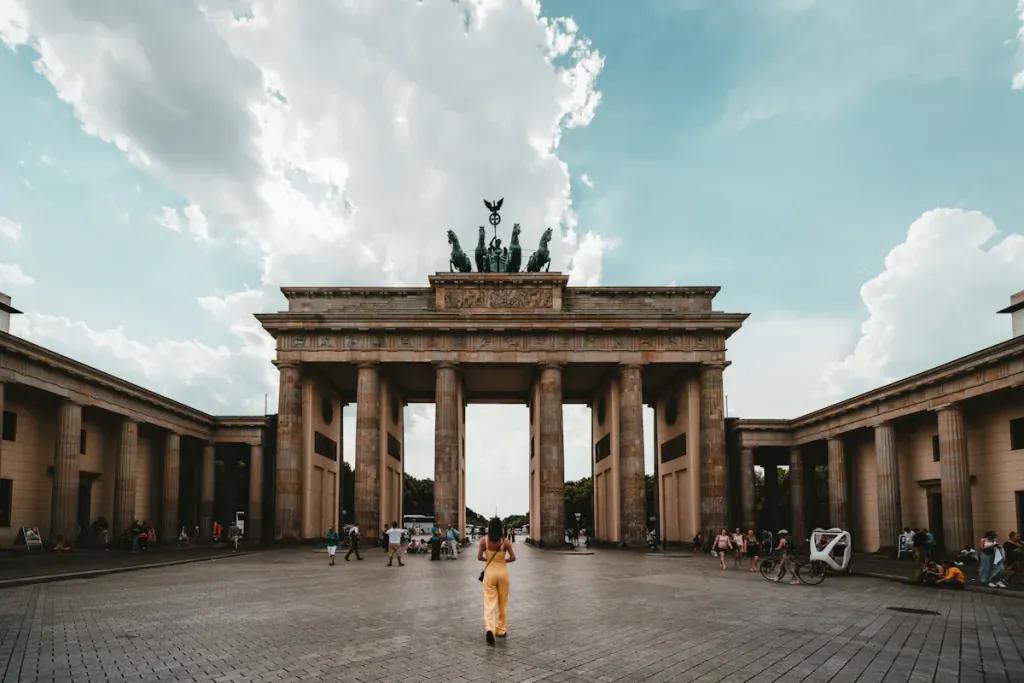
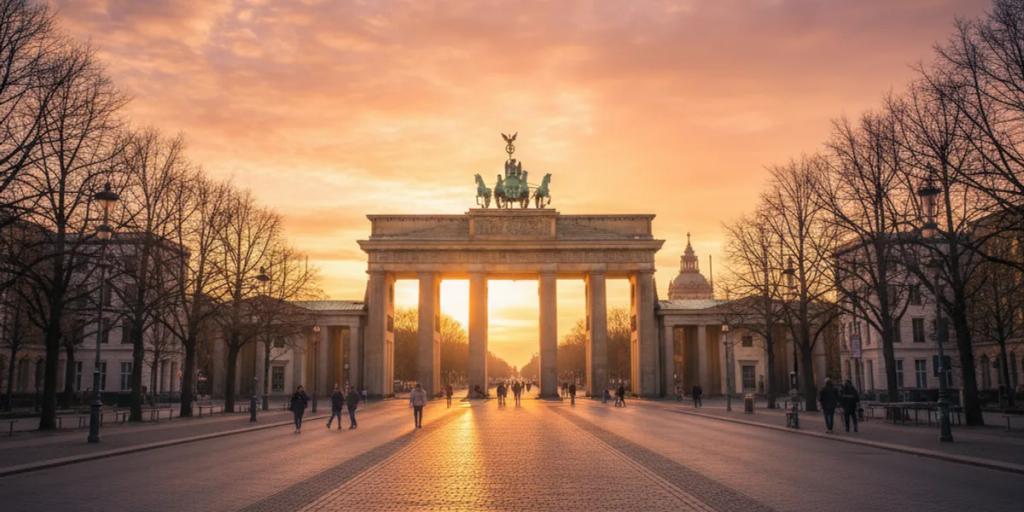
The Brandenburg Gate is mobbed by mid-morning but genuinely empty at dawn - golden hour light hits the east face first, so shoot from Pariser Platz just after sunrise. At the East Side Gallery, the Fraternal Kiss mural gets its crowd early; go before 10am and shoot straight-on from across the path. The Oberbaum Bridge is best at dusk from the riverbank as the U1 rattles over the top. Museum Island composes itself from the Friedrichsbruecke, and Tempelhofer Feld at sunset gives you a former airport runway stretching to the horizon - bring or rent a bike and shoot low along the tarmac. Inside clubs, no photos, ever; and much of central Berlin around the government quarter is a drone no-fly zone.
Berlin has more bridges than Venice - around 1,700 is the commonly cited count, against Venice's roughly 400. Tempelhofer Feld, the former city airport closed in 2008, is now one of the largest inner-city open spaces in the world, runways intact for cyclists and kite-skaters. And when sun hits the TV Tower's steel sphere, the reflection forms a cross - Cold War Berliners nicknamed it the Pope's Revenge, a jab at the atheist East German state that built it.
The Berlinale film festival takes over in February, and Fete de la Musique fills the streets with free stages every 21 June. CSD, Berlin's huge Pride parade, lands in late July, and the Festival of Lights projects onto landmarks for about ten days in October. Silvester (New Year's Eve) centres on a big party at the Brandenburg Gate. May Day in Kreuzberg is a street festival with a long protest tradition - great daytime atmosphere, but evenings can get rowdy.
The love is real: history layered into every walk from the Wall's path to Museum Island, a club scene nothing else in Europe matches, generous parks, and eating out that is still cheap for a Western capital. The gripes are just as real: service is famously blunt and nobody will pretend otherwise, the cash-only friction genuinely annoys, November to February is a grey slog, and gentrification tension is standard small talk. The old BER airport jokes, at least, are retired - it works fine now, even if Berliners still roll their eyes saying so.
Yes - since May 2024 all three German networks provide full 4G in every U-Bahn tunnel and station, the result of a multi-year joint build-out, with 5G being added at major hubs. Whichever network your eSIM connects to, you stay online underground.
Honestly, no. Berlin has far more cash-only bars, clubs, doner shops and restaurants than any comparable Western capital. Carry some euros, and use your data to find your own bank's ATM rather than the independent machines, which add hefty fees.
Only if you need a German phone number. Germany requires passport identity verification to activate any prepaid SIM, which means an in-store video or ID check. For a data-only trip, an eSIM installed before you land skips the bureaucracy and keeps your home number live for bank codes.