Bucharest runs on Orange, Vodafone, Digi and Telekom, and your eSIM rides one of them as its host. This is one of the better-connected cities in Europe and has been for years, which is the first thing worth knowing about it. The second is that Romania's relationship with the EU's various clubs is not the single membership most visitors assume, and the differences change what your phone and your wallet do.
Fixed broadband here is among the fastest and cheapest in Europe, and has ranked near the top of global speed tables for years.
The reason is historical. Romania largely skipped the copper generation. Neighbourhood networks were built out with fibre and ethernet from the late 1990s onwards, often informally and often strung between blocks, and the operators that grew out of that - Digi above all - competed hard on speed and price rather than consolidating.
Mobile follows the same pattern: dense 4G, extensive 5G in the city, and data priced low by western European standards.
What it means in practice: cafe and hotel wifi here is genuinely fast rather than nominally present, and you can lean on it. Bucharest is a well-established base for remote work for exactly this reason.
Three separate questions that visitors routinely collapse into one, and Romania answers them differently.
The EU: yes, since 2007. Roam Like at Home applies, so an EU or EEA SIM uses its domestic allowance here with no surcharge.
Schengen: yes, fully, since 1 January 2025. Air and sea checks went in March 2024 and the land borders followed at the start of 2025, alongside Bulgaria. Arriving overland from Hungary or Bulgaria now involves no passport check, which is recent enough that a lot of published advice still describes the old arrangement.
The euro: no. Romania uses the leu, and has no near-term adoption date. Prices are in RON, and anyone quoting you a price in euros is quoting a tourist.
Cards work almost everywhere and contactless is universal. Carry a little cash for markets, small kiosks and the occasional taxi.
The useful shorthand: your phone behaves as though you are at home, your passport stays in your pocket at the border, and your money still needs changing.
Once you notice these you will see them everywhere, and they are worth understanding rather than ignoring.
Bucharest sits in one of Europe's most seismically active regions. The Vrancea zone, in the Carpathian bend, produces deep and powerful earthquakes that hit this city hard.
The 1977 earthquake killed around 1,500 people here and brought down a large number of buildings.
Buildings assessed as at highest risk carry a red dot - a bulina rosie - on a plaque by the entrance, with a class number. It is a legal requirement, and there are hundreds of them across the centre, many of them beautiful interwar apartment blocks.
What to do with that information: not much, day to day. The risk in any given week is very low. But it is worth knowing what the sign means, glancing at where you are staying, and knowing that the standard advice in a quake is to get under something solid rather than run into the street.
It is also a genuine window into the city: those elegant crumbling facades on Calea Victoriei are not neglected for want of interest, they are caught in an expensive and slow-moving reinforcement problem.
Worth stating plainly, because it is the most common misdirected expectation in Romanian tourism.
Bucharest has essentially nothing to do with it. Bram Stoker never came to Romania, and the novel is set in Transylvania, several hours north across the mountains.
Bran Castle, the one sold as Dracula's castle, is near Brasov, about three hours away, and its connection to Vlad Tepes is thin at best.
Vlad the Impaler is genuinely part of Bucharest's history - the Curtea Veche, the old princely court in the Old Town, is his - but there is no gothic tourism attached to it and locals find the whole business faintly tiresome.
If Transylvania is the goal, plan it as a separate leg with its own base in Brasov or Sibiu, rather than as a day trip from here.
Almost nowhere in the city. The metro is covered, the Old Town is covered, and the network is dense.
The Carpathians, two hours north, behave like mountains: fine in the resort towns of the Prahova Valley, thin on the trails and passes. The Transfagarasan road, which is the drive people come for, has long stretches with nothing.
The Danube Delta, in the far southeast, is the country's real dead zone - a vast wetland where coverage clusters around Tulcea and the larger villages and disappears among the channels.
Some of the deep Communist-era concrete in the Centrul Civic blocks interior signal more than you would expect.
The Palace of the Parliament is a great deal of stone and largely dead inside, which matters only because the tour is long.
- Bolt, which dominates ride-hailing here and is inexpensive. Uber also operates.
- STB Info and Metrorex for the buses, trams and metro, or a general transit app.
- Maps, with offline copies for the mountains.
- A translation app is useful but far from essential. English is widely and well spoken, especially by anyone under forty.
- Glovo or Tazz for delivery, which is how the city eats.
Henri Coanda International (OTP) at Otopeni is about 16 km north.
The train link from the airport to Gara de Nord is the cheapest route in, and the 783 express bus runs frequently to the centre. Bolt or Uber from the airport is straightforward and cheap by European standards. Ignore anyone who approaches you in arrivals offering a taxi.
A metro extension towards the airport has been under construction for years and its opening has slipped repeatedly, so check whether it is actually running rather than trusting a map.
In the city, the metro is fast and cheap and covers the main axes; trams and buses fill the gaps; and the centre is walkable if you accept that the pavements are parked on.
Not much. Wifi is fast and everywhere, the city is compact in its centre, and EU visitors are on their home allowance anyway. A modest plan covers it. Scale up only for mountain trips or the Delta, where you want offline maps regardless.
Summer is genuinely hot. Bucharest sits on a plain with no water to moderate it, and 35C in August is normal. Light clothes, and the city slows down accordingly.
Winter is cold and windy, with the wind off the plain the part that bites. A proper coat.
Spring and autumn are short and the best of it, and need layers.
Bucharest dresses up in the evening, more than most of central Europe, and the Old Town on a Friday is noticeably turned out.
Shoes for uneven pavements. The centre is a mix of restored boulevards and streets that are not.
Something respectable for the Athenaeum or the Enescu festival, both of which are dressed occasions.
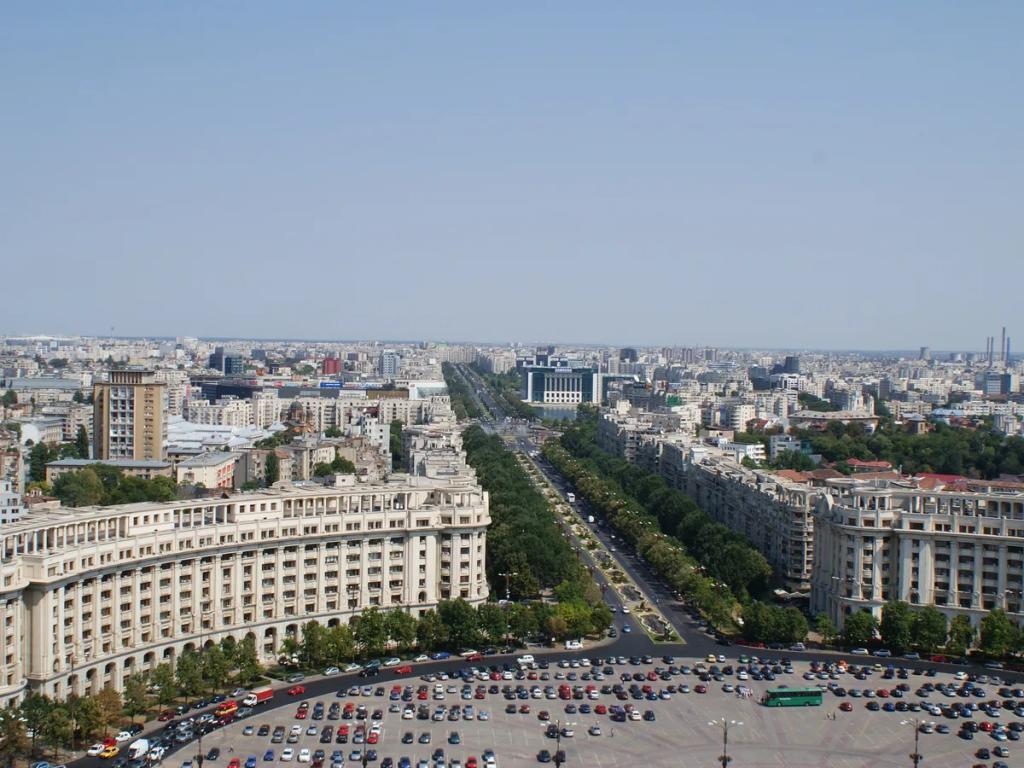
The Palace of the Parliament, from the far end of Bulevardul Unirii at dusk, which is the only way to get the scale of it into a frame.
The Romanian Athenaeum, a domed 1888 concert hall with a painted fresco running the circumference of the auditorium, and one of the most beautiful rooms in southeastern Europe.
Calea Victoriei, for the interwar facades and the abrupt changes of register.
Stavropoleos Monastery, a tiny, intricately carved 1724 church wedged into the Old Town.
The Village Museum in Herastrau park, several hundred genuine relocated wooden houses from across the country.
Carturesti Carusel, a white six-floor bookshop in a restored nineteenth-century building.
Arcul de Triumf, and the boulevard that earned the city its Little Paris nickname.
Piata Revolutiei, where Ceausescu gave his final speech from the balcony in December 1989.
The Palace of the Parliament is the heaviest building in the world, and among the largest administrative buildings anywhere. It contains something like a million cubic metres of marble, all of it Romanian, and it is still not fully occupied.
Building it required demolishing about a fifth of historic Bucharest, including churches, hospitals and whole neighbourhoods. Some churches were physically moved on rails to hide them behind new blocks rather than be destroyed, and several are still there, tucked behind apartment buildings.
Romanian is a Romance language, the only one in its neighbourhood, surrounded by Slavic and Hungarian speakers. If you have French, Italian or Spanish, you will read more of it than you expect.
Bucharest was called Little Paris before the war, and had its own Arc de Triomphe to prove the point.
Nadia Comaneci scored the first perfect ten in Olympic gymnastics at Montreal in 1976, and the scoreboard could not display it - it showed 1.00.
And the Old Town was nearly demolished in the 1980s along with everything else, and survived largely by running out of time.
The George Enescu Festival, in September of odd-numbered years, one of the major classical music festivals in Europe and the reason to be here that month.
National Day, 1 December, with a military parade at the Arcul de Triumf.
The Christmas markets, in Piata Constitutiei and Piata Universitatii, from late November.
Bucharest Pride, in July.
Summer, June to August, is hot and the city empties towards the Black Sea and the mountains; May, September and October are the best months to be here.
The love: Bucharest is one of the last genuinely surprising capitals in Europe. It is cheap, the food is excellent and enormous, the wine is seriously underrated, the internet is fast, and the city has a raw, layered quality - belle epoque, Communist megastructure, and glass tower, sometimes on the same street - that is far more interesting than a preserved old town. The parks are large, the classical music is world-class, and the Carpathians are two hours away.
The complaints are consistent. It is not pretty in the conventional sense, and visitors expecting Prague are disappointed within an hour. The traffic and the parking are genuinely bad. The Old Town has tipped towards stag parties in parts and can be grim on a Saturday night. The contrast between restored and derelict is jarring. Summer heat on that plain is punishing. And stray dogs, though far less of an issue than in the past, still surface in outer districts.
Come in September for the Enescu festival if you can, stay near Piata Romana, take the Palace tour, and give it three days rather than one.
Yes, fully. Romania has been in the EU since 2007, so Roam Like at Home applies and an EU or EEA SIM uses its domestic allowance with no surcharge. Note that this is separate from Schengen and separate again from the euro - Romania is in the first two and not the third.
Yes. Air and sea border checks were lifted in March 2024 and land borders followed on 1 January 2025, together with Bulgaria. Arriving overland from Hungary or Bulgaria involves no passport check. A lot of older advice still says otherwise.
No. The currency is the leu (RON), with no near-term plan to adopt the euro. Cards work almost everywhere and contactless is universal, so this rarely causes friction, but carry a little cash for markets and kiosks.
Yes. Romania has ranked near the top of European and global fixed broadband speed tables for years, a legacy of building out fibre and ethernet early instead of upgrading copper. Mobile data is dense and cheap too, and cafe wifi here is genuinely fast rather than nominal.