Copenhagen runs on TDC/YouSee, Telenor, Telia and 3, and your eSIM rides one of them as its host. Denmark has some of the best mobile infrastructure in Europe: comprehensive 4G, extensive 5G, and fast free wifi in most public buildings, cafes and on much of the transport network. You will not have a coverage problem. There are two things that surprise visitors, and both are about money rather than signal.
This catches people constantly, particularly those arriving from Germany or Sweden on a multi-country trip.
- The currency is the Danish krone, not the euro. Denmark negotiated an opt-out and kept it. Some tourist-facing businesses accept euros at an unfavourable rate; almost none are obliged to.
- EU roaming does apply. Denmark is in the EU, so Roam Like at Home covers an EU or EEA SIM on its domestic allowance with no surcharge. A UK SIM depends on the operator. From outside Europe, a travel eSIM earns its place as usual.
So the roaming half is simple and the currency half is not. If you are hopping to Sweden over the bridge, note that Sweden also keeps its own krona - and the two are not interchangeable despite the shared name.
Denmark has gone further towards cashless than almost anywhere. Contactless cards work everywhere - buses, kiosks, market stalls, museums - and many places no longer take cash at all.
MobilePay is the local payment app and it is genuinely ubiquitous among Danes, but it requires a Danish bank account and CPR number, so a visitor cannot use it. This is Copenhagen's version of the Pix problem: you will see everyone around you paying by phone and you will be paying by card, which works perfectly well.
Bring a card with no foreign transaction fee and you are fully equipped. There is very little reason to carry krone in cash at all.
Almost nowhere - but for completeness:
The Metro tunnels. Copenhagen's metro is driverless and runs 24 hours, which is genuinely useful, and coverage in the deeper tunnel sections is inconsistent.
Christiania. The self-governing freetown in Christianshavn has its own rules, and the most important one for a visitor is that photography is prohibited in parts of it, particularly the former Pusher Street area. Signs make this clear and it is taken seriously. Put the phone away rather than testing it.
Out on the water. Copenhagen is a harbour city and the harbour buses - which are part of the public transport network and the best value sightseeing in Scandinavia - cross open water where coverage dips briefly.
The Øresund Bridge to Malmö: the train takes about 35 minutes and you change country mid-journey. Both are EU, so roaming continues, but your phone will hop networks and Swedish charges apply if you have a non-EU plan.
Amager Fælled and the outer beaches thin out slightly, though never seriously.
- A transport app for tickets across metro, bus, train and harbour bus - one integrated zone system covers all of them.
- Donkey Republic or a similar bike-share app. This is the important one. Copenhagen is a cycling city on a scale nowhere else in Europe matches, with segregated lanes on nearly every street, and cycling is simply the correct way to see it.
- Maps, though the city is compact, flat and easy.
- A restaurant booking app. Copenhagen's food scene runs on reservations and the good places fill weeks out.
- A weather app, because the light and the rain change quickly and outdoor plans need re-checking.
Since this is where visitors most often go wrong: Copenhagen's bike lanes are used at speed by commuters, and they are not a leisure amenity.
- Hand signals are expected - arm out to turn, hand up to stop.
- Keep right, overtake left, and do not stop in the lane.
- Lights are legally required after dark and enforced with fines.
- Do not walk in the bike lane. It is the single fastest way to be shouted at in an otherwise extremely polite city.
Copenhagen Airport (CPH) at Kastrup is exceptionally well connected: the Metro reaches the city centre in about 15 minutes, and trains run to the central station and onward to Sweden. It is one of the easiest airport arrivals in Europe.
The city is compact and flat, and most visitors barely use taxis. Buy a transport ticket or a City Pass at the airport and you are set.
Very little. Free wifi is widespread and the city is small enough that you are rarely navigating hard.
For a week, well under 1GB is realistic if you use wifi. Size up if you are working here, or if Copenhagen is one stop on a longer trip that leaves the EU. Plans top up from your dashboard.
A windproof, waterproof layer, in every season. Copenhagen's weather is rarely extreme and frequently wet, and the wind off the sound is the thing that makes it feel cold.
Layers rather than a heavy coat for most of the year.
Proper winter kit from December to February, when daylight is short and the damp gets into everything.
Shoes you can cycle in.
Something reasonably smart. Danes dress simply but well, and the restaurant and bar scene rewards a bit of effort. Understatement is the register - nothing flashy.
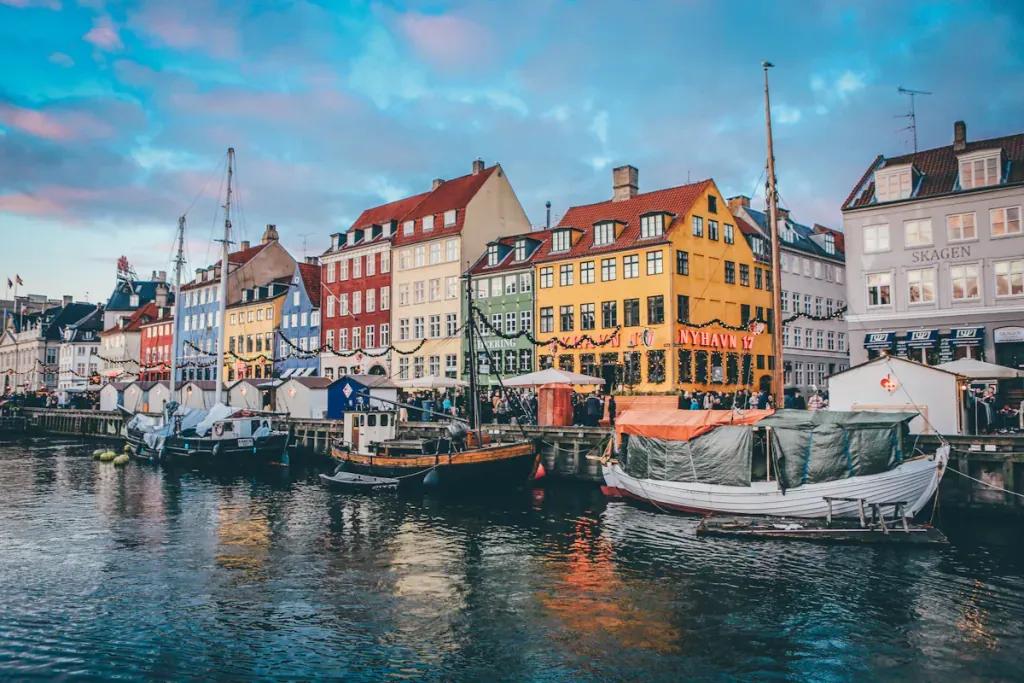
Nyhavn, the painted townhouses along the canal with wooden ships moored in front. It is the postcard and it is crowded from mid-morning; go early.
Nyhavn from the water, on a canal tour or a harbour bus, which is the better angle and much cheaper on the harbour bus.
Tivoli Gardens at dusk, particularly in the Christmas season, when the lights are extraordinary.
The Round Tower (Rundetårn), up its spiral ramp, for the rooftops.
Superkilen in Nørrebro, the striped urban park, and the Cykelslangen cycle bridge - both are modern Copenhagen design at its most photogenic.
The Little Mermaid, which every visitor sees and almost everyone finds smaller and more crowded than expected. Manage the expectation and it is fine.
Tivoli Gardens opened in 1843 and is one of the oldest operating amusement parks in the world. Walt Disney visited and it directly influenced Disneyland.
The Danish monarchy is among the oldest continuous in the world, tracing back over a thousand years.
Copenhagen has more bicycles than inhabitants, and a substantial majority of residents commute by bike year-round, including through winter.
New Nordic cuisine was launched here by a manifesto in 2004 and reshaped restaurant cooking globally; Noma is the name everyone knows, but the depth of the scene is the real story.
And Christiania was founded in 1971 when squatters occupied an abandoned military barracks, and has existed in negotiated tension with the Danish state ever since.
Christmas at Tivoli, mid-November to early January, which is the city at its most charming.
Copenhagen Jazz Festival in July, ten days with hundreds of concerts across the city, many free and outdoors.
Distortion in June, a street music festival that takes over entire neighbourhoods.
Culture Night (Kulturnatten) in October, when museums and public buildings open late.
Summer, June to August, has extraordinarily long daylight and the city lives outdoors; winter is dark by four in the afternoon and is when hygge stops being a marketing word and starts being a coping strategy.
The love: Copenhagen is calm, beautiful and superbly organised, and it is a genuine pleasure to move around - flat, cyclable, walkable, with public transport that simply works. The design and architecture are world-class, the food scene is among the best in Europe at every price level, the harbour is clean enough to swim in from public baths in the middle of the city, and the whole place feels civilised in a way that is hard to argue with.
The complaints are consistent. It is expensive - among the priciest cities in Europe, and eating out adds up fast. The weather is grey, and winter's short dark days are genuinely hard. It is small: three or four days covers the main sights and some visitors find it quiet after that. The Little Mermaid disappoints more or less universally. And Danish social reserve can read as coldness on a short visit, though it is not.
Rent a bike on the first morning, swim in the harbour if it is warm, book restaurants ahead, and go in May, June or September for the light.
Yes. Denmark is in the EU, so Roam Like at Home covers EU and EEA SIMs on their domestic allowance with no surcharge. UK operators vary post-Brexit - check yours. From outside Europe, a travel eSIM is the straightforward option.
No. Denmark is in the EU but kept the Danish krone under an opt-out. Some tourist businesses take euros at poor rates, but the krone is the currency. Sweden, over the bridge, uses a separate krona - the two are not interchangeable.
No - it needs a Danish bank account and CPR number. It is not a problem: Denmark is one of the most cashless countries in the world and contactless cards are accepted essentially everywhere, including on transport and at market stalls.
Not in parts of it, and the restriction is signed and taken seriously - particularly around the former Pusher Street area. Respect it rather than testing it. The rest of Copenhagen is entirely relaxed about photography.