Doha runs on Ooredoo and Vodafone Qatar, and your eSIM rides one of them as its host. Qatar has excellent infrastructure - dense 5G across the city, coverage in the metro, and fast speeds almost everywhere a visitor goes. Connectivity here is not about signal quality. It is about what the network will let you do with it.
Qatar restricts VoIP calling. On local Qatari networks, WhatsApp voice and video calls do not connect. Neither do FaceTime, Viber calls, Telegram calls or Messenger calls. This is enforced under the Communications Regulatory Authority's rules, and it is long-standing rather than new.
Two clarifications that matter enormously:
- Text messaging is unaffected. WhatsApp messages, photos, voice notes and files all work normally. It is specifically the live voice and video call that is filtered.
- The commercial logic is not hidden. Ooredoo and Vodafone Qatar sell international calling minutes, and free app-to-app calls compete with that.
What this means for a travel eSIM, stated honestly. Traffic on a roaming profile is routed through the home operator's infrastructure before it reaches the Qatari internet, which can sit outside the local filtering layer. Travellers roaming on foreign plans very commonly report that WhatsApp and FaceTime calls keep working in Qatar where a local SIM would not.
We are not going to promise you that. It is widely reported, it is the mechanism people rely on, and it is not something any provider controls or guarantees - filtering practice can change, and it varies. Treat working VoIP as likely rather than certain, and if a call absolutely must happen on a given day, have a fallback:
- Hotel wifi at the international properties sometimes routes externally and permits calls.
- A VPN is the common workaround; note that you should check Qatar's current position on VPN use for yourself rather than assuming.
- Ordinary mobile voice calls always work. They just cost what they cost.
If you are here for business and calls are the point of the trip, plan this properly rather than discovering it in the taxi from the airport.
From June to September, Doha runs in the high 40s and beyond with heavy Gulf humidity. This is not "hot for a holiday" - it is a condition the country legislates around: outdoor work is legally prohibited between 10:00 and 15:30 from 1 June to 15 September.
For a visitor the implications are practical:
- Everything indoor-to-indoor. The city is built for it - the metro, the malls, the museums, the hotel lobbies are all heavily air conditioned, and shaded walking routes link many of them.
- Your phone hates it too. Handsets throttle and shut down in direct Gulf sun; a phone left on a car dashboard will not survive the afternoon. Keep it out of the light and expect the battery to behave badly.
- November to March is the actual season - 18-26C, dry, and pleasant enough that the whole calendar of outdoor events lands there.
Genuinely rarely - this is one of the best-covered cities you will visit.
The Doha Metro is comprehensively covered, and every station is fully air conditioned, which makes it a refuge as much as transport. Three lines, driverless, and immaculate.
The desert. Trips to the Inland Sea (Khor Al Adaid) - the UNESCO-listed spot where the sea meets the dunes near the Saudi border - run an hour south into terrain with sparse coverage. Dune-bashing tours go off-road into it. Download the map and go with an operator rather than alone.
Souq Waqif's covered alleys drop a bar or two, as any roofed market does.
Inside the Museum of Islamic Art and the National Museum, both heavy stone-and-concrete structures, coverage is patchier in the deeper galleries.
- Karwa is the official taxi app, and Uber operates. Both work well; the metro plus a short ride covers most itineraries.
- The Doha Metro app for the network, though the system is simple enough to navigate on signage alone.
- Hayya, Qatar's official visitor platform, carries event and venue information and is worth having if you are here for anything scheduled.
- A translation app is less necessary than in most of the region - English is effectively the working language of the city, on signage, in shops and at every counter.
Hamad International (DOH) is consistently rated among the best airports in the world and it is about 10 km from the centre - fifteen to twenty minutes by road, or the Metro Red Line straight into the city.
The airport is a destination in its own right for long layovers, and Qatar Airways' transit arrangements mean many visitors see Doha precisely because they were changing planes. If that is you, note that the metro from the airport makes a five-hour layover genuinely usable.
Arrive connected. Between the taxi app, the hotel address and letting someone know you have landed, the first ten minutes want data - and if VoIP matters to you, that is when you will find out whether it is working.
Moderate. The city is compact, the metro is simple, and much of a visit is indoors.
For a week, 1GB per 2-3 days is comfortable. Size up if video calling home is part of the routine - and see the VoIP section above before you rely on it. Plans top up from your dashboard.
Modesty is expected and it is enforced more clearly than in some neighbouring countries. Shoulders and knees covered in public places, malls and museums; signage at entrances says so plainly. This applies to men as well - no vests, no very short shorts. Swimwear at hotel pools and beaches is fine.
Otherwise: light fabrics and a layer for indoors, because Doha's air conditioning is aggressive and the swing between 45C outside and 19C in a mall is genuinely uncomfortable. Sunglasses, and a hat if you will be outside at all in summer.
Winter evenings can be cool enough for a jacket, which surprises people.
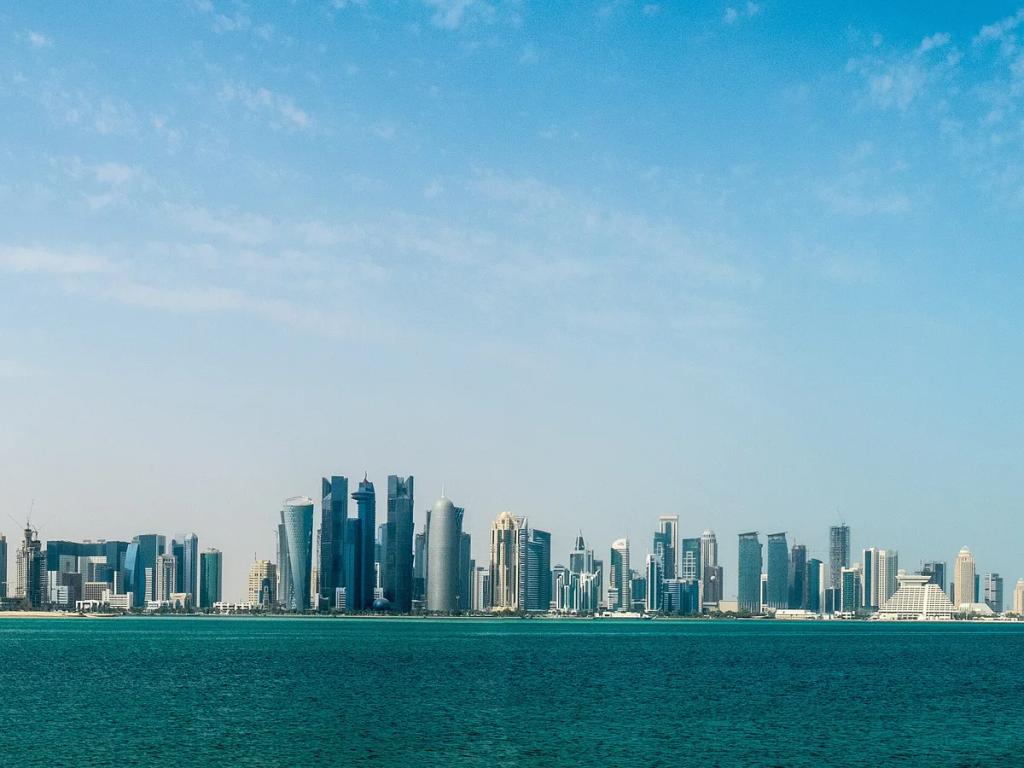
The West Bay skyline from the Corniche at dusk, with a wooden dhow in the foreground - the definitive Doha frame, and the light between sunset and full dark is the window.
The Museum of Islamic Art, I.M. Pei's last major building, on its own island - shoot it from the park to the east, and go inside for the courtyard and the view back across the water.
The National Museum of Qatar, Jean Nouvel's interlocking discs based on the desert rose crystal - a building that photographs unlike anything else.
Souq Waqif after dark, when the heat drops and the falcon souq and the shisha cafés fill up.
Katara Cultural Village and the amphitheatre, and The Pearl for the marina-and-towers version of the city.
Qatar is a peninsula of desert with essentially no natural fresh water - almost all drinking water is desalinated, which makes the city's greenery an ongoing act of engineering.
The Museum of Islamic Art was I.M. Pei's final major commission; he came out of retirement in his nineties for it and toured the Islamic world for years before designing it.
Falconry is a living tradition rather than a display - Souq Waqif has a dedicated falcon souq and a falcon hospital, and the birds travel in aircraft cabins with their own passports.
And the 2022 World Cup left Doha with a metro, a set of stadiums and a hotel supply that a city of this size would not otherwise have - which is part of why it works so well as a stopover.
The season is winter. Everything scheduled - sport, festivals, outdoor dining, the corniche coming alive - happens between roughly November and March.
Qatar National Day, 18 December, brings parades and a great deal of flag-waving.
The Doha Jewellery and Watches Exhibition, Qatar Masters golf and the MotoGP at Lusail all sit in the cooler months.
Ramadan reshapes the day entirely: daytime eating and drinking in public is not done, hours shift late, and the evenings after iftar are the liveliest of the year. Check the dates against your trip - it is a fascinating time to visit if you understand what you are walking into.
The love: Doha does the stopover better than almost anywhere. Two days between flights gets you a world-class museum, a genuinely atmospheric souq, a desert trip and a skyline, all on a metro that works and in a city that is safe, clean and effortlessly English-speaking. The Museum of Islamic Art alone justifies a stop. Food is excellent across every price bracket.
The complaints are fair. The summer is not survivable as a holiday in any ordinary sense, and half the year is written off. The VoIP block frustrates people who arrive assuming they will video-call home. The city can feel new and unrooted - much of it is fifteen years old and it shows. Alcohol is restricted to licensed hotel venues and is very expensive. And visitors should know that Qatar's laws on public behaviour, dress and relationships differ considerably from Western norms; read up rather than assume.
Come between November and March, give it two or three days, and Doha earns its place.
Not on local Qatari networks. Qatar restricts VoIP calling, so WhatsApp, FaceTime, Viber, Telegram and Messenger calls are blocked - though messaging on those same apps works normally. Travellers roaming on a foreign profile commonly report that calls continue to work, because that traffic routes through the home operator rather than the local filter, but this is not something any provider guarantees. If a call must happen, have a fallback.
Yes, among the best you will encounter - dense 5G across the city, including in the metro, on both Ooredoo and Vodafone Qatar.
November to March. June to September runs in the high 40s with heavy humidity, and outdoor work is legally prohibited between 10:00 and 15:30 from 1 June to 15 September, which tells you what the afternoons are like.
Very. Three driverless lines, every station fully air conditioned, it runs from the airport into the city, and in summer it is as much a refuge as a means of transport.