The Galapagos are served by Ecuador's networks - Claro and Movistar - and your eSIM rides one of them as its host. Coverage exists on the three inhabited islands and essentially nowhere else. This is one of the very few places in this set of guides where the honest advice is to plan on being offline for much of your visit and to treat that as part of what you paid for.
The Galapagos have more gates than almost any destination, and none of them can be improvised.
The INGALA Transit Control Card (TCT) costs USD 20 and must be bought at the Consejo de Gobierno counter in Quito or Guayaquil airport, before you check in for the island flight. It is an immigration control document and you present it entering and leaving the province. There is no buying it on arrival.
The National Park entrance fee is USD 200 for international adults and USD 100 for children under 12, paid in cash on arrival at the island airport.
That USD 220 sits on top of flights, and the cash requirement genuinely catches people - bring clean US dollars, because Ecuador uses the US dollar and the ATMs on the islands are few, sometimes empty, and not a plan.
Add the practical point that matters for this page: arrive at Quito or Guayaquil with time and with data. The TCT counter, the baggage biosecurity inspection and the check-in queue all happen before your flight, and this is the moment to have your documents accessible rather than buried in email.
Three islands are inhabited and covered: Santa Cruz (Puerto Ayora), San Cristóbal (Puerto Baquerizo Moreno) and Isabela (Puerto Villamil), with Floreana much smaller and thinner.
Everywhere else - which is to say the overwhelming majority of the archipelago - has nothing. The visitor sites, the snorkelling spots, the tortoise reserves in the highlands and the crossings between islands are outside coverage.
Specifically:
- On a liveaboard cruise, assume you are offline for the duration. Boats may have satellite arrangements; treat them as a bonus, not a service.
- The inter-island ferries - small speedboats, roughly two hours between islands, and rougher than the word "ferry" implies - are open ocean and out of range.
- The highlands of Santa Cruz, where the giant tortoises are, are patchy.
- Isabela is the least connected of the three inhabited islands, which is part of its charm.
Even in the ports, bandwidth is limited: the islands run on constrained backhaul, and hotel wifi is often slow enough that a video call is optimistic. Download before you fly from the mainland.
The Galapagos are 97% national park, and the regulations are enforced rather than suggested.
Drones are banned for tourists. Not restricted - banned. Recreational drone permits are not available, and use is limited to research and monitoring under strict conditions. Bringing one and hoping is a way to have it confiscated.
A licensed naturalist guide is mandatory at almost all visitor sites. You cannot wander off and explore; you go with a guide, on a marked trail, in a group, at a scheduled time. This is not bureaucracy for its own sake - it is why the wildlife still behaves as it does.
Also worth knowing:
- Stay two metres from the animals. They will not move, which is the extraordinary thing; the obligation is entirely yours.
- No flash photography at wildlife.
- Biosecurity inspections happen on the way in - no fresh food, seeds or plant material.
Fewer than almost anywhere, and that is the point.
- Your documents, offline - TCT, park fee receipt, flights, hotel, tour confirmations.
- A downloaded map of the island ports, which are small and walkable.
- Ferry and flight schedules, which change and are best confirmed locally in person anyway.
- Nothing else, really. There is no ride-hailing, no meaningful public transport, and the ports are the size of a village. Taxis are white pickups and cost a dollar or two.
Two airports: Baltra (GPS), serving Santa Cruz via a bus, ferry and second bus, and San Cristóbal (SCY), which is a ten-minute walk from town.
Flights come from Quito and Guayaquil only. Note the one-hour time difference from the mainland - it is a common cause of missed connections.
Give yourself a night on the mainland before the island flight. Same-day international connections leave no margin for the TCT counter, the biosecurity check or a delay.
Very little, and that is not a limitation to work around.
For a week, 1GB is likely more than you use, because most of the week has no signal to spend it on. What matters is what you downloaded before you left the mainland. Plans top up from your dashboard when you are back in a port.
Sun protection above everything. You are on the equator, on the water, with reflected glare. High-factor reef-safe sunscreen, a hat that stays on in wind, sunglasses, and a rash vest for snorkelling - shoulders burn through the water in minutes.
Water shoes or sturdy sandals. Landings are often wet - you step off a panga into the shallows - and the lava rock is sharp.
A light layer for the cool-dry season, June to November, when the garúa mist sits over the highlands and the boat decks are genuinely chilly in the morning.
Motion sickness remedies. The inter-island speedboats are notorious, and the crossing is two hours of open ocean.
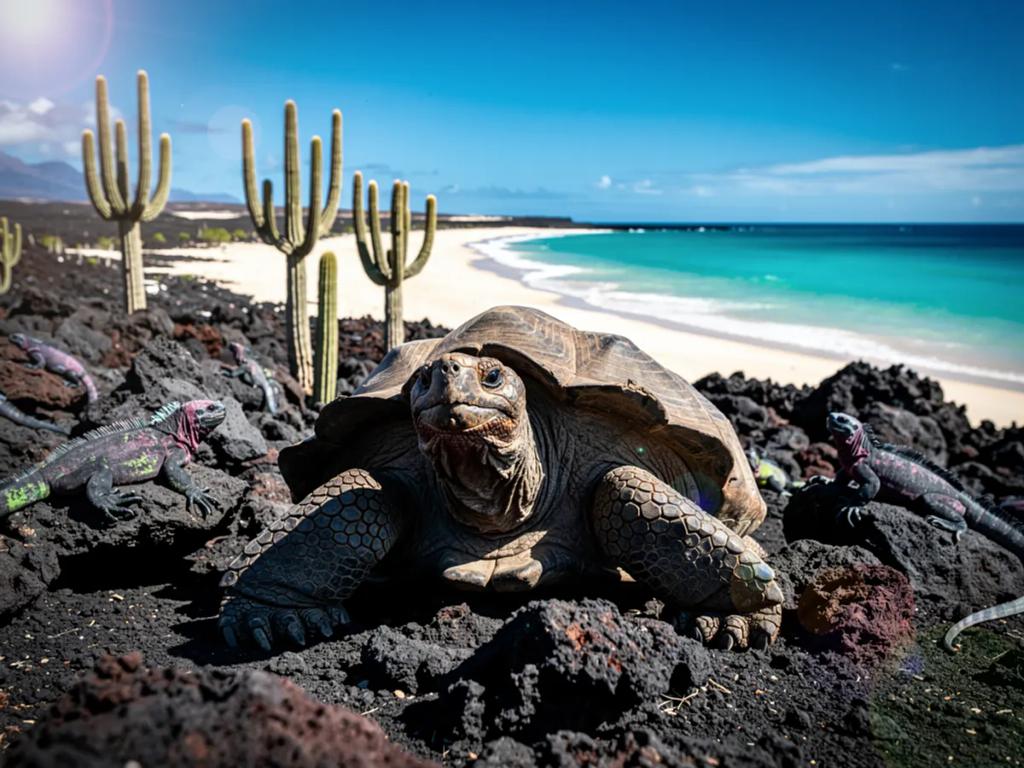
Marine iguanas on black lava - endemic, the only sea-going lizard on earth, and completely indifferent to you.
Blue-footed boobies, ideally displaying - the feet really are that colour.
Giant tortoises in the Santa Cruz highlands, in the wild rather than at a breeding centre.
Sea lions on the benches, boats and pavements of Puerto Baquerizo Moreno, where they have simply taken over the town.
Kicker Rock (León Dormido) off San Cristóbal at golden hour.
Underwater, with a housing rather than a drone - hammerheads, turtles and sea lions that will swim directly at your lens.
Charles Darwin spent five weeks here in 1835 aboard the Beagle - a short visit that took decades to become the theory it is famous for.
97% of the archipelago's land is national park, and the marine reserve around it is one of the largest on earth.
The islands sit on a volcanic hotspot and are still forming - the western islands are the youngest and most active, and eruptions are not rare.
And the animals' famous fearlessness is not tameness but the absence of land predators - nothing here evolved a reason to run from you, which is precisely what the two-metre rule protects.
There is no festival calendar that should shape your trip. The seasons do.
Warm-wet, December to May: calmer, clearer, warmer water - the better snorkelling and diving conditions, and the green season on land.
Cool-dry, June to November: the Humboldt current brings cold, nutrient-rich water, so marine life is at its most active - and the seas are rougher and the highlands sit under garúa mist.
June to August and December to January are the busiest and most expensive months.
The love: there is genuinely nowhere else like it. Wildlife that ignores you entirely, an ecosystem preserved with real seriousness, and encounters - swimming with sea lions, a marine iguana a metre away - that stay with people for decades. The regulation that visitors sometimes resent is exactly why it still works.
The complaints are honest ones. It is very expensive - USD 220 in fees before flights, and island prices for everything else. The rules constrain you: guides, schedules, marked trails and no wandering. The boat crossings are unpleasant for anyone prone to seasickness. Connectivity is poor and bandwidth is thin, which matters for anyone who cannot fully disconnect. And a land-based trip sees considerably less than a liveaboard, which costs considerably more.
Come with the fees in cash, the documents downloaded, and the expectation of being unreachable. That last part turns out to be the best thing about it.
On the three inhabited islands - Santa Cruz, San Cristóbal and Isabela - yes, in the ports. Almost nowhere else. The visitor sites, the crossings between islands and any liveaboard itinerary are effectively offline, and even in the ports bandwidth is limited. Download everything before you leave the mainland.
Two things. The INGALA Transit Control Card, USD 20, bought at the Consejo de Gobierno counter in Quito or Guayaquil airport before you check in. And the National Park fee, USD 200 for international adults, paid in cash on arrival. Bring clean US dollars - island ATMs are unreliable.
No. Drones are banned for tourists across the archipelago and recreational permits are not available. Use is restricted to research and monitoring. Bring a camera, not a drone.
Yes, at almost all visitor sites - a licensed naturalist guide, on marked trails, at scheduled times. You cannot explore independently, and that constraint is the reason the wildlife still behaves the way it does.