Kuala Lumpur runs on Maxis, CelcomDigi, U Mobile and Yes, and your eSIM rides one of them as its host. Malaysian networks are strong and the country was an early and aggressive 5G builder, so the city has fast, dense coverage that reaches into the underground MRT stations and across the whole conurbation. Data here is also famously cheap, which sets a local expectation worth knowing: Malaysians use mobile data freely and the infrastructure is built for it.
KL sits at the opposite end of the spectrum from most European capitals, and adjusting on day one saves a lot of friction.
Touch 'n Go is the one that matters. It began as a transport card and became the dominant e-wallet in the country, and its QR code is on the counter of hawker stalls, mamak shops, convenience stores and taxis alike.
DuitNow QR is the national interoperable standard, so most wallets can scan most codes. In practice the merchant will point at a sticker and expect you to scan it.
Cards work in malls, hotels and restaurants, and much less well at street level. The best food in this city is at stalls, and stalls want cash or a QR.
Cash still moves everything at the bottom end. Small notes for hawker centres, night markets and short taxi rides.
A foreign phone number complicates signing up for the local wallets, so most visitors end up on cards plus cash, with Grab covering the gap. That works fine. Just do not arrive expecting to tap a card at a satay stall.
Grab absorbed Uber's Southeast Asian business and is now the default for getting around, ordering food, and a good deal else.
Use it instead of hailing. Street taxis exist and metered fares are theoretically fine, but the app removes the negotiation, the language question and the route argument in one move.
Traffic is the real constraint. KL congestion is serious and a three-kilometre trip at 6pm can take forty minutes. The rail network, where it goes, beats the road every time.
The rail is four systems wearing one badge. LRT, MRT, monorail and KTM Komuter are run by different operators, and although a single stored-value card covers them, some interchanges mean walking outdoors between stations with a suitcase. Check the map before assuming a connection is a connection.
The city itself, essentially nowhere. Underground MRT stations are covered, the malls are covered, the towers are covered.
Genting Highlands, the casino resort up in the hills, is fine at the top and patchy on the winding road and the cable car up.
Taman Negara, the rainforest reserve, is the real drop. It is 130 million years old and has no interest in your bars. If you are doing a jungle trip, download everything first and tell someone the plan.
The Cameron Highlands thin out in the valleys between tea estates.
Batu Caves is well covered at the base and inside the main cavern, which surprises people who expect a limestone hill to block it.
The islands - Langkawi, the Perhentians, Tioman - vary a great deal, and the smaller the island the more the coverage clusters around the one village with the jetty.
Not a connectivity problem, but the single most underrated planning factor for this city.
Transboundary haze drifts over from land-clearing fires in Sumatra and Borneo, most often between June and October, and can settle over KL for days or weeks.
The Air Pollutant Index is the local measure. Readings above 100 are unhealthy and above 200 are serious; the government publishes them and schools close on the bad days.
What it does to a trip: the skyline disappears, the towers vanish from photographs, and anyone with asthma has a bad time. It is not every year and not the whole season, but it is common enough to check before booking a photography-driven trip.
Masks are sold everywhere when it is happening, and the malls become the day plan.
- Grab, which is close to essential. Rides, food, and payment in one place.
- Waze, which Malaysians use in strong preference to other navigation, and which handles the local traffic reality better.
- MyRapid or Moovit for the rail and bus network.
- An air quality app during haze season, or the official API readings.
- Maps with offline copies if you are heading to the highlands or the jungle.
- A translation app is largely optional. English is very widely spoken in KL, to a higher standard than almost anywhere else in the region.
Kuala Lumpur International (KUL) is about 55 km south of the city, with Terminal 1 and Terminal 2 on the same site. Terminal 2, renamed from klia2 in 2023, is the low-cost terminal and handles AirAsia. They are a train ride apart, so confirm which one you need.
KLIA Ekspres runs non-stop to KL Sentral in 28 minutes and is the fastest way in. The KLIA Transit takes slightly longer with stops for less money, and the airport coach is cheapest of all at about an hour. Grab from the airport is straightforward and reasonably priced.
KL Sentral is the hub for everything else, and most hotels are a short ride from it.
More than a European city trip, because Grab, Waze and food delivery all run continuously and maps get heavy use. Wifi is widespread in malls, cafes and hotels, but the apps you rely on here work while you are moving. A middling plan is comfortable; a small one runs out if you are calling rides all day.
Light, loose and breathable, all year. There is no season that requires anything else outdoors.
Bring a layer for indoors. This is the one people get wrong. Malaysian air conditioning in malls, cinemas and offices is set aggressively cold, and going from 33C outside to a genuinely chilly shopping centre is the normal rhythm of a day here.
Modest dress for mosques and temples. Shoulders and knees covered; Masjid Negara lends robes to visitors at the door.
An umbrella or a packable rain shell. The afternoon storm is close to a daily fixture and it is torrential rather than drizzly. It also passes quickly.
Sandals you can get wet, and shoes you can take off easily, since temples and many homes require it.
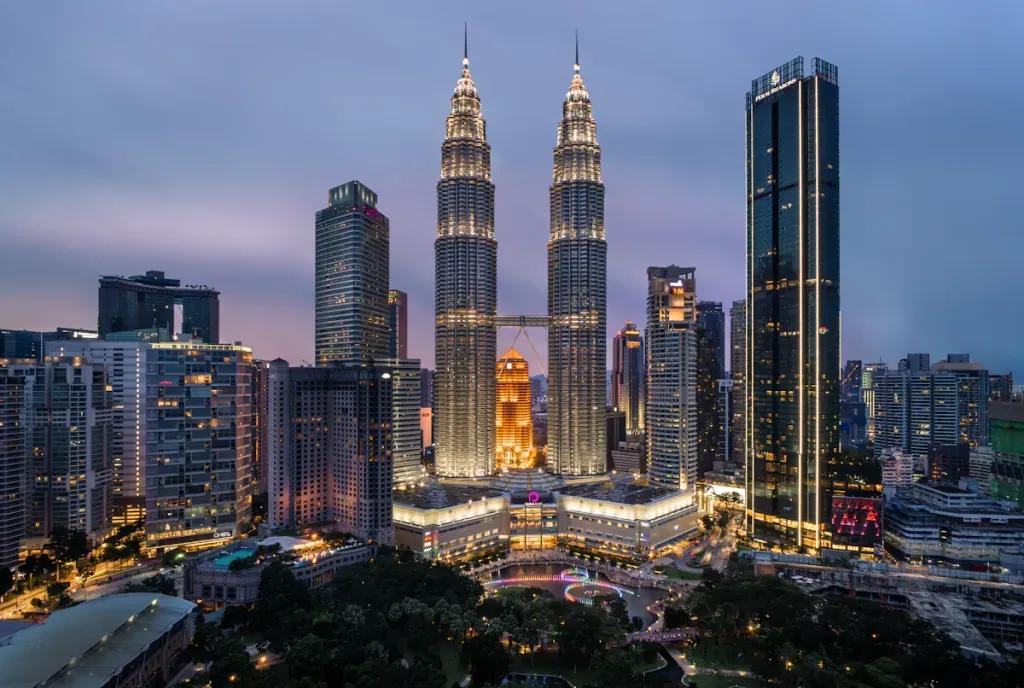
The Petronas Towers from KLCC park, at dusk when the steel lights up and the fountains are running.
Batu Caves' painted staircase, 272 steps in bands of colour under the gold Murugan statue. Early morning, before the heat and the crowds.
Thean Hou Temple, a six-tiered Chinese temple on a hill with lanterns strung across the courtyard.
Jalan Alor after dark, the food street at full noise and neon.
Masjid Jamek at the muddy confluence of the Klang and Gombak rivers, which is the river junction the city is named after.
Merdeka Square and the Sultan Abdul Samad building, floodlit at night.
The skyline from a rooftop bar, of which there are many; the ones on Jalan P Ramlee put the towers at eye level.
Merdeka 118, now the second-tallest building in the world, which has changed the skyline shot completely.
Kuala Lumpur means "muddy confluence", which is an unusually literal name for a capital city, and the confluence in question is right by Masjid Jamek.
The Petronas Towers were the tallest buildings in the world from 1998 to 2004, and remain the tallest twin towers.
Merdeka 118 is the second-tallest building on Earth after the Burj Khalifa, at 678.9 metres. It opened in January 2024 and is visible from most of the city; the observation deck came later than the tower itself, so check it is open before planning around it.
Malaysia's rainforest is around 130 million years old, considerably older than the Amazon.
The city has three major cultural traditions living alongside each other - Malay, Chinese and Indian - which is why the public holiday calendar is so crowded and the food is as good as it is.
And mamak shops open around the clock, so a full meal at 4am is entirely ordinary here.
Thaipusam, in January or February, when hundreds of thousands walk to Batu Caves and devotees carry kavadi. It is one of the most extraordinary religious spectacles anywhere and the city effectively stops.
Chinese New Year, January or February, with Petaling Street at its most alive.
Hari Raya Aidilfitri, marking the end of Ramadan, when the city empties as people return to their home towns and then fills again with open houses.
Deepavali, in October or November, with Brickfields lit end to end.
Merdeka Day, 31 August, independence day, with a parade at Merdeka Square.
Note that during Ramadan the daytime rhythm changes, many local places close until sunset, and the Ramadan bazaars in the late afternoon are one of the best food experiences of the year.
The love: KL is the most comfortable entry point to Southeast Asia. English is everywhere, the infrastructure works, the data is fast and cheap, it is markedly less expensive than Singapore an hour to the south, and the food is a genuine three-culture inheritance rather than a tourist construct. Hawker breakfast, a temple, a rooftop and a night market is an easy and very good day.
The complaints are consistent. It is not a walking city: pavements stop without warning, crossings are scarce, and the humidity punishes the attempt. The traffic is bad. Life happens in malls, which visitors either enjoy or find deadening. It is not conventionally beautiful as a whole, and the good parts are scattered rather than concentrated. And the haze, when it comes, takes the skyline and the outdoors with it.
Base yourself near an MRT or LRT station, use Grab without guilt, eat at the stalls, and go up somewhere high at dusk.
No, the opposite. Malaysia has some of the cheapest and fastest mobile data in the region, and local usage habits reflect that. Coverage in KL is dense, including in the underground rail stations.
No, though it helps. Touch 'n Go dominates and its QR code is on almost every counter, but signing up generally needs a Malaysian number. Cards plus cash plus Grab covers a visitor perfectly well.
Batu Caves is well covered, including inside the main cavern. Genting is fine at the resort and patchy on the road and cable car up. The genuine dead zone in this region is Taman Negara.
Roughly June to October, driven by land-clearing fires in Sumatra and Borneo. It varies a lot year to year. Check the Air Pollutant Index before travelling if photography or asthma matters; above 100 is unhealthy and the skyline disappears well before that.