Victoria Falls town runs on Econet, NetOne and Telecel, and your eSIM rides one of them as its host. Econet has by far the widest coverage in Zimbabwe and is the sensible default. The town, the lodges and the falls viewpoints are covered with 4G. The complications here are that you are standing next to an international border, and that the main attraction will soak your phone.
Victoria Falls sits on the Zambezi, which is the border. Victoria Falls town is in Zimbabwe; Livingstone is in Zambia, and the Victoria Falls Bridge runs between them.
Most visitors cross at least once, because the two sides show you different things - Zimbabwe has the long frontal view of about two-thirds of the falls, Zambia has Knife-Edge Bridge and, in low water, Devil's Pool.
For your phone this means:
- Crossing the bridge is an international roaming event. Zimbabwean and Zambian networks are separate, with separate tariffs, and the change happens without ceremony.
- Signal spills across the gorge. Even without crossing, a handset on the Zimbabwean side can latch onto a Zambian network, or the reverse. Near the bridge this is common.
- If you are on a single-country plan, check what the other side costs before you walk over, or select your network manually.
The KAZA UniVisa is the thing to look into: a single visa covering both Zimbabwe and Zambia, valid 30 days, with day trips into Botswana at Kazungula permitted, sold at the main airports and border posts. It is far more convenient than two separate visas. Its availability has been intermittent over the years, so confirm it is being issued before you rely on it, and have the fallback in mind.
The local name is Mosi-oa-Tunya, the smoke that thunders, and it is literal. At high water the spray column rises hundreds of metres and is visible from a long way off.
Along the rainforest path on the Zimbabwean side, at peak flow you will be walking through what is effectively heavy rain, from below as well as above. This is not a light mist.
So:
- A waterproof bag or case is essential, not a precaution. Phones are killed here every single day.
- Rain ponchos are rented at the entrance and are worth taking.
- Expect your lens to be permanently wet in season. Many people give up and simply look at it, which is not the worst outcome.
The seasonal trade-off is real and worth planning around:
- Peak flow, roughly March to May. Overwhelming volume, thunderous, and so much spray that you frequently cannot see the falls at all.
- Low water, roughly August to January. Far less spray, clear views into the gorge, the rock face visible - and Devil's Pool open on the Zambian side, which is the swim at the very lip and only possible when the river is low.
Neither is the right answer. They are different attractions with the same name.
In the gorge. White-water rafting on the Batoka Gorge - some of the best commercial rafting anywhere - happens well below the rim, and there is nothing down there. It is a full day and the walk out is steep.
Zambezi National Park and the game drives. Coverage follows the town and thins quickly once you are in the park.
Hwange National Park, two hours south and Zimbabwe's largest, is properly remote in most of it.
Sunset cruises on the upper Zambezi are close enough to town to hold signal for most of the run.
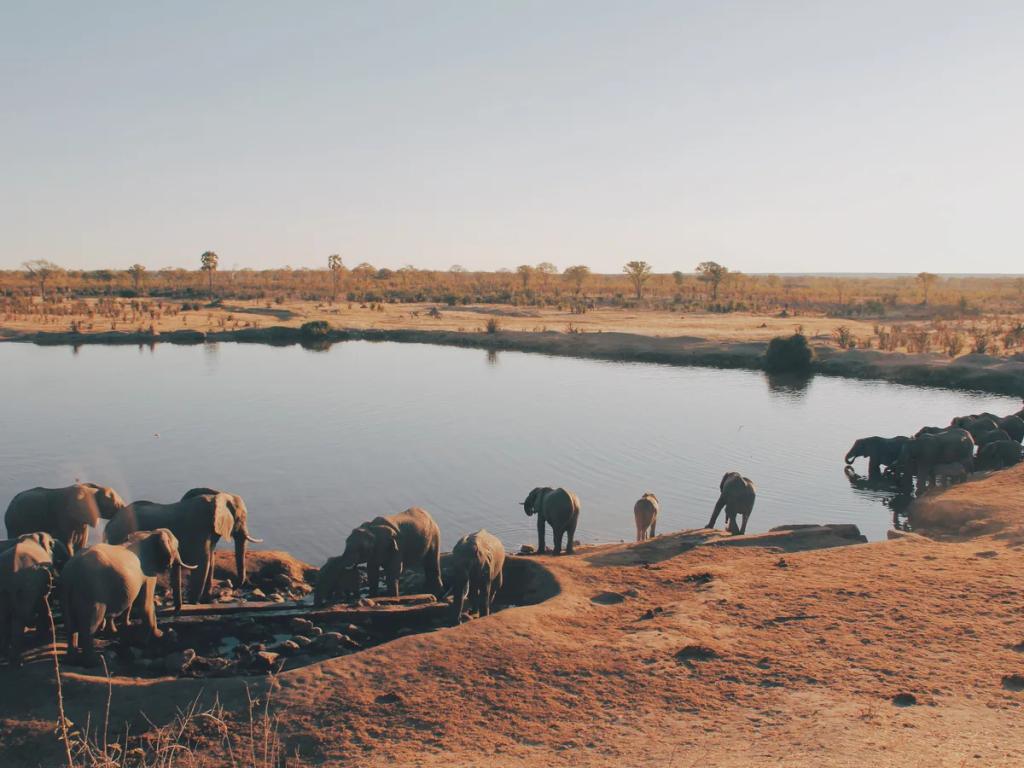
Elephants in town. Not a signal issue but a genuine safety one: elephants, baboons and warthogs move through Victoria Falls town, and walking between lodges after dark is discouraged for good reason. Do not put yourself between an elephant and anything, and do not stop to photograph one at close range.
Zimbabwe's currency situation has been turbulent for two decades and remains unusual.
- US dollars are used widely and are the practical currency for visitors. Zimbabwe has introduced a series of local currencies over the years; the USD is what tourism runs on.
- Bring cash, in small denominations, and in good condition. Torn or heavily worn notes are often refused, and change for large notes can be genuinely hard to find.
- Card acceptance is limited outside the larger lodges and operators, and ATMs are unreliable.
- Zambia uses the kwacha, so a two-country trip means two currencies plus dollars.
This is one of the few destinations in these guides where arriving without cash creates a real problem.
- Your booking confirmations, offline. Activities here are booked ahead and the operators run tight schedules.
- A weather and river-level source, since what you will see depends on flow.
- WhatsApp, which is how operators, guides and lodges communicate throughout the region.
- Maps for the town, which is small and easily walked in daylight.
- Not much else. There is no meaningful ride-hailing; transfers are arranged by your lodge or operator.
Victoria Falls Airport (VFA) is about 20 km from town, with flights from Johannesburg, Harare, Nairobi and Addis. Livingstone (LVI) serves the Zambian side.
Transfers are almost always arranged through your accommodation. Have your visa arrangements clear before the immigration desk, and carry cash in USD.
Malaria prophylaxis is advised for this region - speak to a travel clinic well before you travel.
Little. Most of your time is spent on activities where a phone is stowed, wet, or both.
For a week, 1GB per 3 days is generous. If you are crossing to Zambia, check whether your plan covers both countries or whether you need coverage for each. Plans top up from your dashboard.
Something that dries fast, and a full change for after the falls walk in high season. You will be soaked.
Waterproof footwear with grip. The rainforest path is wet rock and it is slippery.
Layers for winter mornings. June to August is dry and pleasant by day and genuinely cold at dawn - game drives leave before sunrise and open vehicles are freezing.
Neutral colours for safari, and long sleeves and trousers at dusk for mosquitoes.
Serious sun protection in the build-up months, when 40C is normal.
The full frontal view from the Zimbabwean side, along the rainforest path - the classic, and only really photographable at moderate to low water.
The Victoria Falls Bridge, with the gorge below and a bungee jumper if you are lucky.
A helicopter flight, the Flight of Angels, which is the only way to see the whole zigzag gorge system and how the falls have retreated over millennia.
Devil's Pool in low water, from the Zambian side, with a guide - the famous shot at the very lip.
Sunset on the Zambezi from a cruise, with hippos and an enormous sky.
Elephants crossing, which happens with a regularity that stops being surprising by day three.
The falls are not the tallest or the widest in the world, but the combination of height and width makes the largest single sheet of falling water anywhere - roughly 1,700 m across and over 100 m high.
David Livingstone reached them in 1855 and named them after Queen Victoria; the local Lozi name, Mosi-oa-Tunya, had been in use far longer and is now used officially on both sides.
The falls have been UNESCO-listed since 1989, jointly by Zimbabwe and Zambia.
The gorge below is a zigzag because the river has cut back through successive cracks in the basalt over hundreds of thousands of years - each bend is a former waterfall.
And Devil's Pool exists because a rock lip at the edge forms a natural barrier at low water, which is a sentence that reassures nobody looking at the photographs.
There is no festival calendar worth planning around. The river's calendar is the one that matters.
March to May: maximum flow, maximum noise, maximum spray, minimum visibility.
June to August: dry, cool, excellent game viewing as animals concentrate on water, falls still substantial.
September to December: low water, clear views, Devil's Pool open, and increasingly hot until the rains break.
Peak tourist season is roughly July to October.
The love: it is one of the genuine natural wonders, and standing in the spray with the ground shaking is an experience that resists description. The town is also the adventure capital of the region - rafting, bungee, gorge swings, helicopter flights, canoeing - and it combines with Chobe, Hwange and the Okavango into an outstanding trip. Zimbabwean guides are widely regarded as the best trained in Africa.
The complaints are worth knowing. It is expensive - park fees, activities and lodges add up fast, and it is not a budget destination despite the region. The seasonal variation is dramatic and people arrive at the wrong time for what they wanted. It is heavily touristed and persistently hawked, particularly on the walk to the entrance. The money situation frustrates people who assumed cards would work. And two or three days covers the falls themselves, so it works best combined with something else.
Come in June, cross to both sides, book the helicopter, and put your phone in a dry bag.
Yes - Zimbabwe and Zambia are separate countries with separate networks and tariffs, and crossing the Victoria Falls Bridge switches you between them. Signal also spills across the gorge, so a handset can latch onto the other country's network without you crossing at all. Check what both sides cost, or select your network manually near the bridge.
A single visa covering both Zimbabwe and Zambia for 30 days, with day trips into Botswana at Kazungula permitted - much more convenient than two separate visas. It is issued at the main airports and border posts, but availability has been intermittent over the years, so confirm it is currently being issued before depending on it.
It can, easily, and it does so regularly. At high water the rainforest path is effectively heavy rain from every direction. Use a waterproof bag or case and take one of the ponchos rented at the entrance.
Depends what you want. March to May is peak flow - overwhelming, and often so misty you cannot see the falls. August to January is low water, with clear views into the gorge and Devil's Pool open on the Zambian side. June to August is the balance, and also the best game viewing.