Gion Matsuri 2027: Dates, What to Expect & Staying Connected
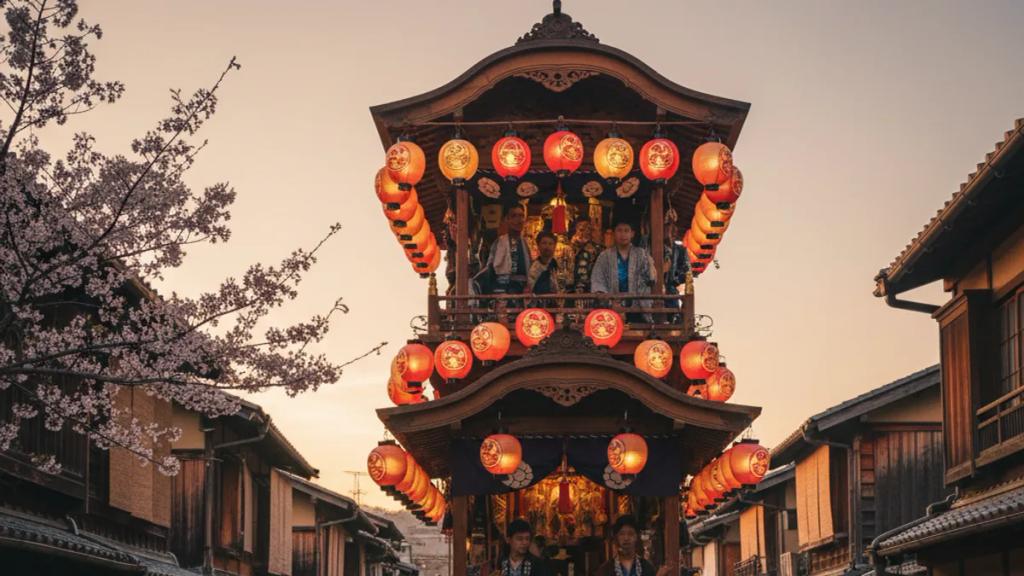
Gion Matsuri runs for the entire month of July 2027 in Kyoto, with the two grand Yamaboko float processions on Saturday 17 July and Saturday 24 July - the same fixed dates every year for over a millennium. Japan's most famous festival hauls 34 wooden floats, some 25 metres tall, through central Kyoto, preceded by yoiyama street evenings that pack hundreds of thousands of people into the Shijo-Karasuma grid. The catch nobody warns you about: Japan does not sell regular prepaid SIMs to visitors without a residence card, and Kyoto's downtown cell sectors buckle exactly when you need them. A Japan eSIM from £1.75 installed before you fly solves both problems.
When exactly is Gion Matsuri 2027?
The festival belongs to Yasaka Shrine and occupies all of July, opening 1 July and closing with a purification rite on 31 July. The dates are fixed by tradition, not announced year by year (see japan.travel). The peak moments in 2027:
- 14-16 July: Saki Matsuri yoiyama evenings. Floats stand lit with lanterns, musicians play on board, and on the 15th and 16th Shijo street closes to traffic and fills with food stalls. The biggest crowd nights of the month.
- Saturday 17 July: Saki Matsuri grand procession. 23 floats leave Shijo-Karasuma at 9:00, led by the Naginata-boko carrying the sacred child who cuts the rope to open the parade.
- 21-23 July: Ato Matsuri yoiyama - calmer, no food stalls, lanterns and music without the crush.
- Saturday 24 July: Ato Matsuri procession. 11 floats run the route in reverse. Smaller, noticeably easier to watch.
In 2027 both processions fall on Saturdays, so expect the weekend crowds to be even heavier than usual.
What should a first-timer actually expect?
A slow, ceremonial spectacle, not a party - and it is free. The show is the floats themselves, hand-built each year without nails, and the tsuji-mawashi corner turns, where teams drag a roughly 10-tonne float through a 90-degree pivot on wet bamboo slats. Paid grandstand seats (roughly 4,000-6,000 yen, premium options more) go on sale in June if you want a guaranteed sightline.
Be honest with yourself about the crowds. Yoiyama nights put hundreds of thousands of people into narrow streets, and police enforce one-way pedestrian flow on the busiest blocks - if you get separated, you cannot simply turn around and walk back. Kyoto hotels for mid-July sell out months ahead and prices spike; staying in Osaka (30-45 minutes by train) is a legitimate fallback.
Why does your phone struggle at Gion Matsuri?
Because the yoiyama evenings compress a stadium-sized crowd into a street grid built for medieval Kyoto. The blocks around Karasuma and Shijo hold hundreds of thousands of people shoulder to shoulder, every one of them streaming lantern-lit floats, sharing live location, and looking up the same stall maps. Japan's networks (docomo, au, SoftBank, Rakuten) are excellent, but no network keeps its speed when this many phones share a few downtown sectors - data crawls and calls drop exactly at peak.
What actually works:
- Agree a physical meeting point before you enter the grid - a numbered station exit or the Daimaru entrance beats "share your location" at 8pm on the 16th.
- Texts and voice notes over calls - small payloads squeeze through congestion; live calls fail first.
- Download offline maps of Kyoto in advance, with the procession route (Shijo, Kawaramachi, Oike) saved.
- Remember the one-way streets: plan your exit direction, because the crowd flow will not let you improvise.
- Upload later - post the evening's videos from hotel Wi-Fi, not from the middle of Shijo.
What is the best connectivity setup for Gion Matsuri?
A Japan eSIM installed before you board. Japan is unusual: ordinary prepaid SIMs are not sold to visitors without a residence card, so your airport options are travel-SIM counters and rental desks at a markup, with queues. A prepaid Japan eSIM sidesteps all of it:
| Data | Duration | Price |
|---|---|---|
| 1GB Data | 7 Days | £1.75 |
| 3GB Data | 15 Days | £4.32 |
| 5GB Data | 30 Days | £5.98 |
| 10GB Data | 30 Days | £9.97 |
| 20GB Data | 30 Days | £16.62 |
| 50GB Data | 30 Days | £25.68 |
| 1 Day | 1 Day | £2.59 |
| 2 Days | 2 Days | £5.19 |
| 3 Days | 3 Days | £7.78 |
| 4 Days | 4 Days | £10.20 |
| 5 Days | 5 Days | £12.93 |
| 6 Days | 6 Days | £15.67 |
| 7 Days | 7 Days | £18.41 |
| 8 Days | 8 Days | £19.78 |
| 9 Days | 9 Days | £21.83 |
| 10 Days | 10 Days | £23.20 |
| 11 Days | 11 Days | £25.25 |
| 12 Days | 12 Days | £27.30 |
| 13 Days | 13 Days | £28.67 |
| 14 Days | 14 Days | £30.04 |
| 15 Days | 15 Days | £32.09 |
| 16 Days | 16 Days | £33.46 |
| 17 Days | 17 Days | £34.15 |
| 18 Days | 18 Days | £35.51 |
| 19 Days | 19 Days | £37.57 |
| 20 Days | 20 Days | £38.94 |
| 21 Days | 21 Days | £40.30 |
| 22 Days | 22 Days | £40.99 |
| 23 Days | 23 Days | £41.67 |
| 24 Days | 24 Days | £42.36 |
| 25 Days | 25 Days | £43.04 |
| 26 Days | 26 Days | £43.73 |
| 27 Days | 27 Days | £44.41 |
| 28 Days | 28 Days | £45.09 |
| 29 Days | 29 Days | £45.78 |
| 30 Days | 30 Days | £47.15 |
Install the QR code at home on Wi-Fi, keep your home number live on dual SIM for calls and bank codes, and switch the Japan line on when you land. No counter, no paperwork, no roaming line on next month's bill.
A July festival trip is data-hungry: offline map downloads, translation apps for menus and signage, train timetables, and a nightly flood of float photos and video. Estimate what you will actually burn:
How do you get to Kyoto and around the festival?
Fly into Kansai International (KIX) and take the Haruka express - roughly 75-80 minutes direct to Kyoto Station. Inside the city during festival peaks, forget buses and taxis: streets around the route close, traffic locks up, and rail is the only sane option. The Karasuma subway line (Shijo station) and the Hankyu line (Karasuma station) drop you inside the festival grid; Gion-Shijo on the Keihan line serves the Yasaka Shrine side.
Load a mobile IC card (Suica or ICOCA on your phone) and top it up in-app - which needs data, another job for the eSIM. Train apps, platform lookups, and last-train times all assume you are online; the last thing you want after the 16th's yoiyama is guessing at the Hankyu timetable offline.
How do you survive Kyoto's July heat?
Take it seriously - this is the festival's real hazard. Kyoto in mid-July runs 33-35C with punishing humidity, and the yoiyama crush radiates body heat on top of it. There is a reason processions start at 9:00 and the street evenings fill up after dark.
Practical rules: drink far more water than feels necessary (vending machines are everywhere), and plan your day around air-conditioned refuges - the Daimaru and Takashimaya department stores sit right on Shijo, and convenience stores make legitimate cooling stops. Navigate to them rather than wandering; this is where cached maps plus live data earn their keep. Carry a towel like everyone else, and if you feel dizzy in the crowd, get out of the flow at the next cross street, not "in a minute".
The bottom line
Gion Matsuri fills Kyoto for all of July 2027, and the two dates that matter are fixed: grand processions on 17 and 24 July, with yoiyama evenings on the nights before each. See at least one of both, book your bed early, respect the heat, and agree a meeting point before the Shijo-Karasuma grid swallows your signal. A Japan eSIM from £1.75 installed at home means you are online from the KIX arrivals hall to the last Hankyu train - in a country that will not sell you a normal SIM at the corner shop.
Do I need tickets for Gion Matsuri?
No. Watching the processions and wandering the yoiyama streets is free. Paid grandstand seats (roughly 4,000-6,000 yen, premium packages more) go on sale around June and are only worth it for a guaranteed front-row view - the street is fine if you arrive early.
Will my phone work during the yoiyama crowds?
Expect it to slow badly at peak, when hundreds of thousands of people share a few downtown cell sectors. Texts and voice notes get through when calls do not, offline maps keep navigation alive, and a pre-agreed meeting point beats live location sharing.
Can I just buy a SIM card when I land in Japan?
Not a regular one - Japan requires a residence card for ordinary prepaid SIMs, so airports sell travel SIMs and rentals at a markup, usually with a queue. An eSIM installed before you fly is the practical route: local-rate data from £1.75, active the moment you land, no counter involved.
Which procession is better, 17 or 24 July?
The Saki Matsuri on the 17th is the headline: 23 floats, the sacred rope-cutting, the biggest crowds. The Ato Matsuri on the 24th runs 11 floats on the reverse route with more breathing room, and its yoiyama evenings have no food stalls, which keeps them calmer. If crowds worry you, choose the 24th.
How much data do I need for a Japan trip?
A one-to-two-week trip with maps, translation apps, train lookups, and heavy photo sharing typically lands in the 5-10GB range; nightly festival video pushes it higher. A fixed-data Japan eSIM can be topped up mid-trip if the float footage adds up.
Land in Japan already online
A Japan eSIM from eSIMpass installs before you fly - local-rate data on a Japanese network for the whole festival, your home number kept via dual SIM, no residence card or airport counter required.
Get Your Japan eSIM