The best eSIM for Singapore is eSIMpass's Singapore plan, starting at £2.32. Singapore is one of the best-connected places on earth, so your eSIM connects to a major local network with fast 4G and widespread 5G almost everywhere a visitor goes, from the Changi arrivals hall to the top of Marina Bay Sands. You scan a QR code before you fly, and your phone is online the moment the plane door opens.
This guide covers exactly what to expect: landing at Changi already connected, coverage across the MRT and malls, how much data you actually need, and one honest note for anyone continuing onward through Malaysia or Indonesia.
Singapore eSIM Plans and Pricing
| Data | Duration | Price |
|---|---|---|
| 1GB Data | 7 Days | £2.32 |
| 3GB Data | 30 Days | £3.17 |
| 5GB Data | 30 Days | £4.23 |
| 10GB Data | 30 Days | £5.29 |
| 20GB Data | 30 Days | £9.37 |
| 1 Day | 1 Day | £2.59 |
| 2 Days | 2 Days | £5.19 |
| 3 Days | 3 Days | £7.78 |
| 4 Days | 4 Days | £10.20 |
| 5 Days | 5 Days | £12.93 |
| 6 Days | 6 Days | £15.67 |
| 7 Days | 7 Days | £18.41 |
| 8 Days | 8 Days | £19.78 |
| 9 Days | 9 Days | £21.83 |
| 10 Days | 10 Days | £23.20 |
| 11 Days | 11 Days | £25.25 |
| 12 Days | 12 Days | £27.30 |
| 13 Days | 13 Days | £28.67 |
| 14 Days | 14 Days | £30.04 |
| 15 Days | 15 Days | £32.09 |
| 16 Days | 16 Days | £33.46 |
| 17 Days | 17 Days | £34.15 |
| 18 Days | 18 Days | £35.51 |
| 19 Days | 19 Days | £37.57 |
| 20 Days | 20 Days | £38.94 |
| 21 Days | 21 Days | £40.30 |
| 22 Days | 22 Days | £40.99 |
| 23 Days | 23 Days | £41.67 |
| 24 Days | 24 Days | £42.36 |
| 25 Days | 25 Days | £43.04 |
| 26 Days | 26 Days | £43.73 |
| 27 Days | 27 Days | £44.41 |
| 28 Days | 28 Days | £45.09 |
| 29 Days | 29 Days | £45.78 |
| 30 Days | 30 Days | £47.15 |
Every plan covers the whole island on a major Singapore network. There is no separate "Changi eSIM" or "Sentosa eSIM" - one Singapore plan works everywhere in the country, from the airport to Jurong to Pulau Ubin.
Landing at Changi: Connected Before You Reach the MRT
Changi is regularly ranked among the world's best airports, and connectivity is part of why. Here is what happens with an eSIM installed:
- You land already connected. Because activation only needs signal (not Wi-Fi), your Singapore eSIM latches onto a local network while you are still taxiing to the gate. By the time you reach immigration you can already message home, call your hotel, or order a Grab.
- Free airport Wi-Fi as a backup. Changi offers free Wi-Fi throughout all terminals if you ever need it, but with an eSIM you rarely will. Your own data is faster and follows you out the door.
- Getting to the city. The MRT (East-West Line) runs straight from Changi into town, and Grab is easy to book from the arrivals curb. Both need live data - the MRT app for routing and top-ups, Grab for the pickup - and your eSIM handles both instantly.
If you want the airport-specific detail, see our Singapore Changi eSIM guide for terminal notes and the exact install-before-you-fly routine.
Coverage Across the Island: MRT, Malls, and Everywhere Else
Singapore is compact and densely built, and its networks reflect that. The three major networks - Singtel, StarHub, and M1 - blanket the country with 4G and have rolled out nationwide 5G. A travel eSIM connects to one of these as its host network, so you get genuine local coverage, not a weak foreign signal.
What that means in practice:
- The MRT works underground. Unlike many metros, Singapore's MRT has strong mobile coverage in tunnels and stations, so you stay online between stops.
- Malls and indoor spots are covered. Orchard Road, VivoCity, Marina Bay Sands, and the big shopping centres all have solid indoor signal.
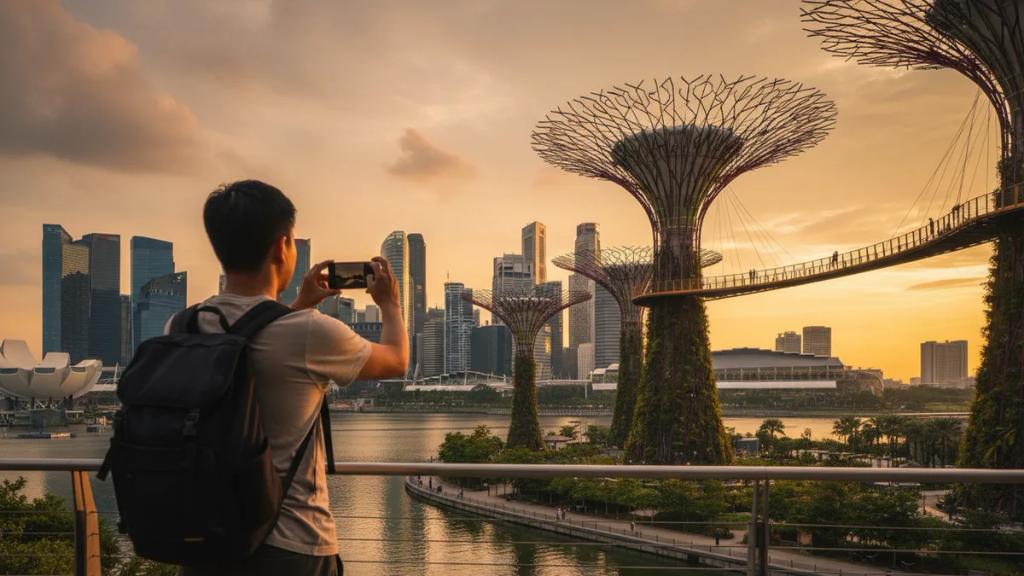
- Tourist areas are excellent. Gardens by the Bay, Sentosa, Chinatown, Little India, Kampong Glam, and the Marina Bay waterfront all have strong service.
Honest single-network note: your travel eSIM runs on one major local network, not a blend of all three. That is completely fine in Singapore, because each of the three national networks already covers essentially the entire country. There are no meaningful dead zones on the main island. The only spots where signal thins are far offshore boat trips and the deep interior of a few nature reserves, and even those are minor.
What Tourists Actually Use Data For in Singapore
Singapore rewards a connected traveller. The things you will lean on data for:
- Grab and public transport. Grab for rides, the MRT and bus apps for routing and fares. This is the single biggest reason you want reliable data here.
- Maps and food hunting. Google Maps to navigate, and reviews to find the right hawker stall at Maxwell, Lau Pa Sat, or Newton.
- Entry and event bookings. Gardens by the Bay, the Night Safari, Universal Studios, and rooftop bars often want an app, QR ticket, or online reservation.
- Messaging and photos. WhatsApp and Telegram for staying in touch, plus backing up the inevitable Marina Bay skyline shots over data.
- Contactless everything. Singapore is heavily cashless; mobile payments and QR codes are the norm.
How Much Data Do You Need for Singapore?
Singapore is a short-stay, high-activity destination for most visitors, so data needs are moderate:
- Weekend or stopover (2-4 days): 1-3 GB covers maps, Grab, and messaging comfortably.
- Full week of sightseeing: 3-5 GB, with room for photo backups and some streaming.
- Heavy user or hotspotting a laptop: 5-10 GB.
Get a personalised estimate:
Continuing Through Southeast Asia? Consider a Regional Plan
Here is the honest planning tip most guides skip. If Singapore is your only stop, a Singapore-only plan is the right call - it is the cheapest way to get exactly what you need.
But Singapore is often a hub. If you are flying onward to Kuala Lumpur, Bali, Bangkok, or beyond, a Singapore-only eSIM stops working the moment you cross the border. In that case a regional Asia plan that spans multiple countries can be simpler and better value than buying a fresh eSIM in each country. For a multi-country trip, read our Southeast Asia backpacking eSIM guide to see whether a regional plan fits your route. For a single Singapore trip, stick with the Singapore plan below.
eSIM vs Roaming vs a Local SIM in Singapore
eSIM vs Roaming vs Local SIM
Compare your options for Singapore
| eSIMpass | Roaming | Local SIM | |
|---|---|---|---|
| Setup time | Instant | None | 30-60 min |
| Cost per GB | ~$2-5 | $10-50+ | ~$3-8 |
| Surprise fees | None | Likely | Unlikely |
| Buy before trip | Yes | Yes | No |
| Keep your number | Yes | Yes | No |
| Speed | 4G/5G | 4G/5G | 4G/5G |
A few practical points:
- Roaming is the most expensive option by far. Many foreign networks charge daily fees or steep per-GB rates for Singapore. Compare against a prepaid eSIM and the difference is large. See eSIM vs roaming for the full breakdown.
- A physical local SIM means finding a shop, showing your passport for registration, and swapping your SIM card. An eSIM skips all of that: it is delivered by QR instantly and installs in minutes, with no queue at the airport counter.
- An eSIM is prepaid and data-only (no local phone number), which is exactly what a tourist needs. You keep your home number reachable on WhatsApp while your data runs on the local network.
Want the cheapest route overall? Our guide to eSIM data plans walks through picking the smallest plan that fits your trip.
How to Install Your Singapore eSIM (Under 3 Minutes)
- Purchase: Select your Singapore plan and complete checkout
- Receive: Get your QR code by email instantly, with no activation fee
- Scan: Open Settings > Mobile Service/Mobile Data > Add eSIM > Scan QR code
- Activate: Turn on data roaming for the eSIM line and set it as your data line
- Connect: You are online the moment you land at Changi
Install the eSIM at home while you still have Wi-Fi, then simply switch it on when you land. Most phones from 2018 onward support eSIM - see our compatible devices list if you are unsure.
Ready for Singapore without roaming fees?
Join 10,000+ travellers who chose eSIMpass. One Singapore plan covers Changi, the MRT, and the whole island on a major local network. Instant QR delivery.
Get Your Singapore eSIMFrequently Asked Questions
Will my eSIM work the moment I land at Changi?
Yes. Activation only needs a mobile signal, not Wi-Fi, so your Singapore eSIM connects to a local network while the plane is still taxiing. You can book a Grab or message home before you clear immigration. Changi also has free Wi-Fi throughout if you ever need a backup.
Which network does the eSIM use in Singapore?
It connects to one of Singapore's major networks - Singtel, StarHub, or M1 - as its host network. It does not blend all three or auto-switch to the strongest of them. In Singapore this does not matter, because each of these networks already covers essentially the entire country with 4G and 5G.
Does it work on the MRT and underground?
Yes. Singapore's MRT has strong mobile coverage in tunnels and stations, so you stay connected between stops. Malls, the airport, and indoor tourist sites are all well covered too.
Should I buy a Singapore plan or a regional Asia plan?
For a Singapore-only trip, buy the Singapore plan - it is the cheapest fit. If you are continuing to Malaysia, Indonesia, Thailand, or elsewhere in the region, a multi-country Asia plan can be better value and saves you buying a new eSIM at each border. Our Southeast Asia backpacking guide helps you decide.
Do I need to register my passport like with a physical SIM?
No. Buying a physical tourist SIM in many parts of Asia means showing your passport for registration at a counter. An eSIM bought online skips that entirely - you receive a QR code by email and install it yourself, no paperwork or queue.
Will my phone work with a Singapore eSIM?
Most phones released since 2018 support eSIM, including iPhone XR/XS and newer, Samsung Galaxy S20 and newer, and Google Pixel 3 and newer. Your phone must be network-unlocked. Check our compatible devices list or the iPhone and Android install guides for details.