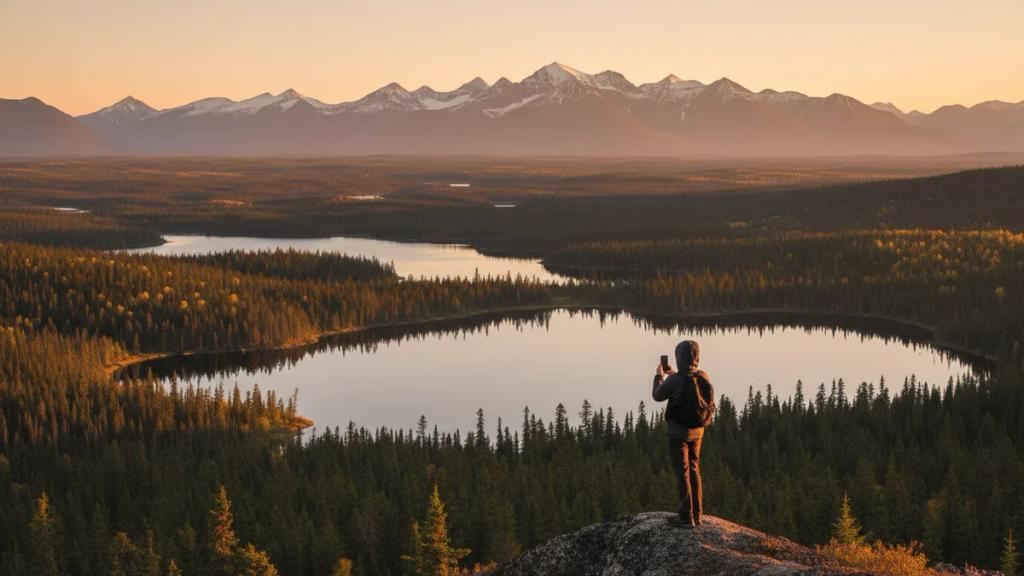
A Canada eSIM from eSIMpass, starting at £2.44, keeps you connected everywhere Canadian mobile coverage actually reaches - cities, towns, major highways, and most national-park gateways - but no eSIM, and no local SIM either, gives you signal in the true backcountry or the far north. This is the honest guide most connectivity articles skip. Canada is the second-largest country on Earth and almost all of it is empty. Coverage hugs the populated south; the moment you head into the mountains, the boreal forest, or the territories, you are relying on preparation, not bars on a screen.
If you understand that split before you go, you can plan a trip where your phone works in every town and trailhead you sleep near, and where the offline stretches are a deliberate choice rather than a nasty surprise.
Where a Canada eSIM Actually Works
Here is the realistic coverage picture that shapes any wilderness trip:
- Strong coverage: Every city and town, from Vancouver and Calgary to Whitehorse and Yellowknife. Solid 4G with expanding 5G in urban areas, connecting through one of Canada's major host networks.
- Usable coverage: The Trans-Canada Highway and other major routes, most national-park gateway towns (Banff, Jasper, Lake Louise village), and many park visitor centres and campgrounds near roads.
- No coverage: Backcountry trails away from towns and highways, the interior of large parks, most of the Yukon, Northwest Territories, and Nunavut once you leave the settlements, and essentially the entire far north. No Canadian network fixes this - the towers simply are not there.
The practical takeaway: a Canada eSIM covers everywhere a typical road trip or park visit eats, sleeps, and refuels. The gaps sit between those points, and you prepare for them by going offline on purpose.
Canada eSIM Plans and Pricing
| Data | Duration | Price |
|---|---|---|
| 1GB Data | 7 Days | £2.44 |
| 3GB Data | 15 Days | £5.52 |
| 5GB Data | 30 Days | £8.61 |
| 10GB Data | 30 Days | £14.95 |
| 20GB Data | 30 Days | £25.38 |
| 50GB Data | 30 Days | £43.80 |
| 1 Day | 1 Day | £4.72 |
| 2 Days | 2 Days | £9.51 |
| 3 Days | 3 Days | £12.93 |
| 4 Days | 4 Days | £16.35 |
| 5 Days | 5 Days | £18.41 |
| 6 Days | 6 Days | £21.14 |
| 7 Days | 7 Days | £23.20 |
| 8 Days | 8 Days | £23.88 |
| 9 Days | 9 Days | £24.57 |
| 10 Days | 10 Days | £25.25 |
| 11 Days | 11 Days | £26.62 |
| 12 Days | 12 Days | £27.99 |
| 13 Days | 13 Days | £29.36 |
| 14 Days | 14 Days | £30.72 |
| 15 Days | 15 Days | £32.09 |
| 16 Days | 16 Days | £33.46 |
| 17 Days | 17 Days | £34.15 |
| 18 Days | 18 Days | £35.51 |
| 19 Days | 19 Days | £37.57 |
| 20 Days | 20 Days | £38.94 |
| 21 Days | 21 Days | £40.99 |
| 22 Days | 22 Days | £43.04 |
| 23 Days | 23 Days | £45.09 |
| 24 Days | 24 Days | £47.15 |
| 25 Days | 25 Days | £49.20 |
| 26 Days | 26 Days | £51.25 |
| 27 Days | 27 Days | £53.31 |
| 28 Days | 28 Days | £55.36 |
| 29 Days | 29 Days | £57.41 |
| 30 Days | 30 Days | £59.46 |
Every plan is prepaid and data-only, so there is no Canadian phone number attached. That is fine for travel: you keep your home SIM active for calls and texts on a dual-SIM phone, and use £2.44 worth of data for maps, messaging, and everything else. For voice, WhatsApp and similar apps work over the data connection wherever there is signal.
Why the North Has No Signal (and Why That Is Normal)
Mobile towers follow people and roads. Canada has roughly the population of California spread across a landmass larger than the entire European Union, and most of that population lives within a couple of hours of the US border. Building and powering towers across thousands of kilometres of tundra, muskeg, and mountain to serve a handful of travellers makes no commercial sense, so it does not happen.
This is why the "which network has the best coverage" question matters far less in the wilderness than in the city. Rogers, Bell, and Telus are the big three, and they have the widest national footprints, but even their maps go blank across the territories and the backcountry. A travel eSIM connects to one of these major host networks, so where any of them reaches, you are covered - and where none of them build, no SIM on Earth helps. Anyone promising "wilderness coverage" is selling you a map of the highways, not the wilderness.
Prepare Before You Lose Signal
Treating the offline stretches as planned rather than accidental is the whole game. Do this before you leave the last town with bars:
- Download offline maps. Google Maps and Apple Maps both let you save whole regions for offline use. GPS positioning works without any mobile signal, so your blue dot keeps moving and navigation keeps routing through every dead zone. Save the entire area you will drive or hike, not just the destination.
- Cache your directions and trail info. Screenshot or download trailhead directions, park maps, campground layouts, and any AllTrails or park-service route details while you still have data. Once you are offline, a cached screenshot is worth more than a spinning loading icon.
- Download entertainment and reading. Podcasts, playlists, and offline maps for the long quiet drives between towns.
- Tell someone your plan. Leave your route and expected return time with a friend, your accommodation, or the park office. This is the single most important safety step in the backcountry, and it costs nothing.
- Top up on data in town. Do photo backups, video calls, and big downloads over your eSIM while you have strong coverage, so you are not burning battery hunting for signal in a canyon.
When You Need More Than a Phone: Satellite Messengers
For day hikes near towns and standard road trips, an eSIM plus offline maps is genuinely all you need. But if you are heading into serious backcountry - multi-day trekking, remote paddling, winter travel, or anywhere far from a road - a phone is not a safety device, because it has no signal to use.
For that, carry a dedicated satellite messenger such as a Garmin inReach or a SPOT device, or use the satellite SOS feature built into recent iPhones and some Android phones. These talk to satellites rather than mobile towers, so they work where no eSIM can, and they let you send an SOS or a check-in message from the middle of nowhere. This is standard practice for anyone spending real time in the Canadian wild, and no travel data plan replaces it. Your eSIM handles the connected 95 percent of the trip; a satellite device handles the risky, disconnected part.
National Parks: Gateway Towns vs the Backcountry
Canada's marquee parks show the coverage split perfectly. In Banff townsite, Jasper townsite, and Lake Louise village you get normal, usable coverage - enough for maps, restaurant bookings, and uploading photos. Many visitor centres and roadside campgrounds have signal too. But hike a few kilometres up a valley, or drive a remote park road, and it drops away fast. Parts of Banff and Jasper away from the highway corridor are effectively offline, and that is true on every network.
If your trip is built around the mountain parks, you will find a Canada eSIM handles the drive, the towns, and the trailheads beautifully. For the deep trails, download everything in town first and treat the interior as offline. Our Canadian Rockies road trip guide breaks down exactly which stretches of that route keep signal and which go dark.
The Territories: Yukon, NWT, and Nunavut
Above the provinces, the coverage rules change again. In the territorial capitals - Whitehorse, Yellowknife, Iqaluit - and along a few main highways like the Alaska Highway and the Dempster's southern reaches, you get usable service in and near the settlements. Everywhere else, assume nothing. Vast sections of the Yukon and Northwest Territories, and almost all of Nunavut outside the communities, have no mobile coverage of any kind.
An eSIM still earns its place here: you will use it constantly in the towns for maps, bookings, weather, and staying in touch. Just build the trip knowing that the space between communities is genuinely off-grid, and pack a satellite device for any travel far from those settlements.
How Much Data Do You Need?
Because your heaviest use happens in towns with strong signal, wilderness trips are often lighter on data than city breaks:
- Light users (maps in town, messaging, occasional email): 3-5 GB for a couple of weeks.
- Road trippers (daily navigation, photo sharing, some streaming on drives): 5-10 GB per two weeks.
- Heavy users (cloud photo backup of every hike, video calls home, hotspot for a laptop): 10-15 GB or more.
Get a personalised estimate based on your habits:
eSIM vs Roaming vs Local SIM in the Wilderness
eSIM vs Roaming vs Local SIM
Compare your options for Canada
| eSIMpass | Roaming | Local SIM | |
|---|---|---|---|
| Setup time | Instant | None | 30-60 min |
| Cost per GB | ~$2-5 | $10-50+ | ~$3-8 |
| Surprise fees | None | Likely | Unlikely |
| Buy before trip | Yes | Yes | No |
| Keep your number | Yes | Yes | No |
| Speed | 4G/5G | 4G/5G | 4G/5G |
None of these three options changes the fundamental coverage map - they all ride the same physical towers. What differs is cost and convenience. Network roaming works but bills at steep daily or per-GB rates; a local SIM means finding a store, showing ID, and getting a Canadian number you do not need. An eSIM installs before you leave home, activates the moment you land in a covered area, and costs far less per gigabyte. For the connected parts of a wilderness trip, that makes it the practical choice - and for a deeper breakdown of the trade-offs, see our guide on eSIM versus roaming.
Getting Set Up
Installation takes a few minutes and is worth doing at home while you have fast, reliable Wi-Fi:
- Buy your Canada plan and complete checkout.
- Receive your QR code by email instantly - no activation fee, no waiting.
- Scan it under Settings, then add your eSIM.
- Activate data roaming on the eSIM line and set it as your data line.
- Connect the moment you land somewhere with coverage.
The eSIM works on an iPhone XR or newer, a Galaxy S20 or newer, and a Pixel 3 or newer, as long as the phone is network-unlocked. If you want the full step-by-step, our installation and activation guide walks through every screen, and you can check your handset on the compatible devices list.
Frequently Asked Questions
Will a Canada eSIM work in the backcountry or on remote trails?
Only where there is mobile coverage, which in the deep backcountry usually means no. An eSIM connects through Canada's major networks, and those networks do not build towers on remote trails or in the far north. In gateway towns and along major highways you will have signal; away from them, plan to be offline and carry a satellite messenger for serious trips.
Does it work in the Yukon, Northwest Territories, or Nunavut?
In the capitals and larger settlements (Whitehorse, Yellowknife, Iqaluit) and along a few main highways, yes. Across the vast spaces between communities, there is no mobile coverage on any network. Use the eSIM in the towns and treat the country between them as off-grid.
Can I use my eSIM for emergencies in the wild?
Only where there is signal. Where there is none, no mobile plan can place a call. For genuine backcountry safety, carry a dedicated satellite messenger or use your phone's satellite SOS feature, which works via satellites instead of mobile towers. The eSIM keeps you connected everywhere coverage reaches.
Do I still get a Canadian phone number?
No. eSIMpass plans are data-only, so there is no Canadian number. Keep your home SIM active on a dual-SIM phone for calls and texts, and use WhatsApp or similar apps over the data connection wherever there is signal.
Should I download offline maps even with an eSIM?
Absolutely, and it is the most important prep step. Save your whole route or park region in Google Maps or Apple Maps while you have data. GPS positioning works with no signal, so navigation keeps running through every dead zone once the maps are cached.
Will my phone work in Canada?
Most phones from 2018 onward support eSIM, including iPhone XR and newer, Samsung Galaxy S20 and newer, and Google Pixel 3 and newer. Canada uses the same LTE and 5G bands as much of the world. Just make sure the phone is network-unlocked before you install.
Ready to explore Canada with data everywhere coverage reaches?
Join 10,000+ travellers who chose eSIMpass. One Canada plan covers every city, highway, and park gateway. Instant QR delivery, no roaming fees.
Get Your Canada eSIM