The best eSIM for a Canadian Rockies road trip is eSIMpass's Canada plan, starting at £2.44, and it works exactly where you need it: the townsites of Banff, Canmore, Lake Louise village, and Jasper, plus the full length of the Trans-Canada Highway. You scan a QR code before you leave home, land in Calgary, and drive west already connected. No roaming bill, no hunting for a SIM shop, no activation fee.
One honest thing up front, because the mountains do not care how good your plan is: coverage in the Rockies follows the road and the towns, and it disappears on much of the Icefields Parkway, on the high passes, and on the backcountry trails. No network fixes that, not Rogers, not Bell, not Telus, not a travel eSIM. This guide tells you exactly where you will have signal, where you will not, and how to plan around the gaps so the dead zones stay scenic instead of stressful.
Canada eSIM Plans and Pricing
| Data | Duration | Price |
|---|---|---|
| 1GB Data | 7 Days | £2.44 |
| 3GB Data | 15 Days | £5.52 |
| 5GB Data | 30 Days | £8.61 |
| 10GB Data | 30 Days | £14.95 |
| 20GB Data | 30 Days | £25.38 |
| 50GB Data | 30 Days | £43.80 |
| 1 Day | 1 Day | £4.72 |
| 2 Days | 2 Days | £9.51 |
| 3 Days | 3 Days | £12.93 |
| 4 Days | 4 Days | £16.35 |
| 5 Days | 5 Days | £18.41 |
| 6 Days | 6 Days | £21.14 |
| 7 Days | 7 Days | £23.20 |
| 8 Days | 8 Days | £23.88 |
| 9 Days | 9 Days | £24.57 |
| 10 Days | 10 Days | £25.25 |
| 11 Days | 11 Days | £26.62 |
| 12 Days | 12 Days | £27.99 |
| 13 Days | 13 Days | £29.36 |
| 14 Days | 14 Days | £30.72 |
| 15 Days | 15 Days | £32.09 |
| 16 Days | 16 Days | £33.46 |
| 17 Days | 17 Days | £34.15 |
| 18 Days | 18 Days | £35.51 |
| 19 Days | 19 Days | £37.57 |
| 20 Days | 20 Days | £38.94 |
| 21 Days | 21 Days | £40.99 |
| 22 Days | 22 Days | £43.04 |
| 23 Days | 23 Days | £45.09 |
| 24 Days | 24 Days | £47.15 |
| 25 Days | 25 Days | £49.20 |
| 26 Days | 26 Days | £51.25 |
| 27 Days | 27 Days | £53.31 |
| 28 Days | 28 Days | £55.36 |
| 29 Days | 29 Days | £57.41 |
| 30 Days | 30 Days | £59.46 |
Every plan covers all of Canada on a major national host network, so the same eSIM works in Calgary, Banff, and Jasper without any change. Pick a data size for the length of your trip and you are done. There is no separate "Rockies eSIM" or "Alberta eSIM" from any provider; a national Canada plan is what you want.
Where Your eSIM Actually Works in the Rockies
Here is the coverage picture that makes or breaks a mountain road trip:
- Strong coverage: the townsites. Banff, Canmore, Lake Louise village, and Jasper town all have solid 4G, with 5G in the busier areas. Expect full service at hotels, restaurants, the Banff Gondola base, the Lake Louise lakeshore, and around the Jasper SkyTram.
- Reliable coverage: the Trans-Canada Highway (Highway 1) between Calgary, Canmore, Banff, and Lake Louise. This is the busy east-west corridor, and towers follow it closely. You can navigate, stream, and take calls along almost the whole stretch.
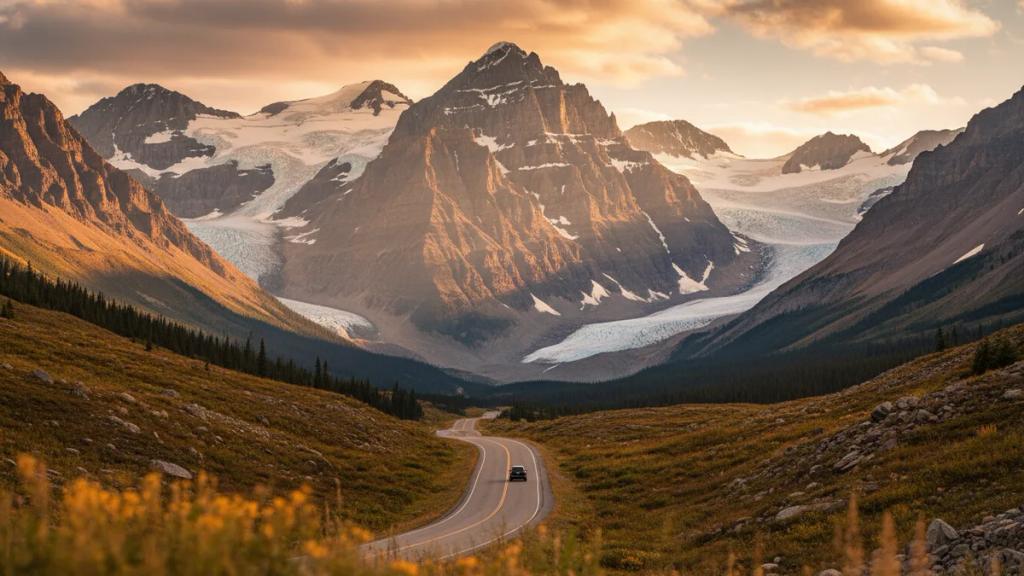
- Patchy to no coverage: the Icefields Parkway (Highway 93 North) between Lake Louise and Jasper. This is the famous 232 km scenic drive, and it is largely off-grid. You will get bars near the Columbia Icefield / Athabasca Glacier visitor area and occasionally at Saskatchewan River Crossing, but long stretches in between have nothing.
- No coverage: mountain passes, backcountry trailheads, and most hiking trails once you leave the townsite. Moraine Lake road, the trails above Lake Louise, Johnston Canyon's upper reaches, and anything in the alpine are effectively offline.
The practical takeaway: an eSIM covers where you sleep, eat, fuel up, and start most days. The scenic drive in between is where you go quiet, and that is normal for every phone on every network.
The Icefields Parkway: Plan for Silence
The Icefields Parkway is the highlight of the trip and the single biggest connectivity gap. Treat it as an offline day and it becomes a joy instead of a worry:
- Download offline maps before you leave Lake Louise or Jasper. Google Maps lets you save the whole corridor for offline use, and GPS positioning keeps working with zero signal, so turn-by-turn navigation runs the entire drive.
- Screenshot or download your reservations. Save your Jasper hotel confirmation, any glacier-tour or Skywalk tickets, and your Parks Canada pass details to your phone before you lose signal. You cannot pull up an email in a canyon with no bars.
- Fuel up at both ends. There is one fuel stop roughly midway (Saskatchewan River Crossing) and it is not always open or cheap. Fill the tank in Lake Louise or Jasper and you never have to think about it.
- Tell someone your plan. With no signal for hours, a simple "we are driving the Parkway today, expect us in Jasper by 6" to family or your hotel is the right move. This is basic mountain sense, not eSIM advice.
Do those four things and the Parkway's lack of signal stops being a problem. You will still have full data at the Columbia Icefield stop to share photos and check tour times, then go quiet again for the scenery.
Why You Want Data in the Rockies at All
Between the dead zones, mobile data earns its keep here:
- Parks Canada and tour logistics. Shuttle bookings for Moraine Lake and Lake Louise, glacier tours, and the Columbia Icefield Skywalk confirm and reschedule by app or email. Weather cancels things fast in the mountains.
- Weather and road alerts. Mountain weather turns in minutes, and Highway 93 and the passes close for snow or wildlife well into spring. Alerts reach you the moment you are back in range.
- Wildlife and trail closures. Bear and cougar warnings and trail closures are posted online and updated daily. Worth checking over morning coffee in town before you head out.
- Navigation and photo backup. Live maps in town, offline maps on the Parkway, and backing up your lake photos over data from the hotel so a dropped phone does not take your Moraine Lake shots with it.
How Much Data Do You Need?
Rough guide for a Rockies trip:
- Light users (maps, messaging, the odd photo upload): 3-5 GB for a week.
- Typical road trippers (daily navigation, social posts, some streaming in the hotel): 5-10 GB per week.
- Heavy users (video calls home, cloud photo backup, hotspot for a laptop or a second phone): 10-15 GB per week.
Because the Parkway and trails are offline anyway, your data mostly burns in the towns and on the Trans-Canada, which makes a mid-size plan go further than you would expect. Get a personalised estimate:
eSIM vs Roaming vs a Local SIM
eSIM vs Roaming vs Local SIM
Compare your options for Canada
| eSIMpass | Roaming | Local SIM | |
|---|---|---|---|
| Setup time | Instant | None | 30-60 min |
| Cost per GB | ~$2-5 | $10-50+ | ~$3-8 |
| Surprise fees | None | Likely | Unlikely |
| Buy before trip | Yes | Yes | No |
| Keep your number | Yes | Yes | No |
| Speed | 4G/5G | 4G/5G | 4G/5G |
Roaming works but Canadian data is some of the most expensive in the world, and foreign networks pass that on. A local SIM means finding a Rogers, Bell, or Telus store in Calgary and burning an hour of your trip on paperwork. An eSIM is installed before you fly and active the second you land, at a fraction of roaming cost. For a road trip on a schedule, that is the easy call. If you are weighing it up, our eSIM vs roaming breakdown lays out the numbers, and the Canada eSIM plans show what the trip will cost.
Keep Your Home Number for Calls
eSIMpass plans are prepaid and data-only, so you do not get a Canadian phone number. That is the right setup for a road trip: keep your home SIM active for calls and texts on dual SIM, set the Canada eSIM as your data line, and make calls over WhatsApp, FaceTime, or Signal, which all run fine on data. Your hotel and tour operators are happy to reach you by email or app. If you want a deeper look at how the two lines coexist, see our guide on eSIM vs roaming.
Installing Your Canada eSIM (Under 3 Minutes)
- Purchase: select your Canada plan and check out. You get a QR code by email instantly.
- Install at home: open Settings, add the eSIM by scanning the QR code, and label it "Canada." Installation needs Wi-Fi, so do it before you fly.
- Land in Calgary: turn on the Canada eSIM as your data line, enable data roaming for that line, and you are connected.
- Drive west: keep your home number on the other SIM for calls.
Most phones from 2018 on support eSIM: iPhone XR and newer, Samsung Galaxy S20 and newer, Google Pixel 3 and newer, and the phone must be network-unlocked. For a full walkthrough with screenshots, see our eSIM installation and activation guide. Want the full regional picture beyond the Rockies? Our Canada wilderness connectivity guide covers the national parks, the territories, and where signal really ends.
Frequently Asked Questions
Will my eSIM work on the Icefields Parkway?
Partly. You will have signal around the Columbia Icefield / Athabasca Glacier visitor area and occasionally near Saskatchewan River Crossing, but most of the 232 km between Lake Louise and Jasper has no coverage from any network. Download offline maps and cache your reservations before you set off, and treat the drive as offline.
Does the eSIM work in Banff and Jasper towns?
Yes, fully. Banff, Canmore, Lake Louise village, and Jasper town all have solid 4G with 5G in the busier spots. You will have full service at hotels, restaurants, and the main attractions in and around town.
Which network does the eSIM use?
It connects to one of Canada's major national host networks (Rogers, Bell, or Telus level coverage), which have the widest reach in the country. It does not hop between all three to pick the strongest, but the host network covers the townsites and the Trans-Canada Highway that your trip actually follows.
Can I get signal on the hiking trails?
Usually not. Once you leave the townsite, most trails, viewpoints, and passes have no signal, including popular ones like the Lake Louise teahouse trails and upper Johnston Canyon. Carry offline maps, tell someone your route, and consider a satellite messenger for serious backcountry days.
Do I need a separate plan for Calgary or the drive in?
No. A national Canada eSIM covers Calgary, the airport, and the whole highway network, so the same plan works from the moment you land through the entire Rockies loop.
Can I make phone calls with it?
The plan is data-only with no Canadian number, so keep your home SIM active for regular calls and use WhatsApp, FaceTime, or Signal over data. On dual-SIM phones both lines run at once, with the eSIM handling your data.
Ready for the Rockies without roaming fees?
Join 10,000+ travellers who chose eSIMpass. One Canada plan covers Banff, Lake Louise, and Jasper. Instant QR delivery, no activation fee.
Get Your Canada eSIM