A US eSIM for a Grand Canyon and Zion road trip starts at £2.59 for 1GB/7 days, and it works well in the gateway towns and at the main visitor centres - but no eSIM, and no local SIM either, gives you signal deep in the canyons or out in the backcountry. That is the honest picture, and most connectivity guides skip the second half of it. This one tells you exactly where your phone will work, where it won't, and how to prepare so the dead zones never leave you stranded.
The short version: buy a US eSIM so you are connected everywhere coverage exists, then do the offline prep in this guide so the gaps are planned for, not a surprise. A US eSIM connects to a major US network (such as T-Mobile or AT&T) the moment you have signal, with no roaming bill.
US eSIM Plans and Pricing
| Data | Duration | Price |
|---|---|---|
| 3GB Data | 15 Days | £3.60 |
| 5GB Data | 30 Days | £5.39 |
| 10GB Data | 30 Days | £9.71 |
| 20GB Data | 30 Days | £17.47 |
| 50GB Data | 30 Days | £39.32 |
| 1 Day | 1 Day | £2.59 |
| 2 Days | 2 Days | £5.19 |
| 3 Days | 3 Days | £7.78 |
| 4 Days | 4 Days | £10.20 |
| 5 Days | 5 Days | £12.93 |
| 6 Days | 6 Days | £15.67 |
| 7 Days | 7 Days | £18.41 |
| 8 Days | 8 Days | £19.78 |
| 9 Days | 9 Days | £21.83 |
| 10 Days | 10 Days | £23.20 |
| 11 Days | 11 Days | £25.25 |
| 12 Days | 12 Days | £27.30 |
| 13 Days | 13 Days | £28.67 |
| 14 Days | 14 Days | £30.04 |
| 15 Days | 15 Days | £32.09 |
| 16 Days | 16 Days | £33.46 |
| 17 Days | 17 Days | £34.15 |
| 18 Days | 18 Days | £35.51 |
| 19 Days | 19 Days | £37.57 |
| 20 Days | 20 Days | £38.94 |
| 21 Days | 21 Days | £40.30 |
| 22 Days | 22 Days | £40.99 |
| 23 Days | 23 Days | £41.67 |
| 24 Days | 24 Days | £42.36 |
| 25 Days | 25 Days | £43.04 |
| 26 Days | 26 Days | £43.73 |
| 27 Days | 27 Days | £44.41 |
| 28 Days | 28 Days | £45.09 |
| 29 Days | 29 Days | £45.78 |
| 30 Days | 30 Days | £47.15 |
Every plan covers the whole United States, so a single US eSIM handles Arizona, Utah, Nevada, and everything in between on one road trip. There is no separate "national park eSIM" from any provider - a park sits inside the US network map like anywhere else, it just happens to be in terrain that towers struggle to reach. If you want to keep costs down across a longer Southwest loop, our data plan guide helps you size the plan.
Where You Will Actually Have Signal
Here is the honest coverage map for the two parks and the drive between them:
- Usable signal: Grand Canyon South Rim near Grand Canyon Village, the main Visitor Center, Mather Point, and Market Plaza. Zion Canyon Visitor Center, Springdale, and the shuttle stops near the park entrance. The gateway town of Tusayan just outside the South Rim. Expect workable 4G here, sometimes congested when the parks are packed in summer, but enough for maps, messages, and a photo upload.
- Patchy signal: Stretches of Desert View Drive along the South Rim, the higher Zion viewpoints, and parts of the approach highways. Signal comes and goes with the terrain - you may have two bars at one overlook and nothing at the next.
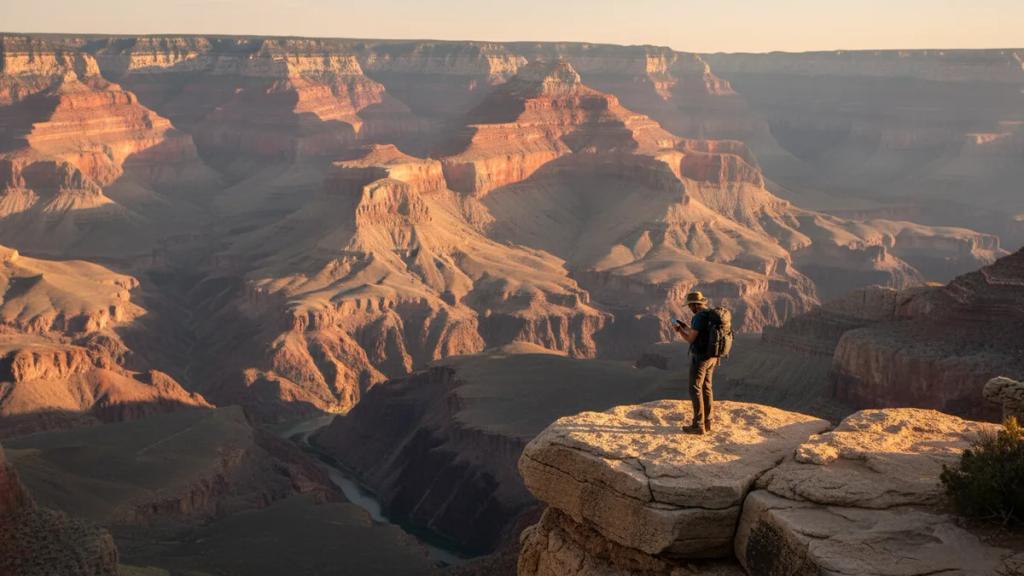
- No signal at all: Below the rim on any Grand Canyon trail (Bright Angel, South Kaibab, down to Phantom Ranch), the North Rim's remote reaches, Zion's backcountry, the Narrows, most of the West Rim and Kolob areas, and the empty desert highways in between. This is not an eSIM limitation. It is physics and remoteness - the canyon walls block line of sight to distant towers, and there simply are no towers in the backcountry. A local US SIM card would show the same dead zones.
The takeaway is simple: an eSIM keeps you connected everywhere a typical itinerary sleeps, eats, parks, and starts a hike. The moment you drop below the rim or head into the backcountry, treat your phone as an offline camera and GPS unit, because that is what it becomes.
The Network Truth: No US Network Fixes the Canyons
Travellers often ask which of the big three US networks - T-Mobile, Verizon, or AT&T - is best for the parks. It is a fair question, and the honest answer matters:
- Verizon has historically had the broadest rural and remote footprint in the US, and it tends to hold a slight edge at some park viewpoints and along lonely stretches of highway.
- AT&T is competitive across the Southwest and covers the gateway towns and visitor centres well.
- T-Mobile has strong, fast coverage in and around towns and along major interstates, and its rural reach has improved a lot, though it can still trail the other two in the most remote pockets.
Two things are true at once. First, a travel eSIM runs on a single host network (commonly T-Mobile or AT&T for tourist eSIMs), so it does not roam between all three networks or "auto-pick the strongest" - it uses one network's map. Second, and more importantly: none of the three has meaningful coverage below the canyon rim or in the deep backcountry. The differences between networks show up at the margins in remote areas, not in the canyon itself, where they all read "No Service." So pick connectivity for where you will actually be online - the towns, the trailheads, the drives - and plan the rest offline. For more on how the networks compare, see T-Mobile vs Verizon vs AT&T for tourists.
The Offline Prep That Actually Keeps You Safe
This is the part that turns a US eSIM from "nice to have" into a trip that runs smoothly. Do this before you lose signal, ideally the night before in your hotel Wi-Fi or over the eSIM in town:
- Download offline Google Maps for the whole region - Grand Canyon, Zion, and the highway corridor. Google Maps lets you save large offline areas, and GPS positioning keeps working with zero signal, so turn-by-turn navigation still runs through every dead zone. Do the same in Apple Maps if you use it.
- Cache your trail maps. Apps like AllTrails let you download individual trail maps for offline use, and the National Park Service app lets you download each park's content in advance. Do this for every hike you plan, including the return route.
- Screenshot the essentials. Your lodging address and check-in details, shuttle schedules, timed-entry or backcountry permit confirmations, tour meeting points, and any reservation numbers. A screenshot needs no signal to open.
- Tell someone your plan. Leave your hiking route and expected return time with a person back home or at your hotel. Rangers recommend this precisely because there is no phone signal below the rim to call for help.
- Charge everything and bring a battery pack. Cold nights and hot days drain batteries, and searching for signal drains them faster. GPS and offline maps are useless on a dead phone.
- For serious backcountry, carry a satellite messenger. A device like a Garmin inReach or the satellite SOS feature on newer iPhones works where no mobile network reaches. If you are going rim-to-rim, overnight below the rim, or deep into Zion's wilderness, this is the real safety layer - not any SIM or eSIM.
How Much Data You Need
You will burn less data than you expect, because you are offline for big chunks of every day inside the parks. Realistic guidance:
- Light users (maps in town, messaging, a few photo uploads): 1-3 GB for a week.
- Typical road trippers (daily navigation, social sharing, reservation juggling, some streaming at the hotel): 3-5 GB per week.
- Heavy users (video calls home, cloud photo backup of thousands of canyon shots, hotspot for a laptop): 5-10 GB per week.
Get a tailored estimate:
Because coverage is concentrated in town and at visitor centres, a smart habit is to back up your photos and handle big downloads while you have signal, then let the phone run offline in the park. If you want headroom for photo backup and hotspotting, an unlimited eSIM plan removes the worry of watching your balance, though unlimited plans typically include fair-use throttling above a threshold and hotspot caps, so check the terms.
Why Data Beats Roaming for This Trip
If you are visiting from outside the US, your home network's US roaming can run well over ten dollars a day, and it bills the same whether you are online for five minutes in Springdale or a full day of navigation. A prepaid US eSIM is a fixed, prepaid cost with no bill shock. Because the parks leave you offline for hours at a time, you often use far less data than you would at home, which makes a modest prepaid plan go a long way. See our full eSIM vs roaming breakdown for the numbers, and compare the options side by side:
eSIM vs Roaming vs Local SIM
Compare your options for United States
| eSIMpass | Roaming | Local SIM | |
|---|---|---|---|
| Setup time | Instant | None | 30-60 min |
| Cost per GB | ~$2-5 | $10-50+ | ~$3-8 |
| Surprise fees | None | Likely | Unlikely |
| Buy before trip | Yes | Yes | No |
| Keep your number | Yes | Yes | No |
| Speed | 4G/5G | 4G/5G | 4G/5G |
A local SIM card is the weakest choice here: you would have to find a network store in a city like Las Vegas or Flagstaff, swap cards, and you would still hit the exact same canyon dead zones. The eSIM installs before you leave home and connects itself the moment you land.
Keeping Your Home Number While You Travel
eSIMpass plans are data-only, so they do not come with a US phone number. That is fine for a road trip, and it is actually convenient: your phone keeps your home SIM active for calls and texts on your normal number, and the eSIM carries the data. WhatsApp, Signal, and iMessage all stay tied to your home number and work over the eSIM's data. Keep your home line on for two-factor codes and calls, and set the eSIM as your data line. Our guide on eSIM installation and activation walks through the dual-SIM setup step by step.
Installing Your US eSIM
- Purchase: Choose your United States plan and check out.
- Receive: Your QR code arrives by email instantly - no activation fee.
- Scan: Open Settings, add the eSIM, and scan the QR code (do this at home on Wi-Fi).
- Activate: Turn on data roaming for the eSIM line and set it as your data line.
- Connect: You are online as soon as you have signal at the airport, in Las Vegas, or rolling into Tusayan or Springdale.
Works on iPhone XR and newer, Samsung Galaxy S20 and newer, and Google Pixel 3 and newer, as long as your phone is network-unlocked.
Frequently Asked Questions
Will my eSIM work at the bottom of the Grand Canyon?
No, and neither will any US SIM card. There is no mobile signal below the rim on Bright Angel, South Kaibab, or at Phantom Ranch. Download offline maps, tell someone your route, and for a rim-to-rim or overnight hike carry a satellite messenger. Treat everything below the rim as fully offline.
Is there Wi-Fi or signal at the visitor centres?
Yes. The Grand Canyon South Rim Visitor Center area, Market Plaza, and Mather Point generally have usable mobile signal, as do the Zion Canyon Visitor Center and Springdale. Coverage can slow down when the parks are crowded in summer, but it is enough for maps, messages, and uploads. Some park facilities also offer limited Wi-Fi.
Which US network has the best national park coverage?
Verizon has traditionally had the widest remote footprint, with AT&T close behind and T-Mobile strongest in and around towns. But a tourist eSIM runs on one host network (often T-Mobile or AT&T), not all three, and none of them reaches the canyon floor or deep backcountry. Choose based on where you will actually be online: the towns, viewpoints, and highways.
Do I need a separate plan for Zion and the Grand Canyon?
No. Both parks are in the US, so one US eSIM covers them and the drive between, including any Las Vegas or Flagstaff nights. There is no separate national-park eSIM.
Will offline Google Maps navigate without signal?
Yes. Once you download the offline area, GPS positioning works with no mobile signal at all, so turn-by-turn driving directions keep running through every dead zone. Download the region before you leave a signal area, and cache your trail maps in AllTrails or the NPS app too.
Can I hotspot for a laptop or a second phone?
Yes, tethering works on the data plans, which is handy for backing up photos from a hotel in Tusayan or Springdale. It uses data quickly, though, so keep an eye on your balance or pick a larger plan. For a longer Southwest loop, our West Coast road trip eSIM guide covers stringing multiple parks and cities together.
Ready to stay connected across the Southwest?
Join 10,000+ travellers who chose eSIMpass. One US plan covers Grand Canyon, Zion, and every town in between. Instant QR delivery, no roaming fees.
Get Your US eSIM