Alanya runs on Turkiye's three networks - Turkcell, Vodafone Turkiye and Turk Telekom - and your eSIM rides one of them as its host. The coastal strip is well covered: dense 4G along the whole seafront from Mahmutlar through the centre to Konakli, with 5G reaching the main urban areas as the national rollout continues. Turkcell has the broadest rural footprint, which starts to matter the moment you head inland towards the Taurus mountains.
This is the connectivity fact that makes Turkiye different from anywhere else on the Mediterranean, and Alanya - with its very large population of seasonal residents and repeat visitors - is where it bites most often.
Turkiye operates an IMEI registration regime. A foreign handset used with a Turkish SIM card beyond a grace period gets blocked from Turkish networks at the device level, not the SIM level - swapping operators does not help. The allowance is commonly described as 120 days, and enforcement is real rather than theoretical: the regulator has blocked millions of unregistered handsets in single sweeps. Registering afterwards costs a substantial one-time fee, and in practice tourists usually cannot register at all, because it generally requires a Turkish ID or residence permit.
Two honest clarifications, because the internet is full of confident half-truths on this:
- The regime attaches to using a Turkish local SIM in a foreign device. Visitors who stay on their home line, on roaming, or on a travel eSIM that roams as a foreign profile are not in the local-SIM registration process at all. That is why a data eSIM sidesteps the paperwork for an ordinary holiday.
- Some vendor pages state flatly that an eSIM is "never" affected. Treat that as marketing rather than law. If you are staying months rather than weeks, or planning to buy a Turkish line, read the current BTK rules before you rely on any of it - this is a regulation that has tightened repeatedly.
For a two-week beach holiday the whole issue is moot. For a winter in Mahmutlar, it is the first thing to sort out.
Alanya Castle. The citadel sits on a rocky peninsula 250 m above the sea, and the climb is the interesting part - coverage on the road up and on the open ramparts is fine, but the Seljuk-era cisterns, the Byzantine chapel and the inner keep passages are thick stone and go quiet.
Damlatas Cave, right behind Cleopatra Beach, is a cave: no signal, by definition. The same goes for the boat-trip stops at the Pirates' Cave and Lovers' Cave along the peninsula.
Dim Cayi, the cold river valley inland where everyone goes to eat on platforms over the water, drops into a gorge and coverage thins with it. Lovely spot; download the map first.
Boat trips lose the shore after a few kilometres out. If you are on a full-day pirate cruise, assume you are offline for stretches.
- BiTaksi is Turkiye's main licensed taxi app and covers the Antalya region. It takes card and cash, and it removes the pricing conversation. One caveat repeated by everyone who lives here: foreign cards are not reliably accepted inside Turkish apps, so keep lira cash as a fallback rather than assuming the card will go through.
- Dolmus by eye, not by app. The shared minibuses running the coast road are the cheapest and most useful transport in Alanya, and they are not really in any app - you flag them down, you say where you are going, you pay the driver. Maps will show you the road; they will not show you the dolmus.
- A currency app. Lira prices move, and menus in the tourist strip are often quoted in euros while the shop next door quotes lira - knowing which is cheaper today is a live calculation.
- Translation. Alanya is genuinely multilingual - German, Russian and English are everywhere in the tourist strip - but step two streets inland and it is Turkish only.
Two airports serve Alanya and the choice matters.
Gazipasa-Alanya (GZP) is the close one, about 40 km east, and 35-50 minutes by road. A Havas shuttle bus runs into town for around 140 lira; taxis negotiate somewhere in the 500-800 lira range depending on your bargaining and the hour.
Antalya (AYT) is the big one, with far more flights - and roughly two hours away along the coast. If your flight lands at AYT, budget the transfer time properly; people routinely underestimate it.
Either way, arrivals are when the transfer confirmation, the hotel location and the first currency check all land at once. Install the eSIM before you fly.
Modest. This is a sit-still holiday for most visitors - beach, old town, a couple of day trips - rather than a navigate-constantly city break.
For a week, 1GB per 3-4 days is a comfortable baseline. Size up if you are working from the balcony, or if the trip includes long inland drives where maps run continuously. Plans top up from your dashboard, and our best eSIM for Turkey guide covers how the Turkish host networks compare if you are combining Alanya with Istanbul or Cappadocia.
Beach kit on the beach, and something with sleeves for the castle - it is an active mosque and archaeological site as well as a viewpoint, and shoulders covered is the courteous default. The climb to the citadel is steep and sun-exposed; proper shoes and water, not flip-flops.
The season runs long here. May and October are excellent - warm sea, thin crowds - while July and August are genuinely hot and the old town's stone holds the heat well past sunset. Winter is mild enough for a jacket rather than a coat, which is precisely why so many northern Europeans overwinter here.
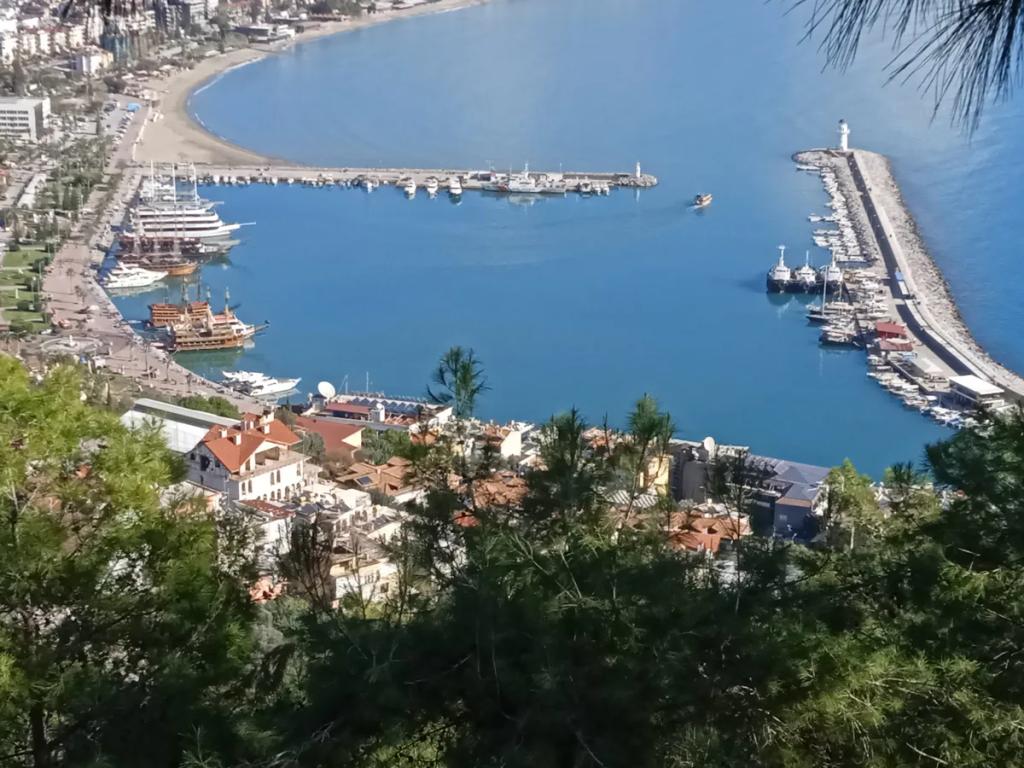
Kizil Kule, the octagonal red-brick tower on the harbour, is the symbol of the city and the easiest shot in Alanya - best in the late afternoon when the brick warms up.
The castle ramparts at sunset, looking back west along Cleopatra Beach with the whole bay curving away. Go up by taxi or the cable car and walk down; the light in the last hour does the work.
Cleopatra Beach from the peninsula path - the long golden arc with the Taurus mountains behind it. Free to enter and Blue Flag rated, which is unusual for a beach this central.
The harbour at blue hour, with the gulet boats lit and the tower behind them.
The citadel above the town is mostly 13th-century Seljuk, built after Alaeddin Keykubad took the city in 1220 - which is where the old name Alaiye comes from - and it sits on Byzantine and Roman foundations. The Kizil Kule was part of the same building campaign, designed to defend the shipyard below it.
The Seljuk shipyard, the Tersane, is still there on the waterfront: five stone bays cut into the rock, one of the very few surviving medieval dockyards in the Mediterranean.
And the beach is named for Cleopatra because the story goes that Mark Antony gave the region to her as a gift - the local claim that she swam here is unprovable and repeated with total confidence by every guide on the coast.
Summer is the event: from June to September the town roughly triples in population and the seafront runs late every night.
The Alanya International Triathlon in October is a long-running fixture that closes coastal roads for a weekend.
Ramadan shifts the rhythm - the tourist strip carries on much as usual, but inland restaurants and the towns behind the coast change their hours entirely.
And the shoulder months, April-May and October-November, are when the northern European long-stayers arrive and the town feels most like a place people live rather than visit.
The love: a genuinely beautiful setting where the Taurus mountains drop straight into a warm sea, a real castle above a real old town, a long season that stretches from April to November, and prices that remain low by Mediterranean standards. The multilingual, long-stay expat culture makes it unusually easy to settle into for weeks at a time.
The complaints are equally real. The coastal strip has been built hard - Mahmutlar in particular is a wall of apartment blocks - and if you arrive expecting an unspoiled Turkish fishing town you have come to the wrong coast by about forty years. Restaurant touts on the harbour front are persistent. Summer heat and summer crowds are both serious. Lira volatility means prices quoted in euros can feel arbitrary. And Antalya airport's two-hour transfer catches people out every single season.
Come in May or October, stay near the old town rather than the far strip, and Alanya makes a strong case for itself.
Only if you use a Turkish SIM card in a foreign handset beyond the grace period - commonly described as 120 days - after which the device itself is blocked from Turkish networks. Visitors on roaming or a travel data eSIM are not in that local-SIM registration process. If you are staying for months or intend to buy a Turkish line, check the current BTK rules first; tourists generally cannot register a device at all without a Turkish ID or residence permit.
The coastal urban areas are being covered as Turkiye's rollout continues, and 4G along the whole seafront is dense and fast. Inland towards the Taurus, Turkcell has the widest reach.
Use BiTaksi, the licensed Turkish taxi app, which covers the Antalya region. Keep lira cash as a backup - foreign cards are not always accepted inside Turkish apps. For getting along the coast, the dolmus minibuses are cheaper than any app and you flag them from the roadside.
Gazipasa (GZP) is 40 km away, 35-50 minutes by road. Antalya (AYT) has far more flights but is about two hours from Alanya - budget that transfer time properly when comparing fares.