The peninsula is served by the same three operators as the rest of the country - Turkcell, Vodafone and Turk Telekom - and your eSIM rides one of them as its host. Bodrum town and the larger villages have dense 4G with 5G spreading through the built-up areas. What makes Bodrum different from the Turkish mainland resorts is not the town. It is the water: a peninsula with two coasts, a dozen bays, a permanent boat culture, and a Greek island close enough to see from the castle.
Here is the connectivity fact that is specific to Bodrum and catches people every summer.
Kos is about 30 minutes away by ferry, and Kos is Greece - which means it is the European Union. Ferries run several times daily in season, and a Kos day trip is one of the most popular things to do from Bodrum. It is also an international border crossing: passports are checked both sides, non-EU travellers need a passport with six months' validity, and EU citizens can use a national ID card.
For your phone, the crossing flips the entire picture:
- A Turkish data plan is out of zone the moment you are in Greek waters. Turkiye is not in the EU roaming area.
- An EU SIM does the reverse - it works normally on Kos and roams expensively the moment you sail back into Bodrum.
- Mid-strait your handset will hop between Turkish and Greek networks with enthusiasm, which is how people end up billed for a network they never meant to use.
If a Kos day trip is on the plan, decide in advance which side you want covered, and turn data roaming off on the crossing itself rather than letting the phone choose.
The same applies in smaller doses to blue-cruise itineraries that touch the Dodecanese - Gokova and Hisaronu stay Turkish, but plenty of gulet routes call at Greek islands.
Bodrum has an unusually large population of people who stay for a season rather than a fortnight - villa owners, sailors between charters, remote workers - and they are the ones this rule is written for.
Put a Turkish SIM in a foreign handset for longer than the grace period, commonly given as 120 days, and the handset itself gets barred from Turkish networks. Not the SIM: the phone. Switching operator changes nothing, un-barring it is expensive, and the process generally needs a Turkish ID or residence permit that a visitor will not have.
Holidaymakers never meet it, because roaming and travel eSIMs sit outside the local-SIM process entirely. Anyone contemplating a winter here should read the current BTK position rather than a vendor page - several of those claim eSIMs are "never" affected, which overstates a narrower truth.
On the water, constantly. This is a boat town. Day trips around the peninsula, the Gokova gulf and the blue-cruise routes all take you kilometres offshore, where coverage thins to nothing between headlands. If your booking, your meeting point or your return transfer lives in an app, screenshot it before you board.
Gumusluk sits at the far western tip, and the walk out to Rabbit Island across the submerged causeway of ancient Myndos is exactly the sort of low, exposed spot where you get one bar and a lot of confidence.
The bays behind the ridges. The peninsula is a spine of hills with settlements on both coasts, and the road between Yalikavak, Turgutreis and Bitez climbs and drops constantly. Signal follows the road, not the map.
Bodrum Castle's interior - the Museum of Underwater Archaeology occupies the towers and dungeons, and the thick Crusader stone does what it looks like it does.
- BiTaksi is the licensed Turkish taxi app and covers the region. Keep lira cash as a backup: foreign cards are not reliably accepted inside Turkish apps.
- Dolmus by eye. The shared minibuses linking the peninsula villages are frequent, cheap and effectively unmapped - you flag them, you say the village, you pay the driver. In summer they are far faster than driving into Bodrum and hunting for parking.
- Ferry schedules, for Kos and for the peninsula boat shuttles, which change with the season and the wind.
- A weather app that shows wind, not just sun. The meltemi - the strong summer northerly - decides whether boat trips run, and locals check it before they check the temperature.
Milas-Bodrum (BJV) is about 36 km northeast of town, roughly 40-50 minutes by road. Havas shuttle buses run to the otogar and the ferry terminal; taxis and pre-booked transfers cover the rest. In peak season the airport is busy with charters and the taxi rank moves slowly.
If you are peninsula-bound rather than staying in Bodrum town - Yalikavak, Turgutreis, Gumusluk - add another 20-30 minutes and book the transfer, because the dolmus network works well between villages and poorly from the airport.
Install the eSIM before you fly. Arrivals here is when the transfer, the villa directions and the first ferry check all land at once.
Moderate, with a caveat. Ordinary beach-and-marina days are light on data. Boat days are heavier than you expect, because everyone pre-downloads maps, music and podcasts before losing signal offshore.
For a week, 1GB per 3 days is a reasonable baseline; size up if you are on a gulet for several nights or running a Kos trip. Top-ups run from your dashboard. If Bodrum is one stop of several, the best eSIM for Turkey guide sets out how the host networks differ.
Bodrum is the dressiest stretch of the Turkish coast. Yalikavak's marina and the Turkbuku beach clubs are properly smart in the evening, and beach kit will not get you far past sunset.
Days are pure Aegean: swimwear, sun protection, and something for the meltemi, which turns a 33C afternoon into a genuinely breezy evening. Boat days need a layer, a hat that will survive wind, and shoes you can get wet.
The castle and the ancient theatre are hot, exposed climbs - proper shoes, water.
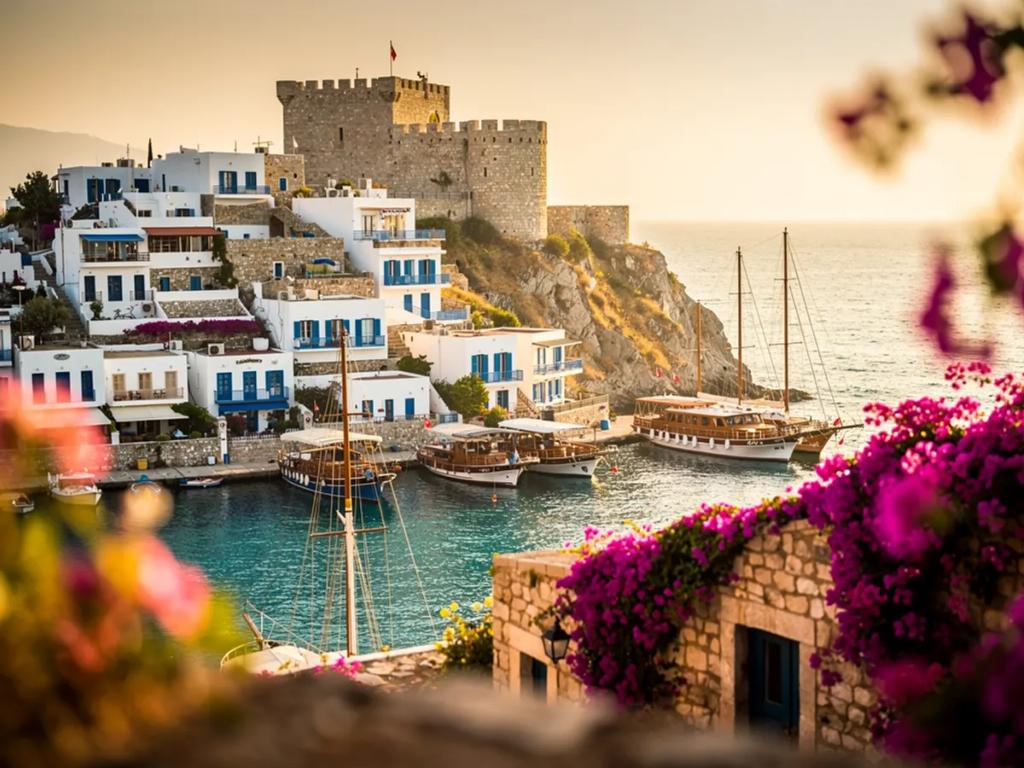
Bodrum Castle from the harbour at golden hour, with the gulets moored in front of it. The castle was built by the Knights Hospitaller partly from the stones of the Mausoleum, which is a photograph with a story attached.
Gumusluk at sunset, eating fish with your feet near the water and the sun going down behind Rabbit Island. It is the single most photographed dinner on the peninsula for good reason.
Yalikavak Marina for the superyacht contrast - the peninsula's luxury end, and a completely different Bodrum from the old town.
The windmills on the ridge between Bodrum and Gumbet, looking down over both bays at once.
Bodrum is ancient Halicarnassus, and the Mausoleum of Mausolus here was one of the Seven Wonders of the Ancient World - the word "mausoleum" comes from this specific tomb. Very little of it survives, partly because the Knights quarried it to build the castle.
Herodotus, the man usually called the father of history, was born here.
And the peninsula is the birthplace of the Blue Cruise - the gulet-based sailing holiday that spread along the whole Turkish coast from these harbours.
Summer, June to September, is the season and the town roughly triples. July and August are peak in every sense.
The meltemi blows hardest in midsummer and shapes the sailing calendar more than any festival.
Bodrum Cup in October is the big gulet and yacht regatta, and one of the best times to photograph the harbour.
Winter is genuinely quiet - much of the peninsula's restaurant and marina economy closes down between November and March, and Bodrum reverts to being a town.
The love: two coasts, a dozen distinct villages with genuinely different characters, the best marina and restaurant scene on the Turkish Aegean, a real castle, and a boat culture that means the sea is the point rather than the backdrop. Gumusluk and Gokova are lovely. The season stretches from May to October.
The complaints are fair. Bodrum is expensive by Turkish standards - Yalikavak and Turkbuku are priced for yacht money and it shows on ordinary menus too. Summer traffic on the single peninsula road is genuinely bad, and parking in Bodrum town in August is a lost cause. Gumbet's club strip is loud and not for everyone. And the town's appeal is spread across the peninsula, so without a car or a willingness to use dolmuses you can feel stuck in one bay.
Base yourself in a village rather than the centre, use the dolmuses, and come in June or September.
No. Kos is Greece and therefore the EU; Turkiye is not in the EU roaming zone. A Turkish plan is out of zone on Kos, and an EU plan is out of zone back in Bodrum. Mid-strait your phone will hop between Greek and Turkish networks, so turn data roaming off on the crossing unless you have deliberately covered both sides.
Only if you use a Turkish SIM card in a foreign handset beyond the grace period, after which the device is blocked from Turkish networks. Roaming and travel data eSIMs are not in that registration process. If you are staying for months, check current BTK rules rather than trusting vendor claims.
Near the coast and in the bays, usually yes. Offshore and between headlands, no. Download maps, tickets and anything you need before you sail, and treat data as intermittent for the duration.
Milas-Bodrum (BJV) is about 36 km from Bodrum town, 40-50 minutes by road, and another 20-30 minutes to the far peninsula villages like Gumusluk or Yalikavak.