Skip to content

eSIM Bali - Best Prepaid Data Plan

Buy eSIM for Bali, Indonesia. Instant QR code delivery, 4G/5G speeds, no roaming fees. Works with iPhone, Samsung & Pixel.

Stay connected in Bali with reliable mobile internet. Use WhatsApp, Google Maps, Uber, and all your favourite apps.

eSIM Bali - Buy prepaid travel data for Bali, Indonesia
Bali, Indonesia - Stay connected with eSIMpass prepaid data plans

Quick Setup

No Roaming

4G/5G Speed

Refund Policy

Data only — no phone number, no calls, no SMS Your own number stays active on your existing SIM (dual SIM), and you can call and message through WhatsApp, FaceTime and similar apps.

Choose Your Plan

Starting from£2.59

Select a data plan above to proceed to checkout

Indonesia eSIM Technical Specifications

Network Speed
4G LTE / 5G
Activation
QR code by email
Calls & SMS
Not included

You do not get a new phone number with this eSIM.

Indonesia eSIM FAQ for UK Travellers

Do I get a phone number with the eSIM?
No. Our eSIMs are data-only, so they do not come with a phone number. You use them for internet access — maps, WhatsApp, email, social media, streaming and any other app. Your existing SIM keeps your own phone number active.
Can I make or receive calls and text messages (SMS)?
Not standard calls or SMS — the eSIM provides mobile data only. You can call and message as much as you like through internet apps such as WhatsApp, FaceTime, Telegram, Signal or Messenger, which run on the eSIM's data. Standard calls and SMS keep working on your usual number through your home operator, as long as you keep that SIM active.
How much data do I need in Indonesia?
It depends on the plan you choose. Across nearly 3,000 of our customers' finished eSIMs, the typical one used half to two-thirds of its plan, and on the smaller plans (1-5 GB) about one in three used all of it. Maps and messaging use little; video, video calls and sharing your connection use the most. If in doubt, take the next size up. If you do run out, you can buy another eSIM at any time - you will need WiFi to install it.
What network speeds will I get in Indonesia?
Your Indonesia eSIM uses a local mobile network: 4G, and 5G where the network offers it. Speed depends on coverage and your location.
Can I share data with my laptop or tablet?
Yes, but only for Data Plans with a fixed data allowance. Unlimited plans do not support hotspot or tethering.
When should I install my Indonesia eSIM?
Install your eSIM while you still have WiFi at home - it is safe to do so days in advance for either plan type. Per-GB plans only start when the eSIM first connects to a network in Indonesia. Unlimited plans run on the travel dates you select at checkout, with the days counting from your chosen start date whether the eSIM is installed or not - so make sure it is on your phone by that date.

Setting up your eSIM? The installation and activation guide walks through it step by step, and the full FAQ covers device compatibility, hotspot, dual SIM and topping up.

Staying connected in Bali: the local guide

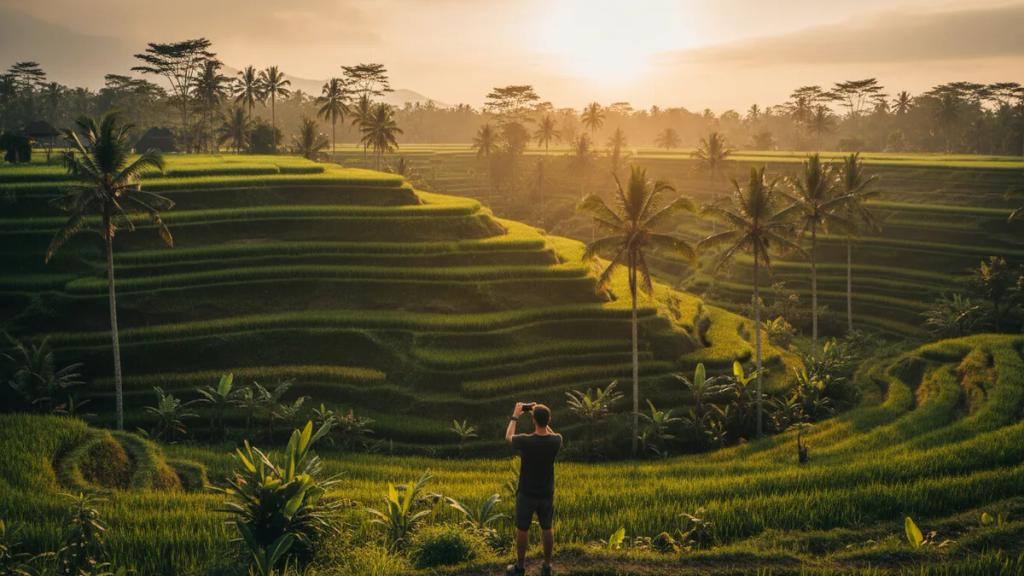
Terraced rice fields and palm trees near Ubud, Bali, under late-afternoon light

Emergency numbers

  • 112 - general emergency (live in Denpasar and major cities, not yet island-wide)
  • 110 - Police
  • 118 / 119 - Ambulance

Time zone

WITA (UTC+8, no DST) - one hour ahead of Jakarta

Weather

Tropical: 27-31C and humid all year; Apr-Oct is the dry season, Nov-Mar brings daily afternoon downpours

Bali runs on three Indonesian networks - Telkomsel, Indosat, and XL - and which one matters depends on where you sleep. In the southern tourist belt (Kuta, Seminyak, Canggu, Uluwatu, Sanur) and in Denpasar, all three deliver solid 4G with 5G spreading, and your eSIM's host network will feel fast. Head inland or offshore and the gap opens: Telkomsel has by far the widest rural reach, which is why it is the network Ubud drivers, Sidemen guesthouses, and Nusa Penida warungs actually rely on.

Where the signal gets thin

Bali's geography is the coverage map. The river gorges around Ubud and the Sidemen valley drop to a bar or two once you are down among the rice terraces - signal returns on the ridge roads. Nusa Penida and Nusa Lembongan have decent coverage in the harbour towns and main strips, but the cliff-top roads to Kelingking and Diamond Beach are patchy on every network, and the fast-boat crossings from Sanur are mostly dead zones on the water. Download offline maps and your boat-ticket confirmation before you leave the pier - the operators check tickets from WhatsApp messages, and reloading one mid-crossing is not an option.

The apps that need data here

  • Gojek and Grab are how Bali moves - scooter taxis, cars, and food delivery, all booked and paid in-app. But learn the local rules: at the airport and in villages with taxi cooperatives (parts of Ubud, Canggu beach ends, and the Nusa islands), rideshare pickups are restricted to designated zones or quietly banned, so drivers will message you a meeting point. That negotiation happens over live data.
  • WhatsApp is Bali's booking system - villas, drivers, surf lessons, boat tickets, even restaurant reservations run on it. If your data is down, so is your itinerary.
  • Payments are not tap-and-go: locals pay by QRIS QR codes, which need an Indonesian e-wallet most visitors cannot set up. Cards work in bigger restaurants and hotels, but warungs, beach vendors, and scooter rentals want cash - data for finding a fee-free ATM is worth more here than tap-to-pay.
  • Ceremony season rewires the roads: during Galungan and temple odalan festivals, processions close streets with no posted detours. Live Google Maps traffic plus a Gojek driver's rerouting is genuinely the only way around them.

Arriving

At Ngurah Rai (Denpasar) airport, fixed-price taxi counters dominate arrivals, and Gojek/Grab pickups are pushed to designated zones - typically a short walk to a specific parking level, coordinated by chat with your driver. There is no train or metro; a Trans Metro Dewata bus network exists but is thin for visitors. In practice you land, open a ride app, and message a driver - which is exactly why installing your eSIM before you fly beats hunting airport Wi-Fi with a queue of scooters idling outside.

How much data do you need in Bali?

More than a European city break. Villa and guesthouse Wi-Fi is famously uneven - fine for messages, then unusable when the afternoon rain knocks it out - so remote workers in Canggu and Ubud treat mobile data as the backup for every video call, and the busier cafes' connections slow to a crawl at peak laptop hours. Between daily Gojek rides, WhatsApp coordination, maps in the gorges, and photo uploads, 1GB per 1-2 days is realistic; double it if you are working. The Bali and Indonesia eSIM guide has the full island-by-island coverage picture, and plans top up from your dashboard if the trip outruns the estimate.

What to wear

Light, breathable clothes all year - it rarely drops below the mid-20s, and the humidity is constant. The rule that matters: temples require a sarong and a sash, and the major ones (Lempuyang, Tirta Empul, Besakih, Uluwatu) lend or rent them at the entrance, so you do not need to pack one. Cover shoulders and knees in inland villages, where beachwear reads as disrespect. Serious sun protection is non-negotiable near the equator, and in the Nov-Mar wet season a packable rain layer earns its space daily.

The photos everyone wants (and how to get yours)

An honesty note on Lempuyang's "Gates of Heaven": the famous water reflection does not exist. The photographers at the gate hold a mirror or glass under your phone's lens to fake it, and the queue for the shot regularly runs one to three hours - arrive at sunrise for shorter lines and a clear view of Mount Agung between the gates. The Tegallalang rice-terrace swings are paid attractions; go before the tour buses (by 8-9am) for soft light and no queue. Uluwatu's clifftop at sunset is the free showstopper - just keep phones and sunglasses zipped away from the monkeys. At ceremonies, always ask before shooting, and never position yourself higher than the priest.

Fun facts

On Nyepi, Bali's day of silence, even the airport closes for 24 hours - some 440 flights were suspended for it in 2026. Most Balinese share a handful of first names given by birth order - Wayan, Made, Nyoman, Ketut - and a fifth child simply restarts the cycle. And alongside the Gregorian calendar, Bali runs on the 210-day Pawukon calendar, which sets most temple festival dates.

Big events

Nyepi (March, occasionally early April; 19 March in 2026) is the marquee event - the eve brings the wild ogoh-ogoh demon parades, then the island goes fully silent for a day. Galungan and Kuningan recur every 210 days on the Pawukon calendar, lining every road with bamboo penjor poles - Kuningan follows Galungan by ten days. The month-long Bali Arts Festival fills Denpasar with dance and gamelan from mid-June to mid-July.

Why people love it - and why some don't

The love is real: a living culture where daily offerings and ceremonies happen around you rather than for you, absurdly green landscapes twenty minutes from any beach, and value - villas, massages, and warung meals that cost a fraction of home. The gripes are just as real: Canggu's traffic has become gridlock on narrow lanes, scooter accidents are the top cause of tourist injury (helmet always, and rent legally), rice fields keep giving way to beach clubs, and the hawker hassle in Kuta wears thin fast. Base yourself away from the worst of it and the ledger tilts heavily towards love.

FAQ: Bali connectivity

Will my eSIM work on Nusa Penida and the boat crossings?

In the harbour areas and main tourist strips, usually yes. On the cliff roads to the famous viewpoints and on the fast boats themselves, expect dead stretches on every network. Save offline maps and your return-boat ticket before leaving Sanur.

Is villa Wi-Fi in Bali good enough to skip mobile data?

Treat it as a bonus. Speeds vary wildly between properties, outages follow the weather, and the connection you tested at check-in can crawl by evening. Anyone taking calls in Canggu or Ubud keeps a data plan as the fallback.

Does the internet really shut off for Nyepi?

Yes. On Nyepi, Bali's day of silence (usually in March), authorities have mobile data switched off island-wide for roughly 24 hours - on every network, eSIM included. Hotel Wi-Fi generally stays on for guests. Plan around it; nothing you buy gets you online outdoors that day.

A Bali eSIM for travellers from the UK

The eSIM covers Bali and the rest of Indonesia, so the same plan works on the Gili Islands, Lombok or Java. Install it at home before the long journey - there is no direct flight from the UK, so you will connect on the way - and switch it on when you land at Denpasar. It is data only: your UK number stays on your phone for bank texts.

Using a UK plan costs £6 a day on EE (£30 for seven days), £8 a day on Vodafone and £5 to £8 a day on Three depending on the plan, and O2 data bolt-ons start at £9 for 1GB.

Visa, arrival card and the Bali tourist levy

British passport holders need a visa. The simplest is the 30-day visa on arrival, which costs 500,000 rupiah, can be paid in cash or by card, and can be extended once for another 30 days; you need proof of an onward or return flight. Your passport needs six months' validity and two blank pages.

Two more things before you land: fill in the free All Indonesia arrival card online within 72 hours of arrival, and pay Bali's tourist levy of 150,000 rupiah (about £8), online on the Bali government's Love Bali site or on arrival. This follows gov.uk (updated 18 September 2026).

Time, plugs and money

Bali is seven hours ahead of the UK in British Summer Time and eight in winter, with no clock changes. Sockets are the European two-pin kind (types C and F), so bring an adaptor. Use only licensed money changers, which show a Bank of Indonesia logo and a QR code - the Foreign Office also warns that card fraud is common.

Good to know before you go

How much is the Bali tourist levy?+

150,000 Indonesian rupiah, about £8, for every foreign tourist arriving in Bali. Pay it online on the Bali government's Love Bali site or on arrival (gov.uk, updated 18 September 2026).

Do British citizens need a visa for Bali?+

Yes. Most buy the 30-day visa on arrival for 500,000 rupiah, payable by cash or card, extendable once for 30 days. You need an onward or return ticket.

Real Reviews from Real Travellers

“I had uninterrupted and consistent quick data service throughout our vacation in Colombia.”

Tamara J WaldronFeb 2026

“I travelled to Japan in October. The connection was great, even in countryside near Mt. Fuji.”

João Miguel TorradoFeb 2026

“I've finally found a great roaming for a fair price. The internet was stable and good enough.”

AudreyFeb 2026

“QR code arrived and I was able to scan and install it in less than 2 minutes. Consistent 4G/5G speeds.”

Nuno CristóvãoFeb 2026

“Landed in Morocco and had internet before the mint tea got poured. Smooth as argan oil.”

Jan WinterFeb 2026

“Easy to use. Convenient. Works perfectly here in Singapore.”

NunoFeb 2026

“I used it when I was travelling, the connection was great.”

Martin GeorgeFeb 2026

“It worked as expected.”

Nuno CordeiroFeb 2026