Edinburgh packs two cities into one skyline - the medieval Old Town stacked on its volcanic ridge, the Georgian New Town laid out in elegant grids below - and in August it becomes something else entirely: the biggest arts festival on Earth. All four UK networks (EE, O2, Vodafone and Three) serve the city with strong 4G and growing 5G, and your eSIM connects through one of them. Street-level coverage is genuinely good almost everywhere a visitor goes. The exceptions are exactly the places Edinburgh is famous for.
The Old Town was built upward and inward, and it shows on your signal bar. The closes - the narrow alleys that plunge off the Royal Mile between towering stone tenements - can knock you down to a flicker until you pop out the other end. Go below ground and it disappears completely: the underground vaults tours (South Bridge vaults, Mary King's Close) are total dead zones, so anything you need mid-tour should be screenshotted first. The bigger planning point is day trips. Edinburgh is Scotland's gateway, and the moment your Glencoe or Highlands tour leaves the motorway you are in real dead-zone country - long glens with no mast in sight. Download offline maps and any tickets before the bus leaves the city.
- Contactless is the ticket on Lothian Buses and Edinburgh Trams: tap your card or phone on boarding (on trams, tap on and off at the platform validators) and the TapTapCap system automatically charges you the cheapest daily or weekly cap. No app required to pay.
- The Lothian Buses app is still worth having for live bus tracking and mobile tickets - Edinburgh's weather makes knowing your bus is 2 minutes away rather than 12 genuinely valuable.
- ScotRail's app handles the day-trip tickets to Glasgow, Stirling and North Berwick, with e-tickets scanned from your phone.
- In August, the festivals live on your phone: the Fringe app is how you find shows, buy last-minute tickets and navigate 200+ venues, and returns for sold-out International Festival and Tattoo shows appear online first. This is when Edinburgh's networks work hardest all year - hundreds of thousands of extra visitors hammering the same masts.
The tram runs from Edinburgh Airport to Princes Street and St Andrew Square in about 30 minutes - tap your contactless card or phone on the platform before boarding and again when you get off, or you will be charged the full airport fare. The Airlink 100 bus covers the same route. Either way, the ride into town is when the arrival messages and first map searches happen, which is why installing your eSIM before departure beats hunting airport Wi-Fi.
Outside festival season, Edinburgh is a compact walking city and a light data burner: 1GB per 2-3 days covers maps, messages and the inevitable castle photos. August rewrites that maths - you will be refreshing the Fringe app between shows, checking venue maps in unfamiliar closes, and posting more. Budget generously for a festival trip, and remember congested networks drain batteries faster too. If you are heading into the Highlands, download offline maps the night before rather than trusting the roadside signal. Top-ups are available from your dashboard if the trip runs long.
Windproof beats waterproof in Edinburgh, and both beat an umbrella - the gusts funneling between the tenements turn umbrellas inside out within a block, which is why locals rarely carry them. Layers are non-negotiable in every season, because a bright morning can turn to haar by lunch. Bring real shoes: the Royal Mile and the closes are steep, uneven cobbles, and if Arthur's Seat is on your list you want grippy soles, not fashion trainers. Kilts are entirely optional, and yes, visitors wearing them get a friendly pass.
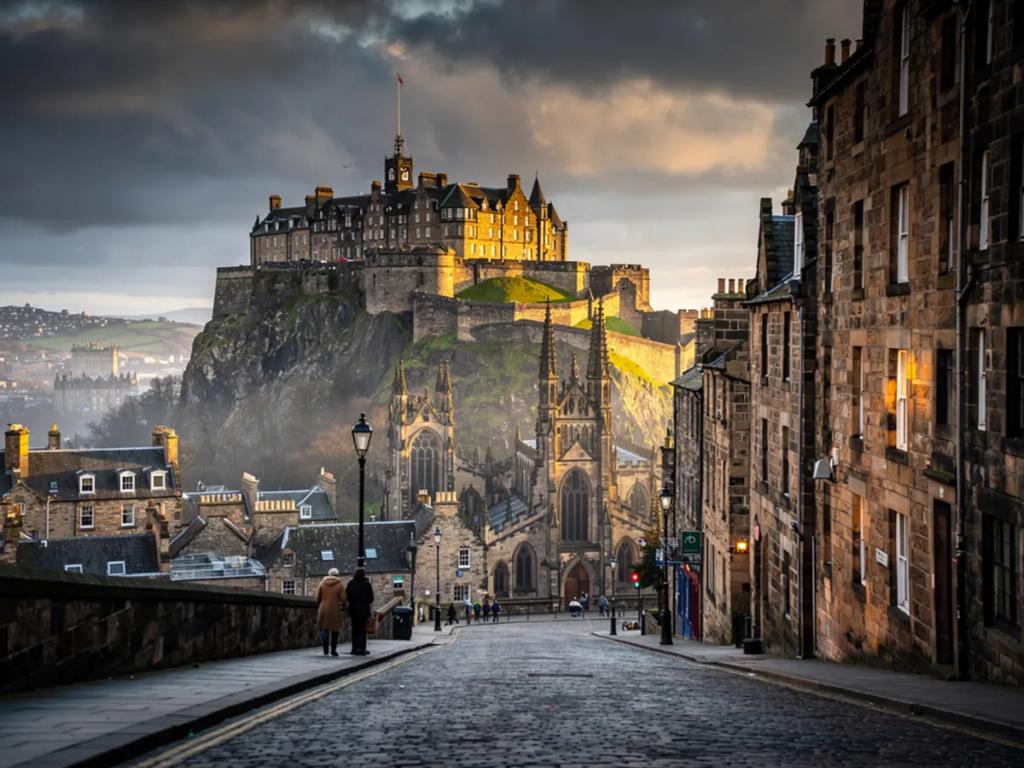
The castle shot that looks framed rather than snapped is from the Vennel steps, off the Grassmarket - the stone walls funnel your eye straight to the ramparts, best in late-afternoon light. Victoria Street's painted curve is Edinburgh's most photographed street, endlessly claimed as the inspiration for Harry Potter's Diagon Alley (J.K. Rowling has never confirmed it) - shoot from the terrace above for the full sweep. Calton Hill at sunset gives you the Dugald Stewart Monument with the castle and Princes Street glowing behind it, the classic postcard. Sunrise types should climb Arthur's Seat; everyone else gets their quiet storybook corner at Dean Village or the mews cottages of Circus Lane.
Edinburgh Castle sits on the plug of an extinct volcano - Castle Rock last erupted some 350 million years ago, and Arthur's Seat is another one. The city founded the world's first municipal fire brigade in 1824 under James Braidwood, weeks before the Great Fire of Edinburgh put it to the test. The One O'Clock Gun still fires from the castle daily except Sundays, a tradition from 1861 when ships in the Firth of Forth set their chronometers by it. And Greyfriars Bobby, the terrier who reputedly guarded his owner's grave for 14 years, has a statue whose nose visitors rub for luck - shiny proof of the habit, though the council would rather you didn't.
August is the main event: the Fringe is the world's largest arts festival, running alongside the Edinburgh International Festival and the Royal Edinburgh Military Tattoo - an extraordinary month, with the honest caveat that hotel prices roughly triple and rooms sell out months ahead. Hogmanay (29 December to 1 January) is among the world's biggest New Year celebrations, with a torchlight procession and a ticketed street party. The Royal Highland Show fills Ingliston with Scotland's farming best each June, and Six Nations rugby weekends in February and March flood the city with singing fans bound for Murrayfield.
The case for Edinburgh is strong: arguably the most dramatic cityscape in Britain (a castle on a volcano makes that claim defensible), a centre you can walk end to end, and festival-season energy that no other city its size can match. The case against is just as honest: in August the Old Town is saturated to the point that many locals simply leave town, the weather is a genuine roulette wheel in any month, the Royal Mile has become a gauntlet of near-identical tartan and whisky shops, and the hills and cobbles that make it beautiful are miserable with a wheeled suitcase. Come in May, June or September and the ledger tilts firmly towards love.
At street level, mostly yes with brief dips - the deep stone alleys can drop you to a bar or two until you reach open ground. The underground vaults and Mary King's Close have no signal at all, so save your tour tickets offline before descending.
No - a contactless card or phone is the ticket on both, with automatic daily and weekly fare capping, and on trams you tap on and off at the platform. The Lothian Buses app earns its download anyway for live tracking when the rain arrives sideways.
Patchily at best. Tours to Glencoe and beyond spend hours in glens with no coverage on any network, so download offline maps, tickets and entertainment before leaving the city. Installing and testing your eSIM before you travel means the city part, at least, just works.