Johannesburg runs on Vodacom, MTN, Cell C and Telkom, and your eSIM rides one of them as its host. South African networks are genuinely good - fast 4G across the whole conurbation, wide 5G in the northern suburbs, and better rural coverage than the size of the country suggests. The country's famous connectivity problem had nothing to do with the operators and everything to do with the power grid - and it is mostly, though not entirely, in the past.
This is the connectivity fact South Africa is known for, and the honest version in 2026 is that it has largely gone away. Most of what you will read online is out of date.
Load-shedding is the national rolling blackout, and it has been suspended. Eskom passed a full year with none at all in May 2026, the first such stretch since 2018, after 205 days of it in 2022 and 335 in 2023. The grid is genuinely in better shape.
Why it mattered for signal, and would again if it returned: base stations run on battery backup, typically holding a few hours. One outage is invisible. The second and third of the same day are not, because the batteries have had no time to recharge, so coverage degraded through the day rather than failing cleanly.
Battery theft from towers was what made that uneven, and it has not gone anywhere. It is still why two neighbouring suburbs can behave differently in any outage, planned or not.
Load reduction is a different thing and is still running. Where local networks are overloaded, Eskom cuts power in specific suburbs in the morning and evening peaks, roughly 05:00 to 09:00 and 17:00 to 22:00. It is targeted rather than national, it is not load-shedding, and it can still take your power out.
Locals still have the app. EskomSePush covers both, by area, and installing it on arrival costs nothing and settles the question for wherever you are staying.
The sensible precautions are cheap: carry a power bank, download maps offline, and do not run your phone to 15% on principle. Hotels and malls run generators or inverters, so their wifi generally survives anything.
This is the safety point that matters most for a visitor, and it is specifically about the device you are reading this on.
Do not sit at an intersection with your phone visible. Smash-and-grab at traffic lights - robots, locally - is the crime a visitor is most realistically exposed to, and a phone held up for navigation is the thing being watched for.
Mount it or mute it. A windscreen mount below the dash line, audio directions, and the route checked before you set off.
Keep windows up and doors locked in slow traffic, and leave a car's length in front of you so you can pull out.
In the daytime, in the northern suburbs and Sandton, walking is fine. Use ordinary city sense: phone away, bag closed, nothing loose.
At night, take a car, even for short distances. Nobody local walks after dark here, and following that norm is not paranoia.
Johannesburg's reputation runs ahead of the reality for most visitors, who have a completely uneventful trip. But the reputation exists for reasons, and the sensible precautions are cheap.
Johannesburg sits at 1,753 metres, higher than most European ski resorts, and visitors consistently fail to account for it.
You will sunburn faster. The UV at this altitude is severe even on a mild day, and "it was only 22 degrees" is not a defence.
You will dehydrate faster. The air is very dry. Drink considerably more than feels necessary.
You may be breathless on the first day or two, particularly if you arrive from sea level and go straight to a gym or a hike.
Alcohol hits harder, which every local will tell you and which is broadly true.
It is why the thunderstorms are so dramatic. Summer afternoons build enormous highveld storms that arrive around four, put on a spectacular display, and clear.
The city is very well covered, including the highways and the townships.
The Cradle of Humankind caves - Sterkfontein and Maropeng, about 50 km northwest - lose it underground, which is unsurprising given you are in a limestone cave system.
The Magaliesberg thins in the valleys.
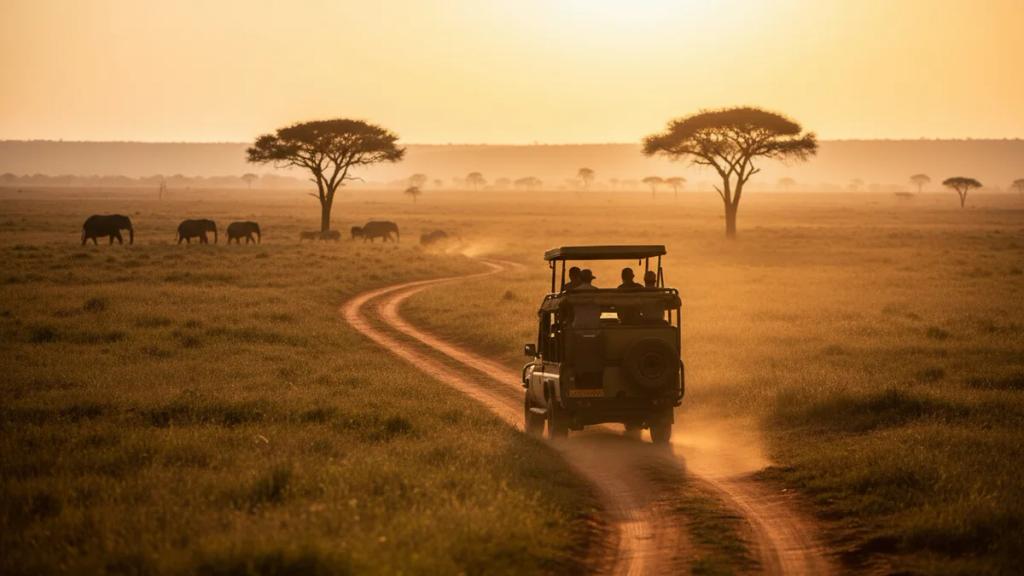
Game reserves vary. Pilanesberg, two hours away, has coverage around the gates and camps and much less in the middle. Kruger, four to five hours east, is patchy by design as much as by accident.
Some of the older CBD buildings are dead inside, and parts of the deep mine museum tours obviously are.
- Uber and Bolt, both of which operate extensively and are the standard way to move around. Having both is normal; prices differ.
- EskomSePush, which shows load-shedding and load reduction by area. Mostly quiet now, still worth having.
- Waze, which South Africans use heavily and which routes around both traffic and, usefully, some areas you would rather not idle in.
- The Gautrain app for the airport train and the Sandton-Pretoria line.
- Maps with offline copies for any trip out to the reserves.
- A translation app is unnecessary. English is one of twelve official languages and is universal in Johannesburg.
OR Tambo International (JNB) is about 25 km east of the centre and is the main gateway to southern Africa, consistently among the two or three busiest airports on the continent alongside Cairo and Addis Ababa.
The Gautrain is the best way in. It runs from inside the terminal to Sandton in around fifteen minutes, is clean, safe, punctual and inexpensive, and it bypasses the motorway traffic entirely. If you are staying in Sandton or Rosebank, take it.
Uber and Bolt work from the airport and are straightforward, with a designated pickup area.
Lanseria (HLA), northwest of the city, handles some domestic and low-cost traffic and is closer to the northern suburbs.
Once here, you need a car or you need ride-hailing. Johannesburg is enormously spread out, built for driving, and the distances between the places you want to visit are real. There is no walkable centre in the European sense, and that is a deliberate legacy of how the city was planned under apartheid rather than an accident.
More than you would think, because ride-hailing and navigation run constantly and the distances are long. Wifi is good in hotels, malls and cafes, and the bigger places run generators, so it stays up through a power cut. A middling to generous plan is the right call, especially if you are self-driving.
Layers, in every season. The daily swing here is large: a 6C winter morning becomes a 21C afternoon and drops again after sunset.
Winter nights are genuinely cold from May to August, and this is the trap, because South African buildings mostly have no central heating. An indoor jumper is not optional in July.
Serious sun protection all year. High altitude, low latitude, thin dry air.
A rain shell from October to March for the afternoon storm, which is brief and heavy.
Smart-casual works everywhere. Johannesburg dresses well and restaurants and bars in Sandton, Rosebank and Parkhurst are noticeably turned out.
Comfortable shoes, though you will walk less than in most cities.
The Nelson Mandela Bridge at dusk, with the skyline behind it.
Vilakazi Street in Soweto, the only street in the world to have housed two Nobel Peace Prize laureates - Mandela at number 8115 and Tutu a short walk away.
The Orlando Towers, the painted cooling towers in Soweto, where people bungee between them.
Constitution Hill, the old fort and prison that now holds the Constitutional Court, built partly from its bricks.
Maboneng and the inner-city murals, best on a Sunday when Market on Main is running.
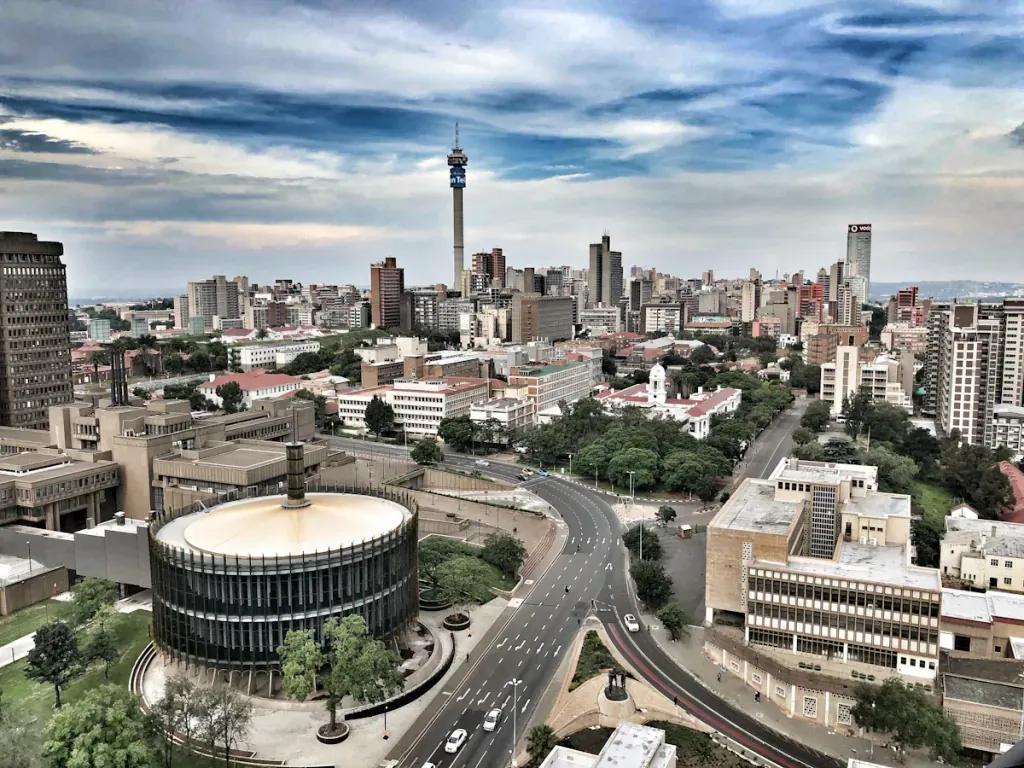
Ponte City, the cylindrical apartment tower with the hollow core, from a distance or on an organised tour.
The Cradle of Humankind landscape, and Maropeng's grass-covered visitor centre.
Jacaranda season in late October, when the northern suburbs turn purple. Pretoria gets the fame, but Johannesburg has plenty.
Johannesburg is one of the largest man-made forests on Earth. Around ten million trees were planted on what was open highveld grassland, and from a high vantage point in summer the city looks like woodland.
It was founded in 1886 because of gold, and the Witwatersrand reef went on to produce something in the order of 40% of all the gold ever mined on the planet.
It is one of the very few major world cities not built on a river, a lake or a coast. There was no reason for a city here except what was underground.
The Cradle of Humankind holds around 40% of the world's known human ancestor fossils, including Mrs Ples and Little Foot, and it is 45 minutes from Sandton.
The mine dumps - the pale yellow hills around the south of the city - are tailings from that gold rush, and some are being reprocessed with modern methods that recover what the Victorians could not.
And the city is called Jozi, Joburg and eGoli, the last meaning "place of gold" in isiZulu.
Standard Bank Joy of Jazz, in late September, one of the major jazz festivals on the continent.
Heritage Day, 24 September, which the country has enthusiastically repurposed as National Braai Day. Being invited to one is the best thing that can happen to you here.
The Rand Show over Easter, a long-running exhibition and funfair.
Africa Day, 25 May, marked across the city.
Jacaranda bloom in late October, which is not an event but arranges everyone's photographs for a fortnight.
Summer, October to March, is warm, green and stormy; winter, May to August, is dry, sunny, dusty and cold at night, and is the best time for game viewing because the bush thins out and animals come to the water.
The love: Johannesburg is the most energetic city in southern Africa and the one where the country's history is most legible. The Apartheid Museum and Constitution Hill are world-class and genuinely difficult; Soweto is not a slum tour but a large, ordinary, proud place with excellent food; the restaurant and music scenes are strong; the weather is superb; and it is startlingly good value. It is also the gateway to the Cradle of Humankind, the Kruger and Cape Town.
The complaints are consistent. It is not beautiful, and it makes no attempt to be. You cannot walk it, which visitors from dense European cities find genuinely disorienting. The crime reputation puts people on edge whether or not anything happens. The inequality is visible and stark, from the highway if nowhere else. Everything requires a car and a plan. And the sprawl means an hour of driving to do two things.
Give it three days rather than treating it as an airport, do the Apartheid Museum early in the trip rather than late, take the Gautrain in from the airport, and get someone to take you to a braai.
Largely not any more. Load-shedding has been suspended, and Eskom reached a full year without any in May 2026. When it was running, towers held on battery for a few hours, so a single outage was invisible while repeated ones in a day drained the batteries and thinned coverage. Two things survive: tower battery theft, which still makes outages uneven between suburbs, and load reduction, a separate and targeted measure that still cuts power in overloaded suburbs around 05:00-09:00 and 17:00-22:00. EskomSePush covers both.
In daylight in Sandton, Rosebank and the northern suburbs, yes, with normal city sense. The specific risk to avoid is holding a phone visibly in a car at traffic lights, which is what smash-and-grab targets. Mount it and use audio directions. After dark, travel by car rather than on foot.
Effectively yes, or Uber and Bolt, which are widespread and inexpensive. The city has no walkable centre and the distances are long. The Gautrain is excellent for the airport, Sandton and Pretoria, but it covers only that corridor.
Possibly, for a day or two. Johannesburg is at 1,753m, so expect faster sunburn, faster dehydration, some breathlessness on exertion and alcohol hitting harder than usual. Drink more water than you think you need and take the sun seriously even when it feels mild.