AIS, TrueMove and dtac cover Krabi province, and your eSIM will use one of them. Our Bangkok, Phuket, Koh Samui and Pattaya guides cover Thai networks, ride-hailing, scooter safety and the country's two opposing monsoon seasons. Krabi's own defining fact is geological: the limestone here comes down to the water in vertical cliffs, and one of the places you are most likely to stay has no road to it at all.
This is the thing to understand before booking, and it is not a quirk - it is the whole character of the place.
Railay is a peninsula, not an island, but the limestone karsts behind it are sheer and unbroken, and no road has ever been built through them.
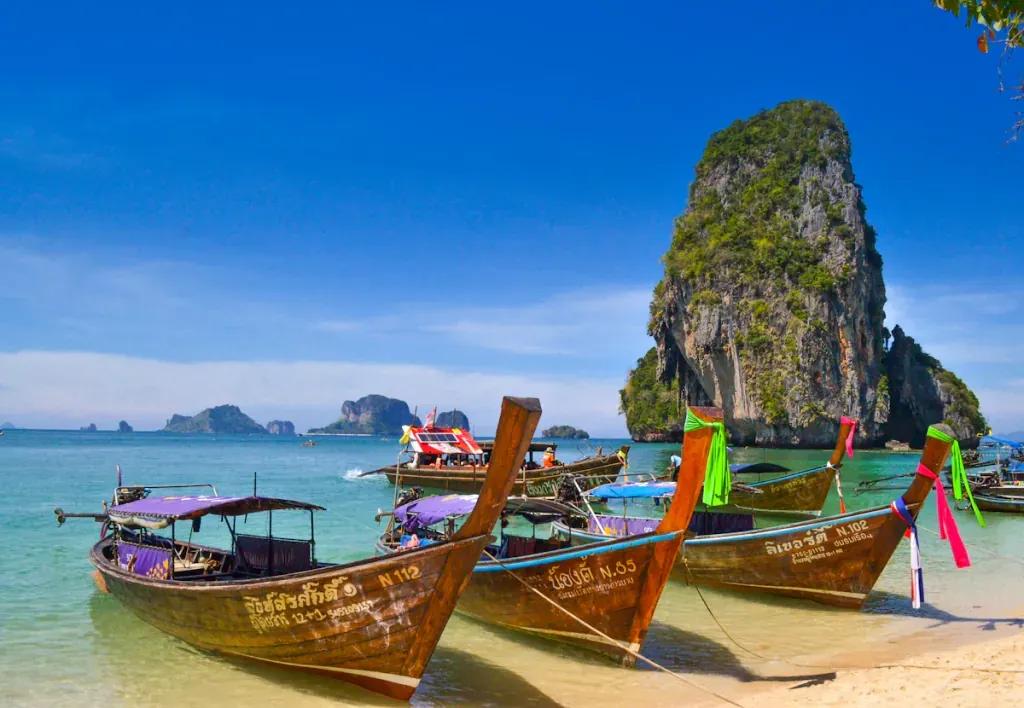
You get there by longtail boat. From Ao Nang beach, or from Krabi Town's Khong Kha pier, in about ten to fifteen minutes.
Boats go when they are full. The standard arrangement is eight passengers; if there are fewer, you wait or you pay for the empty seats. Late at night this becomes expensive.
Tides matter. At low tide, boats cannot reach some beaches directly and you wade the last stretch - fine with a daypack, less fine with a suitcase and a laptop bag.
The last boats are early. Crossings thin out after dark and stop entirely at some point in the evening depending on operator and conditions. If you are staying on Railay and eating in Ao Nang, know when the last boat is.
Services are limited. There are ATMs but few, prices are higher than the mainland because everything arrives by boat, and there is no hospital - a medical problem means a boat to the mainland first.
Which is also the appeal. No cars, no scooters, no through traffic. The quiet on Railay after the day-trippers leave is the reason people stay.
East and West Railay are different. West has the good beach and the sunsets; East is mangrove and mudflat at low tide, and cheaper. They are five minutes apart on foot.
Tonsai, next door, is the climbers' beach - rougher, cheaper, and reached by a scramble over rocks at low tide or another boat.
Krabi is one of the world's major sport climbing destinations, and Railay and Tonsai are the reason.
The limestone is exceptional - steep, featured, pocketed, and rising straight out of the sea.
There are hundreds of bolted routes across every grade, and the schools on Railay will take complete beginners out for a half day.
Deep water soloing is the local speciality: climbing unroped above the sea from a longtail boat, and falling into it. It is as good as it sounds and the operators are experienced.
Bring or rent shoes; everything else is provided by the schools.
Check your insurance. Many travel policies exclude rock climbing, or cover it only with a supplement. This is worth doing before you go rather than after.
Worth repeating because Thailand advice constantly conflates the two coasts.
Krabi is on the Andaman side, along with Phuket.
Its wet season runs roughly May to October, with September and October the heaviest.
The Gulf islands - Samui, Phangan, Tao - are wettest October to December. Our Koh Samui guide covers that inversion in detail.
So a July trip should probably go to the Gulf, and a November trip to the Andaman.
In the wet months here, boat trips to the outer islands are cancelled regularly, and the sea gets rough enough that Phi Phi and Hong Island days simply do not run.
High season is November to April, dry and busy, with prices to match.
Ao Nang and Krabi Town are well covered.
Railay has coverage on the beaches and in the resorts, and it goes patchy right against the cliffs - the karsts throw substantial shadows.
On the longtail crossings, service holds most of the way.
The outer islands - Phi Phi, Hong, Bamboo, Poda - have coverage that varies from decent near the villages to nothing at the anchorages.
Inside the caves and lagoons, including Hong's enclosed lagoon, nothing.
The interior - the Tiger Cave Temple, the Emerald Pool, Khao Phanom Bencha - thins in the jungle and the valleys.
On a climbing route, obviously nothing, and your phone should be at the base anyway.
Ao Nang is the main resort strip - restaurants, shops, dive centres, road access, and the boat pier for everything. Convenient rather than beautiful.
Railay is the postcard, quiet and car-free, and requires the boat logistics above.
Krabi Town is a real Thai provincial town on the river, cheap, with a good night market and almost no beach - a genuine option if you want the province rather than the resort.
Klong Muang and Tubkaek, north of Ao Nang, are quieter beach strips with the bigger resorts.
Koh Lanta, two hours south including a ferry, is a long, calm island with a very different pace, and it is where a lot of returning visitors end up.
Phi Phi is in Krabi province, though most people reach it from Phuket. Note that Maya Bay's access has been restricted and periodically closed to allow recovery - check the current position before booking a trip that promises it.
- Grab, which operates in Ao Nang and Krabi Town and removes the fare negotiation.
- A ferry and boat operator app, for the island transfers and the Lanta crossings.
- A tide table, which genuinely matters here - for Railay's boats, for the Tonsai scramble and for the lagoons.
- Maps with offline copies for the interior.
- A translation app. English is widely spoken in Ao Nang, less so in Krabi Town and the villages.
Krabi International (KBV) is about 15 km from Krabi Town and 25 from Ao Nang, with direct flights from Bangkok and a growing list of regional and seasonal international routes.
Phuket International is the alternative, around three hours by road including the bridge, and often better connected.
Airport buses and minivans run to Ao Nang and Krabi Town; Grab and taxis also work.
Ferries connect to Phi Phi, Koh Lanta and Phuket in high season, with reduced services in the wet months.
For Railay, take a taxi or bus to Ao Nang and a longtail from the beach - there is no way to be driven to your hotel.
Modest. Resort and cafe wifi is good, and Thai data is inexpensive. What earns its keep here is tide tables, boat schedules and weather - all of which you will check daily, and all of which matter more than usual because the transport is maritime.
Beach clothing, with shoulders and knees covered for temples - the Tiger Cave Temple in particular.
Proper footwear you can get wet. You will wade to and from boats, and the Tonsai scramble is over sharp rock.
Climbing shoes if you climb, though rental is easy.
A rain shell from May to October.
Modest cover in Krabi Town, which is a working Thai town with a substantial Muslim population, not a resort.
Serious sun protection, and a rash vest for long boat days.
Railay West beach at sunset, with the karsts on both sides and longtails on the sand.
Phra Nang cave beach, generally rated among the most beautiful beaches in Thailand, with its stalactites coming down to the sand.
The view from the Railay viewpoint, a steep, muddy, rope-assisted scramble that is genuinely hard work and entirely worth it.
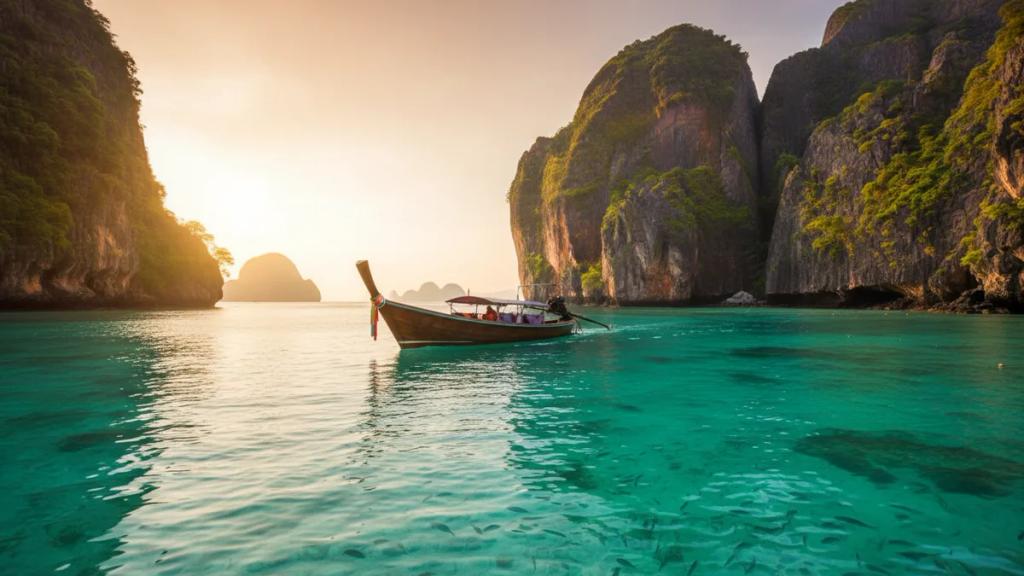
Hong Island's lagoon, enclosed by cliffs, at high tide.
Tiger Cave Temple, after climbing all 1,260-odd steps to the summit Buddha - go at dawn before the heat.
Deep water soloing, photographed from the boat.
Ao Thalane's mangroves, by kayak, which is the quiet alternative to the island day trips.
Koh Lanta's west coast at sunset.
Railay is a peninsula that behaves like an island, cut off by limestone cliffs that have never been roaded through - which is why it has no cars at all.
The karst towers are ancient reef, limestone laid down hundreds of millions of years ago and since uplifted and eroded into the shapes you see.
Phra Nang cave holds a shrine of carved wooden phalluses, offerings to a princess spirit believed to bring fertility and good fortune to fishermen. It is entirely sincere and slightly startling on a beach.
Deep water soloing was popularised here, and Thailand's Andaman coast is one of the sport's global home grounds.
Maya Bay was closed for years to let its reef recover after the damage caused by its fame, and access remains managed - a rare case of a destination successfully limiting itself.
And the Tiger Cave Temple's staircase has over 1,200 steps, is brutally steep, and is climbed daily by people considerably fitter than they look.
High season, November to April, which is dry, sunny and busy.
Songkran, in April, the Thai new year water festival.
Loy Krathong, in November.
Ramadan, which is observed by a substantial part of Krabi province's population - worth being aware of in the towns and villages rather than the resorts.
The wet season, May to October, when prices drop, the landscape is at its greenest and the boat trips become unreliable.
The love: Krabi has the most dramatic coastal scenery in Thailand, and Railay in particular is genuinely extraordinary - a car-free beach ringed by three-hundred-metre cliffs. The climbing is world-class, the island trips are superb, Phra Nang deserves its reputation, and the province is cheaper and less developed than Phuket across the water. Koh Lanta is an hour or two away for anyone who wants to slow down further.
The complaints are consistent. Ao Nang is an ordinary resort strip and the beach there is not why you came. Railay's boat logistics frustrate people who did not plan for them, particularly with luggage or after dark. The day-trip crowds at Phi Phi and Hong are substantial in season. The wet season genuinely disrupts the boat trips that are the point of the province. And prices on Railay are noticeably higher because everything arrives by longtail.
Come between November and March, stay on Railay for at least two nights to see it after the day boats leave, check the tide before booking a late dinner on the mainland, and climb the viewpoint early.
By longtail boat only - there is no road, because the limestone cliffs behind it have never been cut through. Boats run from Ao Nang beach and Krabi Town's pier and leave when they have eight passengers, so you either wait or pay for the empty seats. Crossings thin out after dark, so find out when the last boat is before planning an evening on the mainland.
Yes on the beaches and in the resorts, and it goes patchy hard against the cliffs, which throw substantial shadows. The outer islands vary from usable to nothing, and the enclosed lagoons have none. Download offline maps and a tide table.
November to April, which is the dry season on the Andaman coast. Note that this is the opposite of the Gulf islands - Samui, Phangan and Tao are wettest October to December. Our Koh Samui guide explains the inversion, which most Thailand advice gets wrong.
Quite possibly. Many travel policies exclude rock climbing or require a supplement, and Krabi is one of the world's major climbing destinations, so a lot of visitors do it on impulse. Check the wording before you go, not after.