Mumbai runs on Jio, Airtel and Vi, and your eSIM rides one of them. Coverage across the peninsula is dense and quick, and the tariffs here are famously low. The paperwork side of Indian connectivity - local SIMs, UPI - is set out in our Pune guide, and a travel eSIM sidesteps all of it. What this guide is about is the two forces that actually govern a day in this city: a suburban railway carrying more people than some countries have, and four months a year when the sky empties onto it.
Mumbai's suburban rail carries in the region of seven and a half million passengers a day, on three main lines - Western, Central and Harbour - running the length of a city built on a narrow peninsula.
Nothing else moves this many people here. Roads cannot; the metro is expanding fast and does not yet substitute for it.
The peak-hour crush is genuinely extreme, to the point that railway engineers have a term for it. People travel in doorways. This is normal and it is also how people are injured and killed on this network every year, in numbers that would be a national scandal anywhere else.
As a visitor, ride it off-peak. Between about 11am and 4pm it is busy but civilised, and it is the single best way to understand the city.
Buy a first-class ticket. It costs a few times second class, which is still almost nothing, and the difference in crowding is substantial.
Use the ladies' compartments if you are a woman. They exist for good reason, they are clearly marked, and they are considerably more comfortable.
Keep your phone deep in a front pocket or a zipped bag. Phones are lost and taken in the crush constantly - not usually by pickpockets so much as by the sheer physics of boarding. Do not stand in a doorway holding one.
The Metro is the calmer alternative where it goes, including the newer underground line, and it is air-conditioned and signposted in English.
Four months of the year, Mumbai's weather is the single biggest variable in any plan.
The monsoon runs roughly June to September, and the volume is difficult to convey - the city can take a month of British rainfall in a day.
On 26 July 2005 Mumbai received around 944 mm in twenty-four hours. The city stopped: trains halted, the airport closed, hundreds died. It is the reference point everyone here uses.
Ordinary heavy days flood predictably. Low-lying junctions go under, the same ones each year, and when water reaches the tracks the local trains stop - which means the city stops.
Do not schedule tightly in monsoon. A flight out on a heavy afternoon is a genuine risk; the road to the airport floods, and so does the airport approach.
Build in a buffer, keep an eye on the forecast, and treat a red warning as a day to stay put rather than push through.
And it is wonderful when it breaks. The first rains after the heat are a citywide event, the air changes completely, and the coast turns green. People who come in July on purpose are not mad.
The city is very well covered, including the trains and the metro.
Network congestion is the real failure, not absence. In a city of over twenty million, cells saturate at peak times, at events, and along the rail corridors at rush hour. Full bars and no throughput is the normal Mumbai experience of a bad moment.
The Elephanta Caves, an hour by ferry across the harbour, are patchy - the caves themselves are cut into rock and have nothing.
On the harbour ferries it comes and goes.
In the older stone buildings of Fort and Colaba, indoor signal is weaker than the coverage map suggests.
During monsoon, heavy rain degrades service and power cuts affect local infrastructure. This is when offline maps earn their place.
Mumbai is India's most expensive city, and visitors used to Indian prices elsewhere are surprised - hotels in particular are priced closer to international levels.
Cards work widely in restaurants, hotels and shops. UPI dominates local payments and generally needs an Indian bank account.
Cash for the small things - trains, taxis without apps, street food, markets.
Uber and Ola both operate, and black-and-yellow taxis still run on metres in the older parts of the city, which is increasingly rare in India.
Autos do not run south of Bandra. In the island city - Colaba, Fort, Marine Drive - it is taxis, trains, metro or walking. This surprises people constantly.
- Uber and Ola, plus Rapido for motorbikes in the suburbs.
- m-Indicator, which is the local rail app everybody in Mumbai actually uses - timetables, platforms and live status for all three lines.
- Maps with offline copies, especially in monsoon.
- Zomato or Swiggy, because Mumbai's food delivery is extraordinary and cheap.
- A translation app is rarely needed. English is widely spoken across the city; Hindi and Marathi are the local languages.
Chhatrapati Shivaji Maharaj International (BOM) is about 25 km north of the island city, with Terminal 2 handling international traffic and being genuinely impressive.
Uber and Ola work from designated zones; prepaid taxis are the alternative.
Budget an hour to ninety minutes to Colaba or Fort in normal traffic, and considerably more in rain or peak. The Coastal Road and Sea Link have improved this significantly but not solved it.
Most nationalities need a visa; India's e-visa is the usual route and should be arranged well ahead.
Be generous. Ride apps, m-Indicator, maps and delivery run continuously, and through the monsoon you will be refreshing conditions all day. Hotel wifi is reliable. Tariffs here make a large allowance almost free, so the only thing a small plan buys you is anxiety.
Light, breathable, modest. Mumbai is the most liberal major Indian city and dress is noticeably relaxed by national standards, but shoulders and knees covered remains the sensible default outside Colaba and Bandra.
Sandals you can wade in during monsoon, and shoes you accept will get ruined. Locals change footwear at the office.
A compact umbrella and a rain shell, June to September - and expect both to lose.
A layer for indoors, where air conditioning is set very cold.
Something smarter for the evening. Mumbai goes out, and the bars and restaurants in Colaba, Lower Parel and Bandra are dressed.
Marine Drive at night, the curve of lamps along the bay that gives it the name Queen's Necklace, from the Chowpatty end.
Chhatrapati Shivaji Maharaj Terminus, the UNESCO-listed Victorian Gothic railway station, lit after dark - and it is a working station carrying those millions.
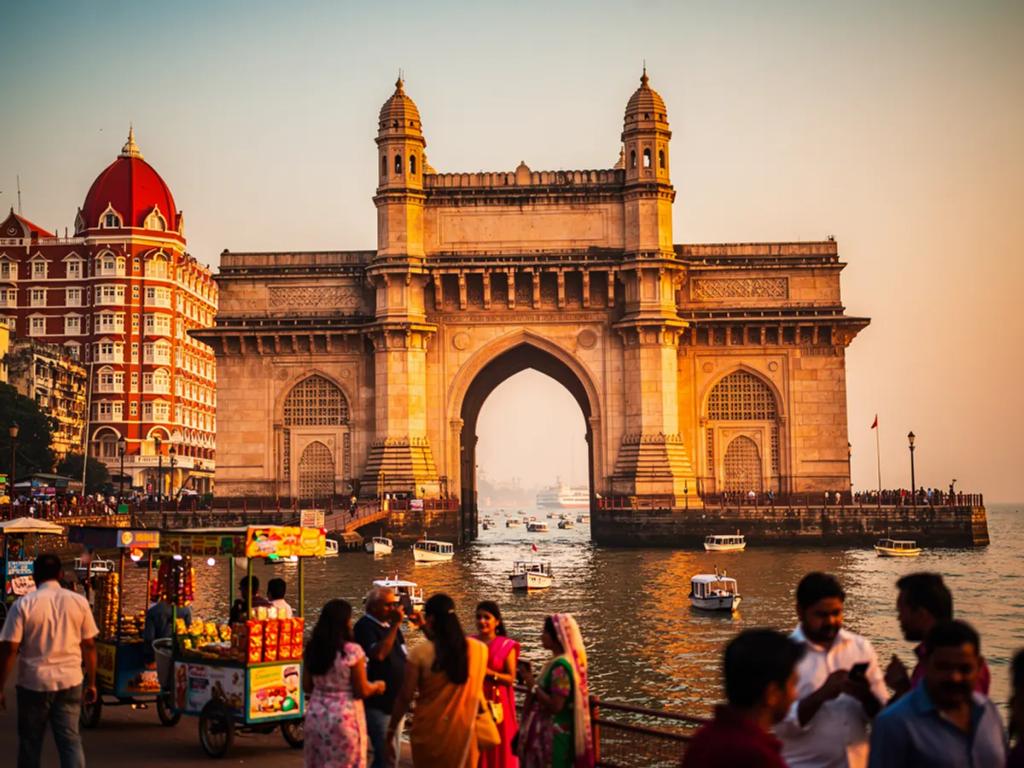
The Gateway of India at dawn, before the crowds, with the Taj Mahal Palace hotel beside it.
Dhobi Ghat, the open-air laundry, from the bridge at Mahalaxmi.
Banganga Tank, an ancient stepped water tank hidden in Malabar Hill, which almost no visitor finds.
Elephanta Caves, an hour by ferry, for the rock-cut Shiva sculptures.
The Art Deco buildings along Oval Maidan, which with the Gothic ensemble opposite form a UNESCO World Heritage Site.
Bandra's sea-facing promenade at sunset, and the street art in Chapel Road.
Mumbai was seven islands. They were joined by centuries of land reclamation, which is why the city is the shape it is and why parts of it flood the way they do.
It has the second-largest collection of Art Deco buildings in the world, after Miami, most of it along Marine Drive and the Oval Maidan - and it sits directly opposite a Victorian Gothic ensemble, which is why UNESCO listed the two together.
The dabbawalas deliver around 200,000 lunchboxes a day, from homes to offices and back, largely without written addresses and with an error rate so low it has been studied at business schools.
Chhatrapati Shivaji Maharaj Terminus is a UNESCO site that is also a commuter station, which is a strange combination to stand inside at eight in the morning.
Dharavi is one of the most densely populated places on earth and also a functioning industrial economy, with recycling, leather and pottery businesses turning over an enormous amount annually.
And Bollywood makes more films a year than Hollywood, most of them here, and the industry's presence in the city is impossible to miss.
Ganesh Chaturthi, in August or September, which is Mumbai's defining festival - eleven days, idols in every neighbourhood, and immersion processions to Girgaon Chowpatty that bring the city to a standstill. It is extraordinary and it is not a quiet time to visit.
Diwali, in October or November.
The Kala Ghoda Arts Festival, in February, a free street arts festival in the Fort district.
The Mumbai Marathon, in January.
November to February is the season - dry, cooler and comfortable. March to May is hot and humid. June to September is monsoon.
The love: Mumbai is the most energetic and most cosmopolitan city in India, and it works in a way that surprises people. The architecture is remarkable and largely unvisited - Victorian Gothic and Art Deco facing each other across a maidan. The food runs from street vada pav to some of the best restaurants in Asia. It is safer for women than most Indian cities and considerably more relaxed socially. And it has a self-belief and a pace that people either find electrifying or exhausting.
The complaints are consistent. The crowds are relentless and the trains are genuinely intense. The monsoon removes four months from the calendar for most visitors. It is expensive by Indian standards, especially hotels. The air quality in winter is poor. The traffic eats hours. And the inequality is visible everywhere, from the Antilia tower to the settlements beneath it, which some visitors find impossible to sit with.
Come between November and February, ride a local train at midday in first class, walk the Art Deco stretch of Marine Drive, and take the early ferry to Elephanta.
Yes, along the whole network, and the metro too. The problem at rush hour is congestion rather than coverage - cells saturate and you get full bars with nothing moving. The practical risk on the trains is your phone rather than your signal: keep it in a zipped pocket and do not stand in a doorway with it out.
For a short visit, no. Foreign visitors face a real bureaucratic obstacle course to obtain one, which our Pune guide documents along with the illegal workarounds touts offer. Prices are low whichever route you take, so the eSIM wins on hassle rather than cost.
Badly, on the worst days. Heavy rain floods the same low junctions each year, and when water reaches the tracks the suburban trains stop - which stops the city. The road to the airport floods too. Between June and September, build real slack around flights and treat a red warning as a day to stay put.
No - autos are not permitted south of Bandra, so in Colaba, Fort and along Marine Drive you use taxis, trains, the metro or your feet. The old black-and-yellow taxis there still run on metres, which is increasingly unusual in India.