AIS, TrueMove and dtac cover Pattaya, and your eSIM will use one of them. Coverage along the whole eastern seaboard is strong and Thai data is cheap - our Bangkok, Phuket and Koh Samui guides cover the country's networks, ride-hailing and the regional weather split. What makes Pattaya different from any of those is its distance from the capital, which is under two hours, and that single fact shapes everything about how the place works.
Pattaya is about 150 km from Bangkok and roughly 90 minutes to two hours by road on the motorway.
Which means it is a weekend city, not a holiday island. Thais come down from Bangkok on Friday and go back on Sunday, and the whole place changes character with the week.
Midweek is quiet and cheap. Weekends are busy, and hotel rates move accordingly - the opposite pattern from island destinations where the season matters more than the day.
It is genuinely day-trippable, which almost nowhere else on this list is. If your trip is Bangkok-based, Pattaya is a viable overnight or even a long day.
No flight required. Buses run constantly from Bangkok's Ekkamai and Mo Chit terminals and from Suvarnabhumi airport directly, and minivans go door to door. This makes it dramatically cheaper to reach than Samui or Phuket - see our Koh Samui guide for what those flights cost.
U-Tapao airport is 40 minutes south and takes some domestic and regional flights, but most visitors come by road.
And it is the eastern seaboard's centre, surrounded by Thailand's industrial corridor - which is why the city is larger, more built-up and more workaday than a resort of its beach quality would otherwise be.
Worth addressing directly rather than tiptoeing around, because it is the first thing anyone says about Pattaya.
The city has a well-known sex tourism industry, concentrated in specific areas - Walking Street, parts of Beach Road and the surrounding sois - and it is visible rather than hidden.
It is also a large ordinary city of over a hundred thousand residents, with families, schools, malls and a substantial expatriate retirement community.
And the two are geographically separable. Jomtien, south of the centre, is a long quiet beach with family hotels and condominiums. Naklua, to the north, is quieter still and more residential. Wong Amat is the upmarket end.
Central Pattaya at night is the part people mean. If that is not what you came for, stay in Jomtien or Naklua and you will barely encounter it.
Book deliberately. More than anywhere else in this series, where you sleep in Pattaya determines what holiday you have, and the distance between those experiences is about three kilometres.
Be aware of the surrounding issues. Where a sex industry operates at this scale, exploitation and trafficking exist alongside it. Thai law on underage involvement is enforced and foreign nationals are prosecuted, and several countries prosecute their own citizens for offences committed abroad.
The city and the coast road are comprehensively covered.
Koh Larn, the island 40 minutes offshore by ferry, has coverage in the village and along the main beaches and thins around the headlands.
On the ferries and speedboats, service holds most of the way across.
Khao Chi Chan and the inland attractions are fine on the roads.
Khao Yai National Park, several hours north, is a genuine gap - but that is a different trip.
The islands further out towards Koh Samet, two hours east, are covered around the resorts.
Coverage is genuinely not a problem on this coast. The eastern seaboard is Thailand's industrial heartland and the infrastructure reflects that.
Songthaews here are called baht buses, and they run fixed loops around the city.
Flag one down, ring the bell to stop, pay at the window - a flat fare for a standard hop along the main routes, and considerably more if you charter one privately.
Confirm whether you are joining a route or hiring the vehicle before you get in. This is where visitors overpay, because a driver may quote a charter price for what you assumed was a shared ride.
Grab and Bolt both operate and remove the question entirely.
Motorbike taxis in orange vests do short hops.
Scooter rental is widespread and dangerous. As on Samui, most travel insurance is void without a licence covering motorcycles, and Thailand's road casualty rate is among the world's highest. Rent only if you genuinely ride.
Walking is viable along the beach road and unpleasant elsewhere - pavements are inconsistent and the heat is constant.
- Grab and Bolt, both of which work well and are inexpensive.
- Maps, though the city is a simple grid of numbered sois between the beach and Sukhumvit Road.
- A ferry timetable for Koh Larn, which runs to a schedule and fills at weekends.
- A translation app. English is widely spoken in the tourist areas - more than in most Thai cities - and Russian, Chinese and Korean signage is common too.
- Nothing special for payments. Cards work in hotels and malls; cash and QR elsewhere.
Suvarnabhumi (BKK) is the usual gateway, with direct buses to Pattaya taking about two hours and running frequently.
Don Mueang (DMK) also connects by bus.
U-Tapao (UTP) is 40 minutes south and takes some domestic and regional services.
Minivans and private transfers run door to door and are cheap by international standards.
By train there is a slow service from Bangkok that takes considerably longer than the bus and is worth doing once for the experience rather than the speed.
Modest. Hotel and cafe wifi is good and widespread, the city is compact, and Thai data is inexpensive. Grab and maps are the main uses. There is no coverage problem here to plan around.
Beach clothing at the beach, and shorts and a shirt everywhere else - Pattaya is about as informal as Thailand gets.
Covered shoulders and knees for temples, including the Sanctuary of Truth and Wat Phra Yai.
A rain layer from June to October, for the afternoon downpour.
Serious sun protection, and reef shoes for Koh Larn's rockier ends.
Something smarter for the better restaurants in Naklua and on the Wong Amat end, which are genuinely good.
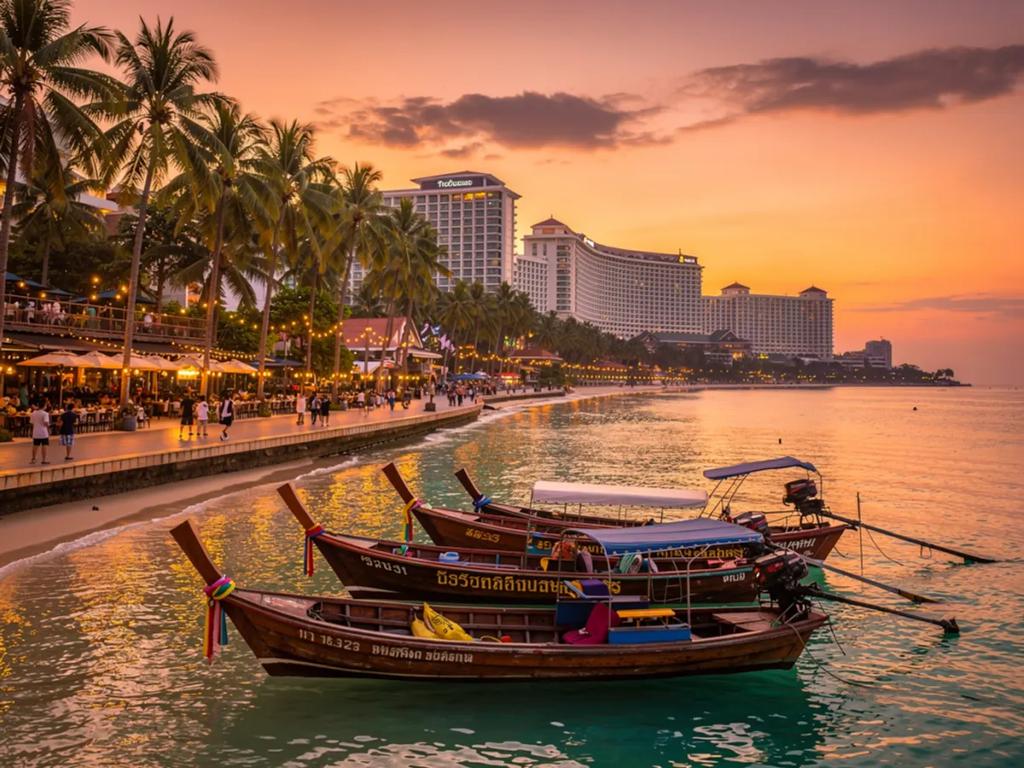
Pattaya Bay from the Pratumnak viewpoint, the classic curve of the bay with the city behind, best at dusk.
The Sanctuary of Truth, an enormous all-wooden temple on the headland at Naklua, carved entirely without nails and still unfinished after decades. It is genuinely extraordinary and the single best thing in Pattaya.
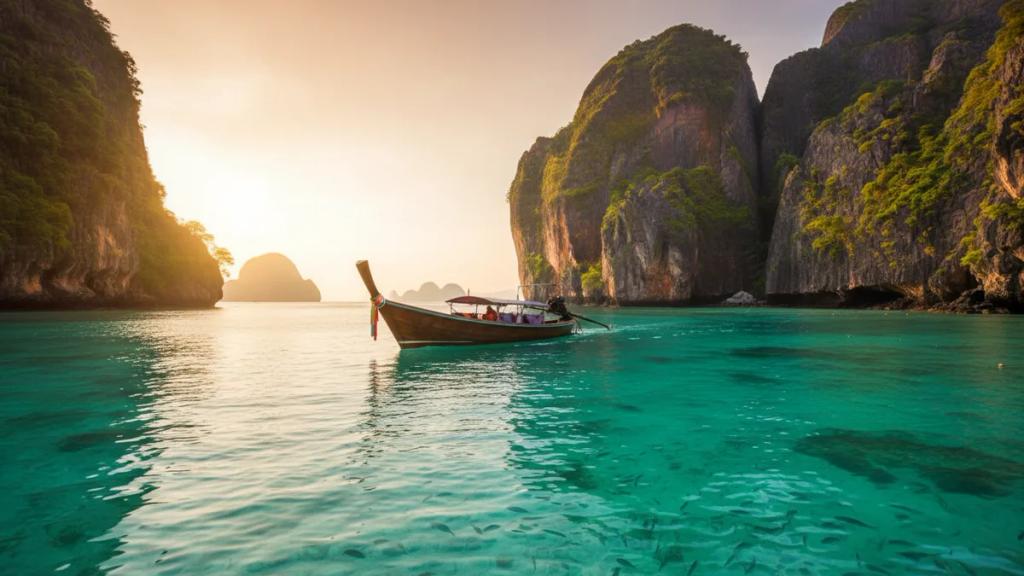
Koh Larn's beaches, especially Samae and Tien, which have the clear water the mainland beach does not.
Wat Phra Yai, the Big Buddha on the hill, at sunrise.
Khao Chi Chan, the Buddha Mountain - a 130-metre image laser-cut into a cliff face and inlaid with gold.
Nong Nooch tropical garden, which is far better than it sounds.
Jomtien beach at sunset, looking north to the high-rises.
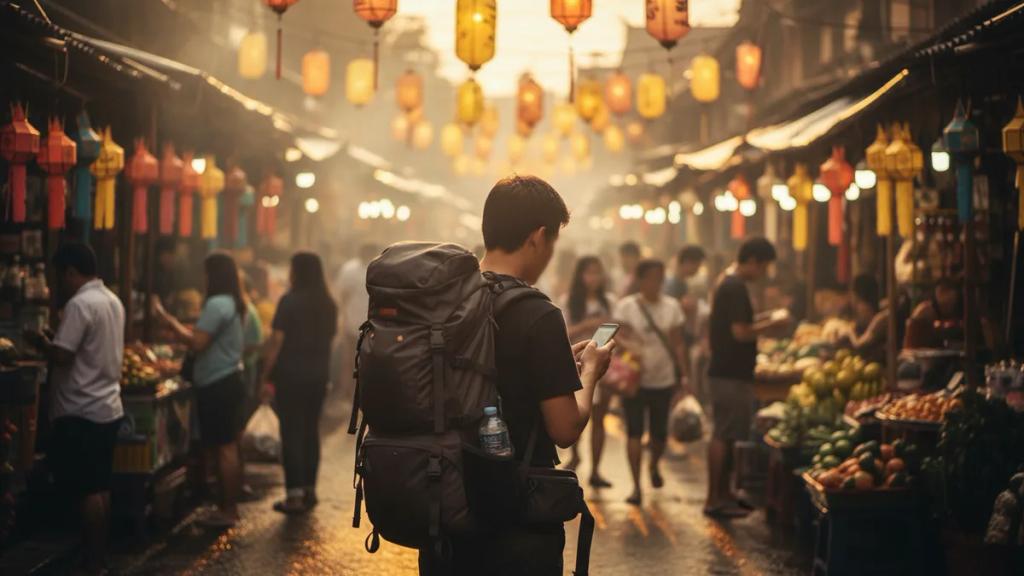
The floating market, touristy and photogenic in equal measure.
Pattaya was a fishing village until the 1960s, when American servicemen on leave from Vietnam began coming down from the Korat and U-Tapao bases. The city that exists now grew from that.
The Sanctuary of Truth has been under construction since 1981 and is built entirely of teak, carved by hand, with no nails - and it is still not finished. That is part of the design philosophy.
Koh Larn means Coral Island, and it is where Pattaya's own beach quality goes to be redeemed - the water there is genuinely clear.
U-Tapao was a major US airbase during the Vietnam War and is now being developed as the third airport for the Bangkok region.
Khao Chi Chan's Buddha was cut into the cliff by laser in the 1990s to mark the king's golden jubilee, and it is 130 metres tall.
And Pattaya has one of the largest expatriate retirement populations in Asia, which is a side of the city that visitors rarely see and residents talk about constantly.
Songkran, in April - and Pattaya's runs longer than anywhere else in Thailand, with Wan Lai in mid-April extending the water fighting for days after the rest of the country has stopped.
Loy Krathong, in November.
The Pattaya International Music Festival, in spring, free and on the beach.
Chinese New Year, which fills the city.
November to February is the dry, comfortable season. March to May is very hot. June to October brings afternoon rain but is far from a washout, and the eastern seaboard is drier than the Andaman coast in those months.
The love: Pattaya is easy and cheap in ways the islands are not. You can be here from Bangkok in two hours without a flight, hotel quality per baht is excellent, the food is superb across every cuisine, Koh Larn provides the clear water, and the Sanctuary of Truth is a genuinely world-class piece of work. Jomtien and Naklua are pleasant, low-key beach neighbourhoods that have nothing to do with the city's reputation.
The complaints are consistent and largely fair. The main beach is mediocre - the water in the bay is not what you flew for, which is why Koh Larn exists. The city is built-up and traffic-heavy, more urban than resort. The reputation is earned in the central strip, and visitors who did not want to see it will see it if they stay there. It is not scenic in the way southern Thailand is. And some travellers simply do not want to be here, which is a legitimate position and easily accommodated by going somewhere else.
Come midweek, stay in Jomtien or Naklua, take the ferry to Koh Larn for the swimming, and give the Sanctuary of Truth an unhurried afternoon.
By road, in about two hours. Buses run frequently from Ekkamai and Mo Chit terminals and directly from Suvarnabhumi airport, and minivans go door to door. No flight is needed, which makes Pattaya dramatically cheaper to reach than Samui or Phuket.
Jomtien to the south, or Naklua and Wong Amat to the north. Central Pattaya after dark is the part the city is known for, and it is geographically confined - the difference between a family beach holiday and the other thing is about three kilometres. Book deliberately.
A songthaew running a fixed loop - flag it down, ring the bell to stop, pay at the window. A standard hop along the main routes is a small flat fare. Confirm you are joining the route rather than chartering the vehicle before getting in, because that is where visitors overpay. Grab and Bolt both work and remove the question.
Not in Pattaya Bay itself, which is the honest answer. Take the 40-minute ferry to Koh Larn, where the water is genuinely clear and the beaches are what you came for. Jomtien is better than central Pattaya but still not island quality.