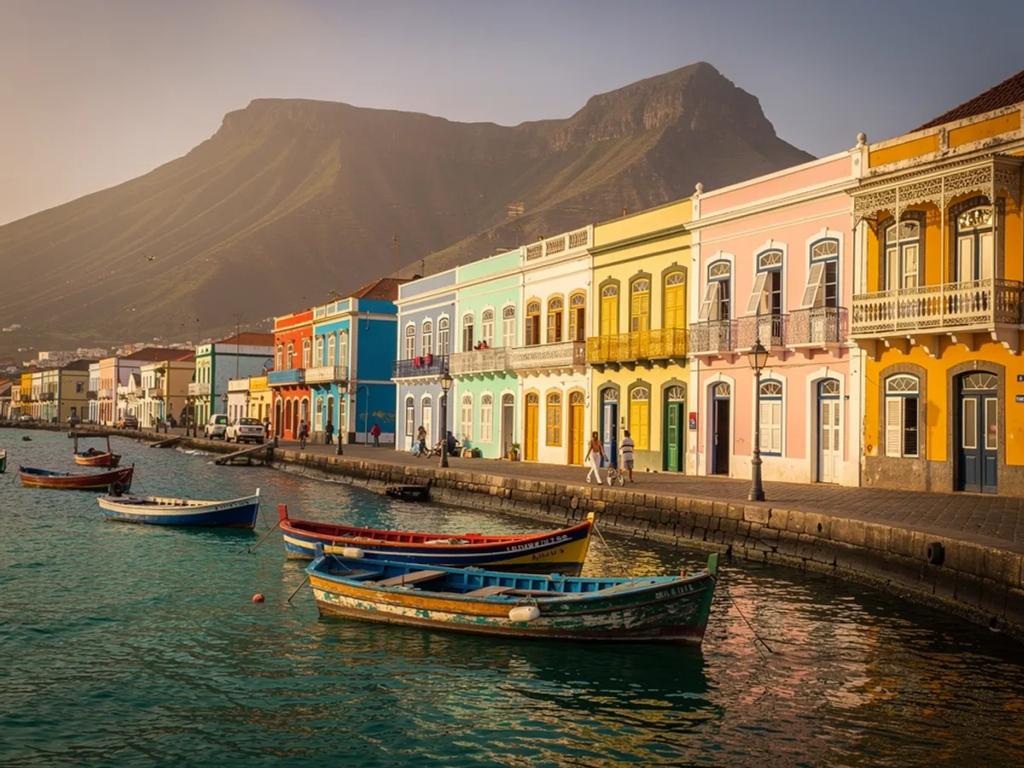
Sal runs on CVMovel and Unitel T+, and your eSIM rides one of them as its host. Coverage in Santa Maria, Espargos and along the main road between them is perfectly good, and 4G is fine for everything a visitor needs. The two things worth understanding before you arrive are that this is not the EU however European the resorts feel, and that there is a small, entirely legal trick being played on you every time you pay in euros.
This is the most useful piece of practical knowledge for a Sal holiday, and almost nobody explains it.
The currency is the Cape Verdean escudo (CVE), and it is pegged to the euro at a fixed rate - 110.265 escudos to one euro. The peg does not move. It is underwritten by a credit facility from the Portuguese government, a legacy of the islands' history.
Euros are widely accepted in hotels, restaurants and shops across Sal and Boa Vista, which is convenient and feels seamless.
But the rate they use is 100, not 110. Rounding the peg down to a tidy 1:100 quietly adds roughly ten percent to everything you buy.
So change money or pay by card. ATMs in Santa Maria and Espargos dispense escudos at the real rate. Card payment is settled at the true peg too.
Keep euros as a backup rather than a primary method, and expect change to come back in escudos regardless of what you paid with.
Ten percent across a week's holiday is a real number, and it is the single easiest saving available here.
The peg creates a second, more expensive misunderstanding.
Everything about a Sal holiday reads as European - euro prices, a charter from a European airport, a hotel whose staff greet you in four European languages. Cape Verde is not in the EU or the EEA, so Roam Like at Home does not reach here and an EU SIM bills at out-of-zone rates.
People find this out from the statement rather than the departure lounge. A travel eSIM avoids it, and Santa Maria's hotel wifi is decent enough to fall back on.
Santa Maria and Espargos are well covered, as is the road between them, which is most of the island's inhabited length.
The interior is empty in every sense. Sal is flat, arid and largely uninhabited away from the two towns, and coverage thins accordingly.
Kite Beach and the eastern shore are fine near the resorts and patchier further along.
Out on the water, which is where you will be, you have whatever the shore gives you. Kitesurfers and windsurfers should not count on a phone as a safety plan - go out within sight of a school, and tell someone.
Boat trips to Shark Bay, the north or on a fishing charter drop off quickly.
Inter-island flights and ferries cross open ocean with nothing.
Sal is where most visitors land and it is not representative of the country, which is worth knowing before you judge the archipelago by it.
Sal is flat, dry and barren, closer to the Sahara than to the tropics, with year-round sun and almost no rain. That reliability is exactly why the resorts are here.
The name means salt, and the salt pans at Pedra de Lume, in a collapsed volcanic crater, are where the island's original economy came from. You can float in the brine.
The other islands are wildly different. Santo Antao is green and vertical with serious hiking, Fogo has an active volcano you can climb with vineyards in the caldera, Sao Vicente has Mindelo and the music, Santiago has the capital and the UNESCO-listed Cidade Velha.
Inter-island flights and ferries make a multi-island trip straightforward, and anyone spending more than a week should do it.
If you came for a beach and sun, Sal delivers that with more consistency than almost anywhere in the Atlantic.
- Maps with offline copies, since the island is small but the interior tracks are unmarked.
- A windsurfing or kitesurfing forecast app, which is what half the island checks first thing each morning.
- A translation app. Portuguese is the official language and Kriolu, Cape Verdean Creole, is what people actually speak. Staff in tourism speak English, Portuguese, French and often Italian; away from the resorts, less so.
- WhatsApp, which is how local businesses, taxis and excursion operators all communicate.
- A taxi is arranged by phone or at a rank rather than through an app - the international ride-hailing services do not operate here.
Amilcar Cabral International (SID) at Espargos is the main international gateway for the whole country, about 18 km north of Santa Maria.
Transfers take around 20 to 25 minutes. Most package holidays include one; taxis are readily available and fares to Santa Maria are broadly standardised, but agree it before you get in.
Direct flights run from Lisbon and from a number of European cities, many of them seasonal charters, which is why Sal receives visitors who never see another island.
Around Santa Maria you walk. Beyond it, you take a taxi, hire a car or join an excursion. Aluguers, shared minibuses, run the Espargos road cheaply and are how locals travel.
Not much. This is a beach holiday on a small island, hotel wifi covers most of it, and there is limited reason to be online. A small plan is ample. Where it earns its place is maps for a self-drive day and the wind forecast.
Beachwear at the beach, and something on top elsewhere. Cape Verde is relaxed and Muslim-minority, but Santa Maria's town is a working place and walking through it in swimwear is poor form.
Light clothing year-round. It genuinely does not get cold.
Something windproof. The trade winds blow constantly from December to March and a light shell makes evenings considerably nicer.
Serious sun protection. You are at 16 degrees north with no cloud and a constant breeze that hides how much sun you are getting. This is the classic Sal mistake.
Shoes for the salt pans and lava rock, which are sharp underfoot.
Water shoes if you are swimming anywhere other than the main beach.
Kite Beach, with dozens of kites up at once in the afternoon breeze.
Pedra de Lume, the salt crater, where the pans go pink and white and you can float.
Buracona and the Blue Eye, a lava cave where midday sun through an underwater opening lights the pool an improbable blue. Timing matters - late morning to early afternoon.
Santa Maria pier at dawn, when the fishing boats land and the catch is cut on the sand with an audience of gulls.
The salt flats near Pedra de Lume from above.
Palmeira, the small working harbour, for a version of the island with no tourism in the frame.
The empty eastern beaches, reachable by quad or 4x4, where you will be alone.
The islands were uninhabited before the Portuguese arrived in the 1460s, which makes Cape Verde one of very few countries with no indigenous population - its culture is entirely a creole formed in the Atlantic.
More Cape Verdeans live abroad than at home. The diaspora, concentrated in Portugal, the United States, the Netherlands and elsewhere, outnumbers the roughly half a million people in the archipelago.
Cesaria Evora took morna - the melancholy national music, now on the UNESCO list - to the world, performing barefoot in solidarity with the poor of her country. The airport on Sao Vicente carries her name.
Morabeza is the Cape Verdean word for the particular warmth and ease the islands claim as their national quality, and there is no clean translation.
Cape Verde runs on UTC-1, one of very few places to use that offset, so it is an hour behind Lisbon.
And Sal's fresh water is desalinated from the sea. There are no rivers and effectively no rainfall. Drink bottled water.
Carnival, in February, and though Mindelo on Sao Vicente has the famous one, Sal marks it too.
Kitesurfing and windsurfing competitions through the windy season, with Sal a regular stop on international tours. The island has produced world champions.
Santa Maria's Municipality Day and the summer beach festivals, when the town's music scene comes out.
December to March is the wind season and peak for board sports. August to October is warmest, calmest and best for swimming, with a small chance of rain.
There is no bad time to come, which is unusual and is much of the point.
The love: Sal is dependable in a way few destinations are. Sun almost every day of the year, warm water, a long pale beach, direct flights from Europe, and a relaxed, safe, genuinely friendly island where nobody is hustling you. The kitesurfing and windsurfing are world class. The music in Santa Maria's bars is real rather than staged. And morabeza is not a marketing word - visitors consistently remark on how easy and warm the encounters here are.
The complaints are consistent. The island is barren, flat and brown, and people expecting tropical lushness are startled. There is not much to see, and the sights fill a day and a half. It is resort-dominated, and Santa Maria's strip can feel detached from the country it is in. Food is limited and imported, with prices to match, since almost nothing grows here. The wind that delights kitesurfers annoys sunbathers for four months of the year. And a few visitors leave feeling they saw a beach rather than Cape Verde - which is fair, and is an argument for taking the short flight to another island.
Go for the beach and the wind, change money properly, and take three days on Santo Antao or Fogo if you have them.
No. Cape Verde is in neither the EU nor the EEA, so Roam Like at Home does not apply and an EU SIM roams at out-of-zone rates. The euro peg and the European flights and hotels lead a lot of visitors to assume otherwise, and they find out from the bill.
Escudos. Euros are accepted almost everywhere, but merchants generally convert at 1 euro to 100 escudos when the real fixed peg is 110.265 - roughly a ten percent premium. Withdraw escudos from an ATM or pay by card, which settles at the true rate, and keep euros as a fallback.
No. Sal has no rivers and almost no rainfall, and its fresh water is desalinated. Drink bottled water, which is sold everywhere.
Along Santa Maria and the developed east coast, generally yes. The interior and the remoter beaches thin out, and offshore you have only what reaches from the shore. If you are kitesurfing or windsurfing, treat the phone as useless for safety - stay within sight of a school and tell someone your plan.