China Mobile, China Unicom and China Telecom serve Shenzhen, and your eSIM will roam onto one of them. The blocked-apps question that dominates travel to China is covered properly in our Shanghai and Guangzhou guides, and the short version holds here: a roaming eSIM usually routes your traffic outside the mainland and sidesteps the problem. What is specific to Shenzhen is that it sits directly on the Hong Kong border, which makes it the easiest place in China to use a visa policy most travellers have never heard of.
This is genuinely the most useful thing to know about visiting Shenzhen, and it is underused.
China operates a 240-hour visa-free transit policy - ten full days - for citizens of 55 countries, expanded from the older 72- and 144-hour schemes.
The condition is that you are in transit. You need an onward ticket to a third country or region, with confirmed dates and seats, departing within the ten days.
Hong Kong and Macao count as a third region, which is the part that matters here. Flying in, spending a week, and leaving overland to Hong Kong satisfies the rule.
It covers 65 ports across 24 provinces, and the Guangdong entry points include the Hong Kong-Zhuhai-Macao Bridge and the West Kowloon terminus of the high-speed rail.
You can actually do things. Tourism, business, visiting family and exchange visits are all permitted during the stay - it is not an airside transit.
Check your nationality and your intended port before relying on it, because both lists have been revised repeatedly and the policy is administered strictly.
If you do not qualify, ordinary Chinese visas apply, and Shenzhen has historically offered a limited port visa at some crossings - confirm current arrangements rather than assuming.
The border is a city boundary here. Shenzhen and Hong Kong are contiguous, and millions cross every year.
Luohu / Lo Wu is the classic crossing, metro to metro, and the busiest.
Futian / Lok Ma Chau is the other rail crossing, often quieter.
The high-speed rail from Futian or Shenzhen North reaches West Kowloon in about fifteen minutes, which is faster than crossing most large cities.
Allow real time at peak. Weekend mornings and holidays produce queues measured in hours.
Hong Kong is a separate roaming zone from mainland China on essentially every plan - our Guangzhou guide covers that question. Do not assume one covers both.
Your phone will hop networks near the border in both directions, sometimes while you are still on the wrong side of it, which can produce surprising charges.
Shenzhen is the fastest-built large city in human history, and knowing that explains what you see.
In 1979 this was a county of market towns and fishing villages with a population in the tens of thousands.
It was designated China's first Special Economic Zone in 1980, as an experiment in market reform next door to Hong Kong.
It now holds something over seventeen million people, and it is the headquarters of Huawei, Tencent, DJI and BYD.
There is almost no old city. Visitors expecting temples and lanes find a comprehensively modern metropolis, which disappoints some and delights others.
The metro is enormous and excellent - one of the largest systems in the world, built almost entirely in the last twenty years, air-conditioned and signed in English.
The bus and taxi fleets are fully electric. Shenzhen electrified all of its buses and then its taxis, tens of thousands of vehicles, years ahead of anywhere comparable. The city is noticeably quieter than its size suggests.
Huaqiangbei is the largest electronics market on earth, and it is the single most interesting place in Shenzhen.
It is several multi-storey buildings of stalls selling components - chips, connectors, screens, cameras, cable, tooling - largely to trade buyers rather than consumers.
You can have almost anything built or repaired within a few hundred metres, which is why the global hardware industry passes through here.
Go on a weekday. It is a working market, not an attraction, and weekends are quieter in the wrong way.
Bargaining is expected in the consumer sections and less so in the component halls, where prices are thin and volumes are the point.
Be realistic about counterfeits. Plenty of what is sold is genuine, plenty is not, and telling the difference requires knowledge you probably do not have. Buy for interest, not for value.
The city is comprehensively covered, metro included, and mainland Chinese networks are fast.
At the border crossings, your handset may register on a Hong Kong network while you are still in Shenzhen, or the reverse. Watch this if you are on a mainland-only plan.
Inside the market halls at Huaqiangbei, several floors of metal shelving and electronics do exactly what you would expect to indoor signal.
Dapeng Peninsula, the coastal area east of the city, thins on the headlands and hiking trails.
Wutong Mountain, the highest point in the city, drops out on the upper paths.
On the high-speed rail to Hong Kong, coverage cuts over as you pass the boundary.
China runs on WeChat Pay and Alipay, and cash is close to obsolete.
Both now accept foreign cards. Since 2023 international Visa and Mastercard can be linked to the apps, and this transformed what visiting China is like - before it, foreign visitors genuinely struggled to pay for anything.
Set this up before you arrive, at home, on wifi. It requires identity verification and it is much easier done calmly than at a metro gate.
Some small vendors still prefer the local wallets without foreign cards attached, and a little cash covers those.
- WeChat and Alipay, set up before departure, which are payment, messaging and transport in one.
- DiDi, the ride-hailing app, which has an English interface within Alipay.
- The Shenzhen Metro via either wallet app, which lets you scan through the gates.
- Maps - the international ones are unreliable in China because of the coordinate offset applied to mapping data; Amap or Baidu are what actually work, and both have some English.
- A translation app with camera input, which is essential outside the business districts.
Shenzhen Bao'an International (SZX) is about 30 km northwest of the centre and connected by metro.
Hong Kong International (HKG) is a genuine alternative - ferries and coaches run directly to Shenzhen, and for many international routings it is the better-connected airport.
By high-speed rail, Shenzhen North and Futian connect to Guangzhou in half an hour and to Hong Kong's West Kowloon in about fifteen minutes.
Overland from Hong Kong at Lo Wu or Lok Ma Chau is the traditional route, metro to metro.
A decent allowance. Everything here runs through your phone - payments, transport, translation, ride-hailing - to a degree that is unusual even by modern standards. A dead battery in Shenzhen is a genuine problem rather than an inconvenience. Carry a power bank.
Light and breathable in summer, which is hot, humid and wet.
A layer for indoors, where air conditioning is set cold.
Warmer clothes December to February, when it is mild but the buildings are not heated the way northern Chinese ones are.
Comfortable shoes. Shenzhen is walkable in patches and enormous overall, and you will cover distance in metro stations alone.
An umbrella for summer, when downpours are sudden and heavy.
Business dress if that is why you came - this is a working city and the tech and trade sectors dress accordingly.
Huaqiangbei's market floors, stacked with components - ask before photographing individual stalls.
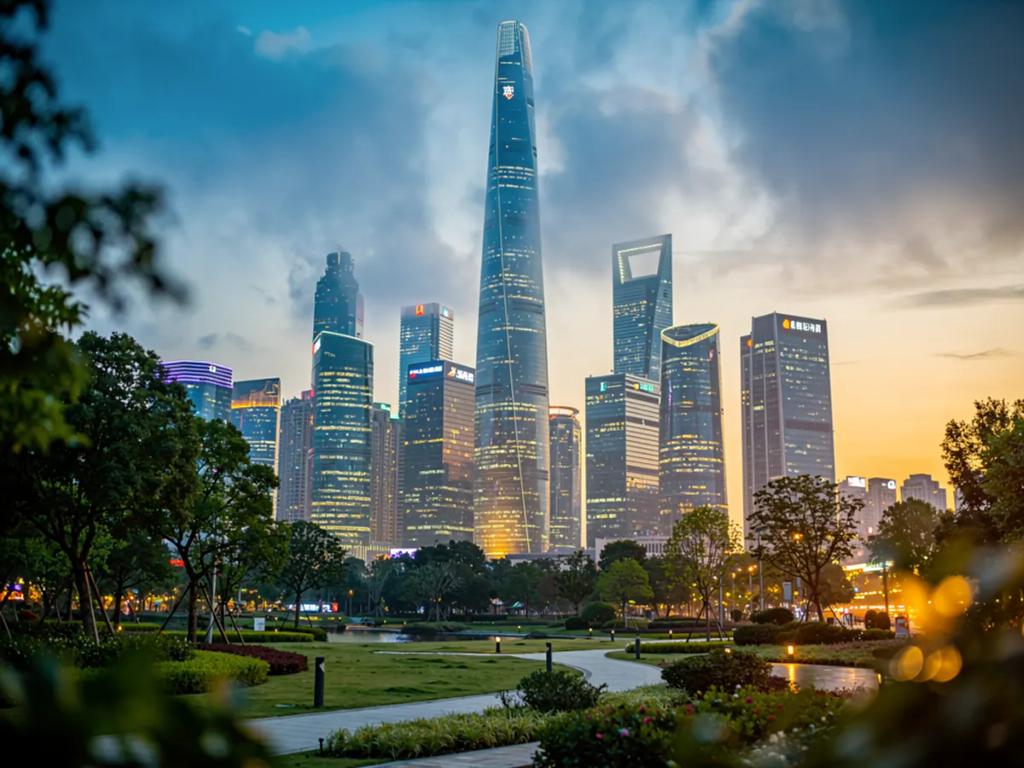
The Ping An Finance Centre, one of the tallest buildings in the world, from the observation deck or from across the district.
Shenzhen Bay Park at sunset, looking across the water to Hong Kong's New Territories.
Dafen Oil Painting Village, where a substantial share of the world's reproduction oil paintings are produced, street after street of studios.
OCT-LOFT, a converted factory complex of galleries, cafes and design studios.
Dapeng Fortress, a Ming-dynasty walled town on the coast - one of the very few genuinely old things in the municipality.
The Shenzhen skyline from Wutong Mountain, if you climb it early.
Window of the World, a park of scale-model landmarks, which is exactly as odd as it sounds.
Shenzhen went from tens of thousands of people to over seventeen million in about forty-five years, which is the fastest urbanisation of that scale in recorded history.
It was China's first Special Economic Zone, designated in 1980 specifically because it sat next to Hong Kong.
Every bus and taxi in the city is electric. Shenzhen electrified its entire public bus fleet and then its taxi fleet, tens of thousands of vehicles, well before any comparable city.
Huaqiangbei is where a great deal of the world's consumer electronics is prototyped, and hardware startups fly here specifically to walk its floors.
Dafen village once produced a substantial proportion of the world's reproduction oil paintings, painted by hand, in an assembly-line arrangement.
And the whole of China runs on a single time zone, Beijing time, despite spanning a distance that would be five zones anywhere else.
Chinese New Year, in January or February, when Shenzhen empties more dramatically than almost any Chinese city - most of its population came from elsewhere and goes home. Much closes for a week or more.
The China Hi-Tech Fair, in November, one of the country's largest technology exhibitions.
The Canton Fair in neighbouring Guangzhou, spring and autumn, which fills hotels across the whole delta - our Guangzhou guide covers it.
October to April is the comfortable window. July to September is hot, wet and the typhoon season.
The love: Shenzhen is the most futuristic city most visitors will ever see, and it is fascinating precisely because it has no past to speak of. The metro is superb, the parks are excellent, the food spans every Chinese region because everyone here came from somewhere else, and Huaqiangbei is genuinely unlike anything anywhere. It is also the easiest entry point in China for a first visit, with Hong Kong fifteen minutes away.
The complaints are consistent. There is little conventional sightseeing - no old town, few historic sites, and visitors wanting classical China should go elsewhere. It is enormous and the interesting parts are far apart. The summer is oppressive. The language barrier is significant outside business contexts. And the app dependency is total in a way that punishes anyone who did not set up payments before arriving.
Come between October and April, set up WeChat Pay before you fly, spend a weekday morning in Huaqiangbei, and take the fifteen-minute train to Hong Kong.
Possibly. China's 240-hour visa-free transit covers citizens of 55 countries for ten days, provided you hold an onward ticket to a third country or region with confirmed dates. Hong Kong and Macao count as a third region, which makes Shenzhen unusually easy - fly in, stay a week, leave overland to Hong Kong. Check your nationality and your entry port, as both lists change.
Generally yes on a roaming eSIM, because your traffic routes outside the mainland. Our Shanghai and Guangzhou guides explain the mechanics properly. A local Chinese SIM does not behave the same way.
WeChat Pay or Alipay, with an international card linked - possible since 2023 and the single biggest improvement to visiting China in years. Set it up at home before you fly, because verification is much easier on a calm wifi connection than at a metro gate. Keep a little cash for small vendors.
Almost never - Hong Kong is a separate roaming zone on essentially every plan. Your phone may also hop across the border before you do, so check what you are registered on if you are near the crossings.