St Patrick's Festival Dublin 2027: Dates & Staying Connected
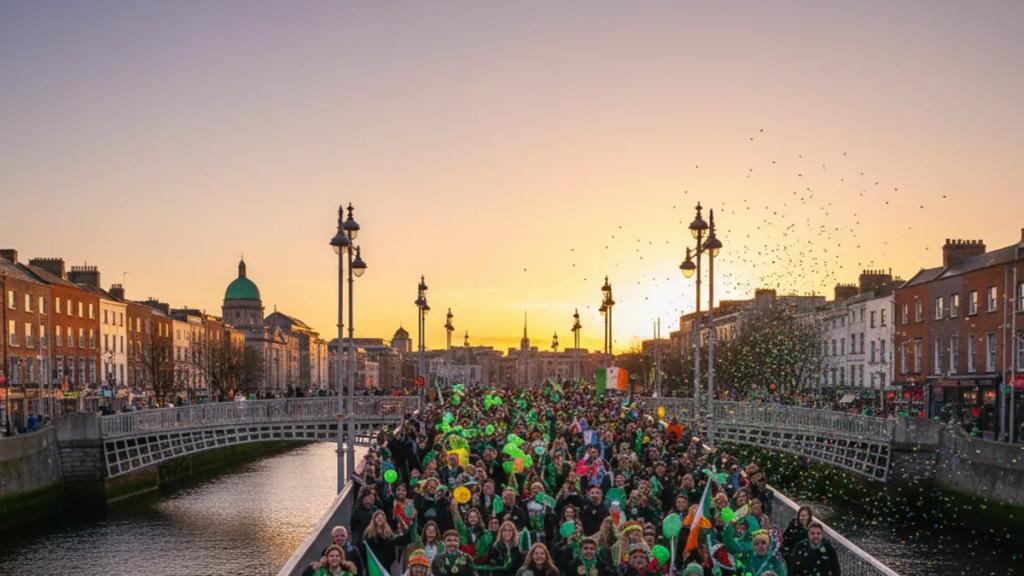
St Patrick's Day is always 17 March - in 2027 that is a Wednesday - and Dublin builds a multi-day festival around it, with the big parade rolling through the city centre from noon. The 2026 edition ran 14-17 March; the 2027 programme is not published yet, so expect a similar span and check stpatricksfestival.ie closer to the date. What is certain every year: roughly half a million people line the route, the centre closes to traffic, and the mobile network buckles exactly when your group scatters across the Liffey. Visiting from outside the EU? An Ireland eSIM from £2.42 beats paying roaming rates for the same congested signal.
When exactly is St Patrick's Festival 2027?
The parade is on Wednesday 17 March 2027 - that never moves, because St Patrick's Day is a fixed national holiday. The surrounding festival typically starts a few days earlier: 2026 ran 14-17 March with music, funfairs, and events across the city, and 2027 should follow the same shape once the official site announces it.
Timing realities worth planning around:
- The parade starts at noon from Parnell Square and takes about two hours to pass any given point. Front-row ambitions mean staking out O'Connell Street from 9-10am.
- 17 March is a public holiday - shops run reduced hours and the whole country is off, so the crowd is locals plus tourists.
- A Wednesday parade is a small mercy: midweek editions draw slightly thinner crowds than weekend ones - still hundreds of thousands.
- Book accommodation early - Dublin hotel prices climb steeply for the festival window.
What is the parade day actually like on the ground?
Honest answer: crowded, cold, often wet, and still worth it. The parade runs from Parnell Square down O'Connell Street, across the Liffey at O'Connell Bridge, and past Trinity College towards St Patrick's Cathedral. Around half a million spectators pack that roughly 2.5 km route, five to ten deep at the good spots - arrive at 11:45 and you will mostly see the backs of heads.
The parade is free; grandstand seats sell out well in advance at a hefty premium. Mid-March Dublin is typically 5-10 C with a real chance of rain, so dress for standing still in the cold for three hours. And the pub myth deserves saying plainly: the famous pubs run one-in-one-out queues by early afternoon, some charge entry, and Temple Bar is a crush best experienced briefly or not at all.
Why does your phone die exactly when you need it in Dublin?
Because half a million people are compressed into a few streets served by the same city-centre cell sectors, all streaming, video-calling, and messaging at once. Irish networks handle normal Dublin fine; they do not handle the parade crush. Data crawls along O'Connell Street from late morning, calls fail, and live location sharing becomes fiction.
The specific Dublin problem is regrouping across the river. The route crosses the Liffey, road closures split the centre in two, and packed bridges make crossing slow - groups that separate "just for a minute" on opposite banks can spend an hour finding each other. And pub Wi-Fi will not save you: on the day it is shared with a few hundred customers per pub and effectively dead.
What actually works:
- Agree physical meeting points before the parade - one north of the river (the Spire) and one south (Trinity College's front gate), so you have a fallback on either bank.
- Send texts and voice notes, not calls - small payloads squeeze through congestion far better than a live call.
- Download offline maps of Dublin before the day; the closed streets do not need live data if your map is cached.
- Upload later - post the parade videos from your accommodation Wi-Fi in the evening, not from the crowd.
What is the best connectivity setup for St Patrick's in Dublin?
It depends where you are coming from, and this is worth being honest about. Visiting from another EU or EEA country? Your home SIM roams in Ireland at no extra cost under roam-like-at-home rules - you do not need to buy anything, though your data fights the same congestion as everyone else's.
Coming from the US, Canada, Australia, or anywhere else outside the EU? Roaming is the pain point: typical travel passes run 10-15 USD per day for the privilege of that same jammed signal. A prepaid Ireland eSIM gets you a fixed data bundle on an Irish host network at local rates instead:
| Data | Duration | Price |
|---|---|---|
| 3GB Data | 30 Days | £2.42 |
| 5GB Data | 30 Days | £3.32 |
| 10GB Data | 30 Days | £4.98 |
| 20GB Data | 30 Days | £9.66 |
| 50GB Data | 30 Days | £40.79 |
| 1 Day | 1 Day | £2.59 |
| 2 Days | 2 Days | £5.19 |
| 3 Days | 3 Days | £7.78 |
| 4 Days | 4 Days | £10.20 |
| 5 Days | 5 Days | £12.93 |
| 6 Days | 6 Days | £15.67 |
| 7 Days | 7 Days | £18.41 |
| 8 Days | 8 Days | £19.78 |
| 9 Days | 9 Days | £21.83 |
| 10 Days | 10 Days | £23.20 |
| 11 Days | 11 Days | £25.25 |
| 12 Days | 12 Days | £27.30 |
| 13 Days | 13 Days | £28.67 |
| 14 Days | 14 Days | £30.04 |
| 15 Days | 15 Days | £32.09 |
| 16 Days | 16 Days | £33.46 |
| 17 Days | 17 Days | £34.15 |
| 18 Days | 18 Days | £35.51 |
| 19 Days | 19 Days | £37.57 |
| 20 Days | 20 Days | £38.94 |
| 21 Days | 21 Days | £40.30 |
| 22 Days | 22 Days | £40.99 |
| 23 Days | 23 Days | £41.67 |
| 24 Days | 24 Days | £42.36 |
| 25 Days | 25 Days | £43.04 |
| 26 Days | 26 Days | £43.73 |
| 27 Days | 27 Days | £44.41 |
| 28 Days | 28 Days | £45.09 |
| 29 Days | 29 Days | £45.78 |
| 30 Days | 30 Days | £47.15 |
Install the QR code at home on Wi-Fi, switch the line on when you land at Dublin Airport, and you are online on the bus into town. Dual SIM keeps your home number live for calls, texts, and bank codes while data runs on the Irish line.
How much data does a festival city break burn? Maps, messaging, and a parade day's worth of photos and video add up faster than you expect - estimate it:
How do you get to Dublin and around the city that week?
Dublin Airport has no train link - the Aircoach and Dublin Express buses reach the centre in roughly 30-45 minutes, and both are booked or tracked via app, which needs data on arrival (one more reason to install the eSIM before you land). In the city, Luas trams and Dublin Bus cover everything, paid with a Leap card or contactless.
On parade day itself, plan on foot: the core closes to traffic from mid-morning, Luas cross-city services are curtailed, and taxis cannot get near the centre. Everything that matters sits within a walkable square kilometre or two, and the TFI Live transit app - useful the rest of the week - also wants a data connection.
Is St Patrick's in Dublin just a giant pub crawl?
No, and the festival works hard to be more than that. The daytime programme is genuinely family-friendly: the parade is a pageant of theatre companies, international marching bands, and giant puppets rather than a booze parade, and the citywide events lean into music, food, and Irish culture. Kids on shoulders are as much its signature as green wigs.
The drinking reputation is earned after dark in a fairly small area - Temple Bar and the streets around it get messy by evening. Not your scene? Eat outside the core and catch a trad session in a quieter neighbourhood pub. Your scene? Go early, expect queues and cover charges, and keep the meeting-point plan alive - the network will still be struggling at 9pm.
The bottom line
St Patrick's Day 2027 is Wednesday 17 March, the parade rolls through central Dublin from noon, and the festival around it will span several days once the programme lands on stpatricksfestival.ie. Come early for a view, dress for cold rain, and agree meeting points on both banks of the Liffey before the network jams. Arriving from outside the EU? Land with an Ireland eSIM from £2.42 already installed - online from the airport bus to the last song of the night, no roaming bill chasing you home.
When is the St Patrick's Day parade in Dublin in 2027?
The parade is on Wednesday 17 March 2027, starting at noon from Parnell Square and running through the city centre. St Patrick's Day is a fixed date, so the parade day never moves; the festival days around it are announced on the official site closer to the time.
Is the Dublin parade free to attend?
Yes, standing along the route is free - around half a million people do exactly that. Paid grandstand seating is sold through the festival and sells out well ahead of the day. For a decent free spot, arrive two to three hours before the noon start.
Will my phone work during the parade?
Expect slow data and failed calls in the centre from late morning - hundreds of thousands of phones share the same cell sectors along the route. Texts and voice notes beat calls in congestion, offline maps beat live navigation, and pub Wi-Fi is effectively useless on the day.
Do I need an eSIM if I am visiting from another EU country?
No - EU and EEA SIMs roam in Ireland at domestic rates under roam-like-at-home rules, so your home plan just works. An Ireland eSIM from £2.42 is aimed at visitors from the US, Canada, Australia, and other non-EU countries, where roaming passes typically cost 10-15 USD per day.
What is the weather like in Dublin in mid-March?
Cold and changeable: typically 5-10 C with a realistic chance of rain and wind, and you will be standing still outdoors for hours. Waterproof layers beat umbrellas in a packed crowd.
Land in Dublin already online
An Ireland eSIM from eSIMpass installs before you fly - local-rate data on an Irish network for the festival, your home number kept via dual SIM, and no roaming surprises on next month's bill.
Get Your Ireland eSIM