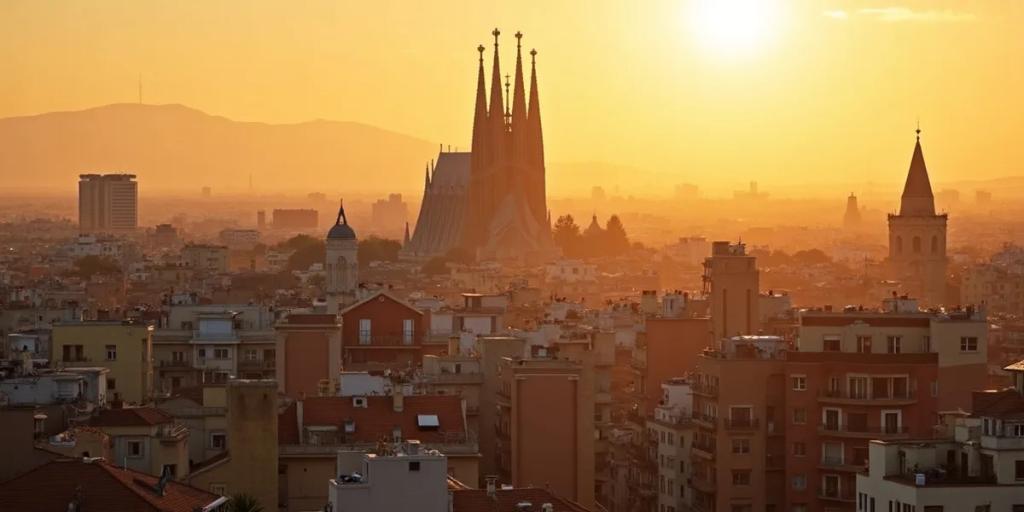
Barcelona is one of Europe's easiest cities to stay online in - dense 4G and 5G from Spain's big three networks (Movistar, Vodafone, Orange), plus challengers like Yoigo, blanket the city. Your eSIM rides one of these as its host network, and in practice that means fast data everywhere tourists actually go: the Eixample grid, the beachfront from Barceloneta to the Fòrum, Montjuïc, and the metro.
Two honest exceptions. The Gothic Quarter and El Born are a maze of six-story stone alleys, and signal can drop to a bar or two mid-block - it recovers at every plaça, so if maps stall, walk twenty metres towards daylight. And while the TMB metro has mobile coverage across most stations and tunnels, the moving train between deep stations can still stutter - load your route before descending and it is a non-issue.
- TMB App + T-mobilitat run Barcelona's buses and metro; paper tickets still exist, but journey planning, disruption alerts and the T-mobilitat card top-ups are all in-app.
- FreeNow and Cabify are the ride apps locals actually use (Uber also operates); taxis are plentiful but the apps spare you the meter-Spanish negotiation at 2am.
- Timed tickets are the norm: Sagrada Família, Park Güell and Casa Batlló sell out days ahead and check-in happens from your phone - screenshot the QR codes, but you will still want data for the inevitable time-slot change.
- Tap-to-pay is universal - card or phone works from metro gates to market stalls at La Boqueria, so there is no cash-hunting errand on arrival.
From El Prat airport, the Aerobús to Plaça Catalunya and the R2 Nord train both run frequently; the metro's L9 Sud also connects but needs a separate airport fare. Contactless bank cards cover most of it, and the ride into town is exactly when the "just landed" messages, accommodation directions and first map searches hit your data plan - which is why installing the eSIM before you fly beats hunting airport Wi-Fi.
Barcelona is about two hours from London: British Airways flies from Heathrow eight times a day and Vueling twice, and flights from Luton take around two hours ten, from Manchester and Stansted about two and a half. Barcelona is always one hour ahead of the UK.
Budget for the tourist tax, charged per person per night for up to seven nights. From April 2026 Catalonia's rate is €3.40 at a four-star hotel and €7 at a five-star, and Barcelona adds its own €5 surcharge on top - so €8.40 and €12 a night respectively, and €9.50 in a tourist flat (Catalan tax agency, checked 9 October 2026). Staying near the airport doesn't avoid it: El Prat and L'Hospitalet added their own surcharges on 1 October 2026. Driving in? The Foreign Office notes that Barcelona requires some vehicles to be registered in advance (gov.uk, updated 12 August 2026).
Your UK plan: Spain is in every big UK network's Europe zone - included on O2, £2.72 a day on EE, £2.75 on Vodafone unless your plan has Euro Roam, and £2 or £2.75 on Three. For a long weekend that adds up; a Barcelona eSIM is a single fixed price.
A typical Barcelona city break is map-heavy (those alleys), photo-heavy (Gaudí does that), and translation-light (English is widely workable). For most travellers 1GB per 2-3 days covers maps, messaging and social posting comfortably; add headroom if you video-call home or upload every vermut. Plans can be topped up from your dashboard if the trip outruns the estimate, and the Spain network comparison breaks down how the host networks differ if you care about the details.
Barcelona is smart-casual and forgiving, but two things catch visitors out: churches enforce covered shoulders and knees (the Sagrada Familia turns people away for beachwear), and evenings turn cool off the sea even in June - carry a light layer. Winter needs a real jacket, not a parka. Beachwear is for the beach; walking the city shirtless is actually fineable in Barcelona.
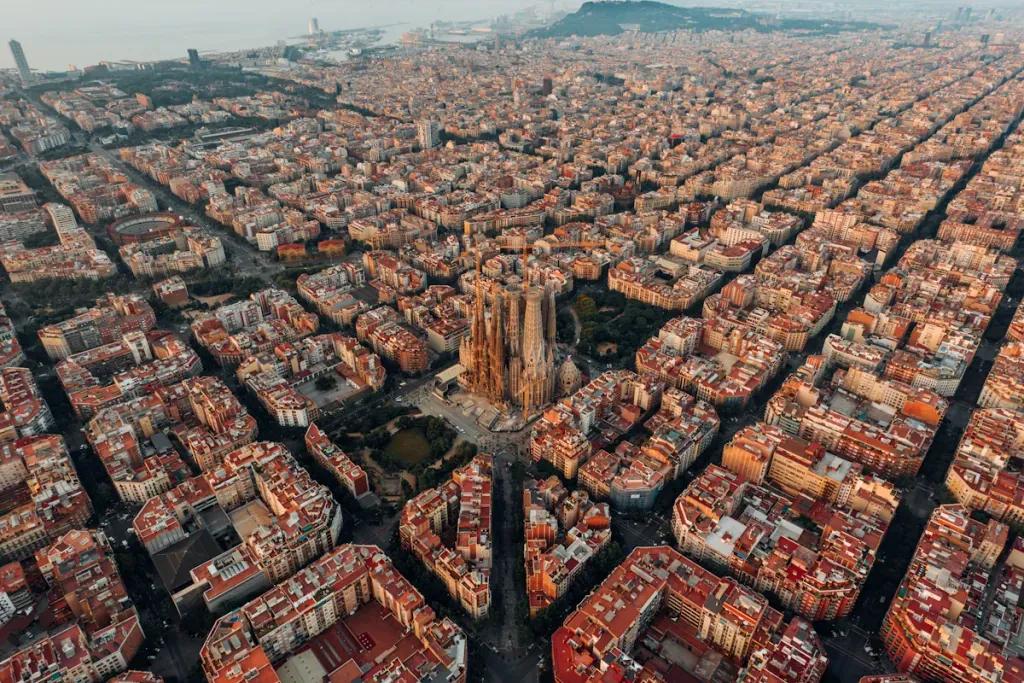
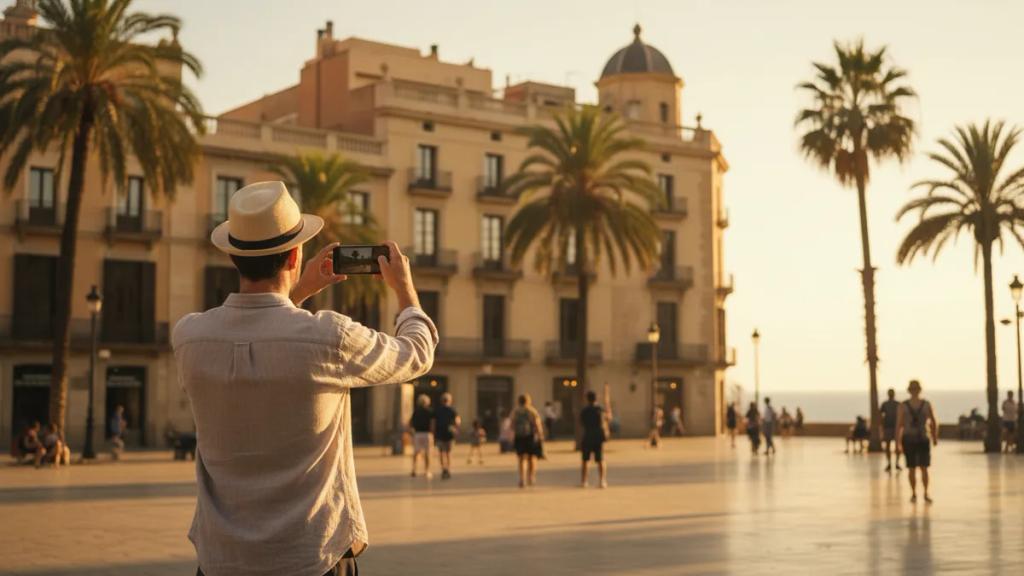
The classics reward timing over gear. The Sagrada Familia's Nativity facade glows in the first hour after sunrise - stand across the pond in Placa de Gaudi and crouch low to get the reflection. Park Guell's mosaic bench wants late golden hour, and the famous dragon staircase shot means arriving at opening or accepting a crowd. For the skyline-with-sea shot, the Bunkers del Carmel at sunset beats any rooftop bar - face southwest and let someone shoot you from slightly below against the city grid. Drones are a no-go over the city without permits.
The Sagrada Familia has been under construction since 1882 - longer than the Great Pyramid took. The Eixample's octagonal corners exist so 19th-century trams could turn. And Barcelona's beaches are largely artificial: much of the sand arrived for the 1992 Olympics.
La Merce (late September) is the city's biggest festival - human towers, fire runs and free concerts across town. Sant Jordi (23 April) turns the streets into a book-and-rose market. Primavera Sound (late May/early June) and Sonar (mid-June) bring the music crowds, and Festa Major de Gracia (mid-August) dresses an entire neighbourhood in handmade decorations.
The love is easy: a walkable city where Gaudi, beach afternoons, and 1am dinners coexist, with weather that behaves most of the year. The gripes are real too: pickpocketing on the metro and Ramblas is genuinely common (keep the phone zipped), the Gothic Quarter can feel like a theme park in August, and locals' patience with over-tourism is visibly thin - some neighbourhoods now greet visitors with "tourists go home" stickers. Go shoulder-season, stay curious, and both sides of that ledger tilt in your favor.
Mostly yes - TMB stations and the majority of tunnel sections have coverage, which is genuinely unusual for a European metro. Expect brief dropouts between deep stations; anything you need underground (route, ticket QR) is safer loaded before you tap in.
The city runs the Barcelona WiFi network at hundreds of public points, and cafés are generous - but it is registration-gated, patchy between hotspots, and useless exactly when you need it (navigating between them). Treat it as a bonus, not a plan.
Only if you need a Spanish phone number. Spain requires passport ID registration to buy a physical SIM, which means queueing at a shop; for a data-only week, an eSIM installed before you land skips the paperwork entirely and your home number stays live for bank codes.