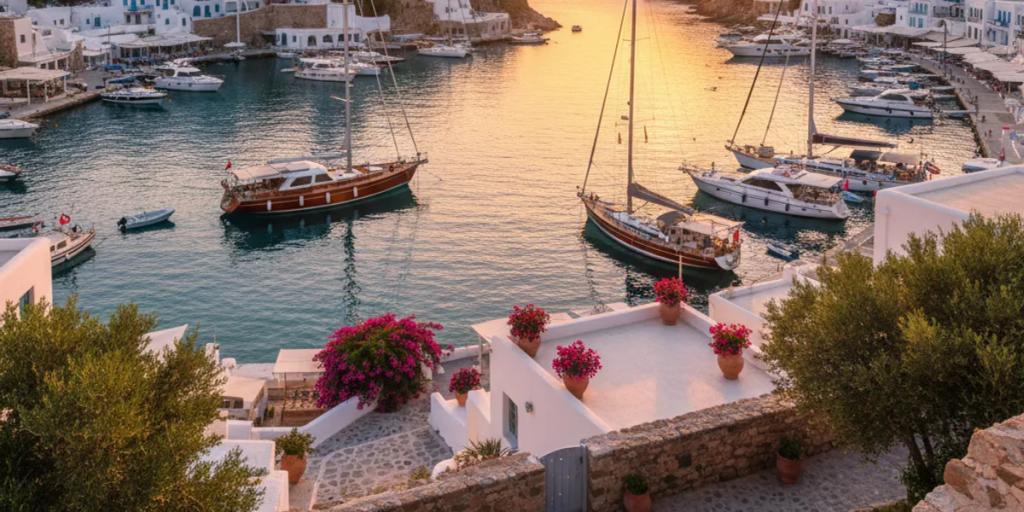
Ibiza runs on Spain's big three networks - Movistar, Vodafone and Orange - and around Ibiza Town, Playa d'en Bossa, San Antonio and Santa Eulalia your eSIM gets fast 4G and 5G without drama. The catch: the island also has a rugged, pine-covered north where coverage thins out exactly where the best swimming is. Know which Ibiza you are heading to on a given day and your data plan will keep up.
The north and the wild southwest are the honest exceptions. Cliff-hemmed coves like Benirras and Cala d'en Serra sit in deep folds of coastline where every network struggles - you may get enough for a WhatsApp text on the sand and nothing for uploads until you climb back to the road. The Es Vedra viewpoints near Cala d'Hort are similar: dramatic terrain, inconsistent bars. Inland villages are generally fine, but the winding lanes between them can flicker. Cache the day's route and your parking pin before leaving town, and treat the dead spots as a feature - half the island's charm is that nobody can reach you at Benirras anyway.
Ibiza's club economy is now almost entirely digital, and this is where data stops being optional. Tickets for Ushuaia, Hi Ibiza, Pacha and the other superclubs are bought online, often weeks or months ahead for opening and closing parties, and your entry is a QR code on your screen. Table bookings, guest lists and set-time updates live in apps and DMs. Then the real test: getting home, because Ibiza's peak-hour taxi shortage is notorious. Uber operates on the island but only via private-hire licences - bookings must be made around 30 minutes ahead and availability often vanishes on big nights - while FreeNow and local apps like TaxiClick connect you to licensed taxis. The Disco Bus night lines (roughly June to September, about half past midnight until 6:30am, a few euros a ride) are the budget fallback, and their timetables are online too. Screenshot everything, but keep live data for the inevitable plan changes.
- Ferry apps for Formentera. Balearia, Trasmapi and Aquabus run the 30-minute crossing from Ibiza Town many times a day; most let you board with an e-ticket on your phone (Trasmapi still wants tickets collected at the port, so check before you sprint for a sailing).
- TIB island buses connect Ibiza Town, San Antonio, the airport and the bigger beaches; timetables shift by season and live online, and the club-season Disco Bus lines are published the same way.
- Beach logistics. Boat trips, sunset cruises and popular restaurant tables (the Cala d'Hort sunset spots especially) are book-ahead affairs in summer.
- Tap-to-pay works everywhere from beach chiringuitos to market stalls, so cash is optional - though a few euros help at hippy market stands.
Ibiza's airport sits 15 minutes from town, with the AERO3 express bus to Ibiza Town, AERO1 to San José and San Antonio, and AERO5 to Playa d'en Bossa, plus a taxi rank that moves fast on arrival (it is departures at 6am that hurt). The ride in is precisely when accommodation directions, ferry bookings and first-night ticket confirmations all want data at once, so set up your eSIM before departure rather than gambling on airport Wi-Fi.
Ibiza is about two and three-quarter hours from Manchester and Stansted, and British Airways flies twice a day from Heathrow. It is always one hour ahead of the UK.
The Balearic sustainable tourism tax is charged per person per night, plus 10% VAT: from May to October, €2 at one- to three-star hotels and in holiday lets, €3 at four-star and €4 at five-star; from November to April it falls to between 50 cents and €1. Under-16s are exempt, and the rate halves from the ninth night (Balearic government). In San Antonio, local law bans happy hours, open bars, pub crawls, party boats and off-licence sales between 9.30pm and 8am, and the Foreign Office warns of serious accidents - and fines - at illegal commercial parties in villas on Ibiza (gov.uk, updated 12 August 2026).
Your UK plan: Spain is in every big UK network's Europe zone - included on O2, £2.72 a day on EE, £2.75 on Vodafone unless your plan has Euro Roam, and £2 or £2.75 on Three.
An Ibiza trip is messaging-heavy (coordinating groups across beach, villa and club) and upload-hungry - sunset videos from Benirras queue until you are back in coverage, then eat data in a burst. Around 1GB every 2-3 days handles navigation, group chats and posting; budget extra for poolside streaming. Villas in the campo often share one strained connection between eight guests, so assume your eSIM is the reliable line. If you want to know which Spanish host network your plan rides on, see the Spain network comparison.
Daytime Ibiza has no rules: swimwear at the beach, a cover-up for towns (walking through Ibiza Town in a bikini earns fines under local bylaws, as elsewhere in Spain). Clubs are more relaxed than their prices suggest - there is no suit-and-heels culture - but the big venues do enforce specifics: no fancy dress at Ushuaia, no swimwear, sports jerseys or bare torsos inside. The one thing everyone forgets is a layer: sunrise after an afterparty, the early Formentera ferry and October terrace nights all turn genuinely cool.
Es Vedra at sunset is the island's money shot, but note the famous Torre des Savinar clifftop was closed off by landowners in 2025 after years of overcrowding - use the official viewpoint above Cala d'Hort instead, arriving an hour before sunset for parking. Dalt Vila's ramparts glow at golden hour; shoot from the Portal de ses Taules gateway looking up, then from the top walls back across the harbour. Benirras on a summer Sunday gives you the drum-circle silhouette shot as the sun drops behind Cap Bernat. And the day trip that fills camera rolls: Ses Illetes on Formentera, where the water genuinely looks Caribbean, plus the pink-tinged evaporation ponds at Ses Salines on the way home - a protected natural park, so leave the drone in its case.
Knowing where to point the camera is half the job - the other half is what you do in front of it. These six poses are the ones that actually work on this island, with the timing and camera position that make them look effortless.

The Es Vedra wingspan. Stand at the official viewpoint above Cala d'Hort, arms fully spread, and let the sun sink directly behind the island. Your photographer crouches low and shoots slightly upward so your silhouette clears the horizon - expose for the sky and everything else takes care of itself. Arrive an hour early; the light peaks in the last fifteen minutes.
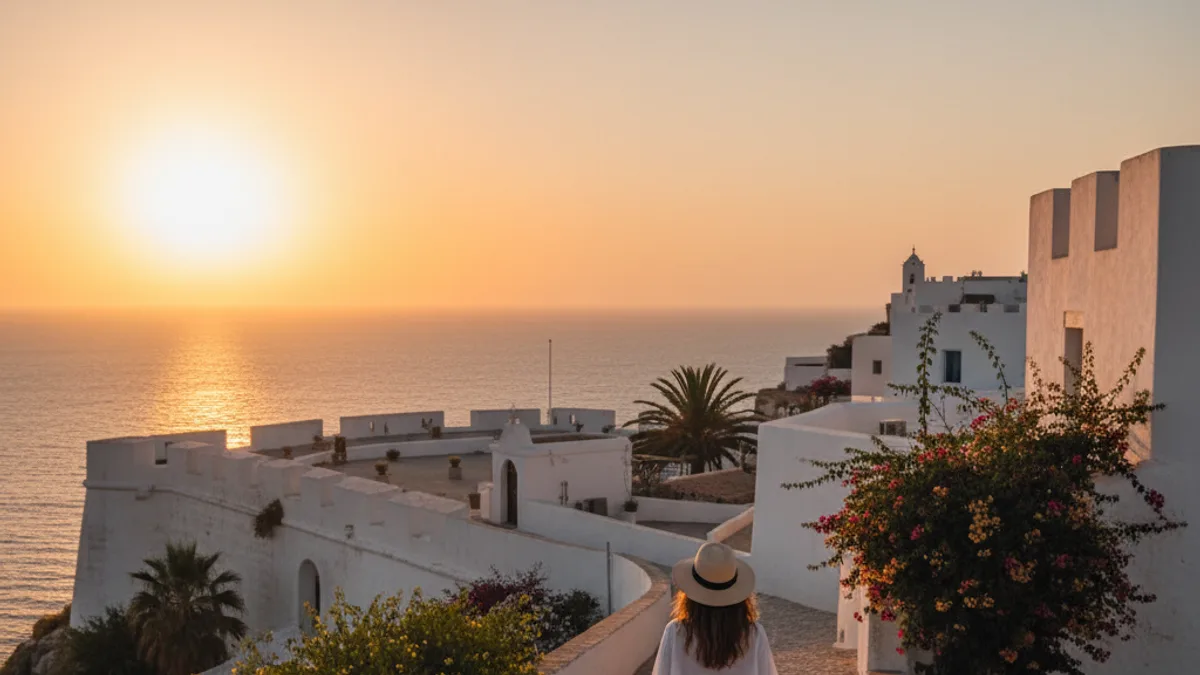
The rampart walk-away. On Dalt Vila's walls, walk slowly away from the camera mid-stride, one hand trailing the stone. Movement reads more natural than standing still, and the walk-away hides the universal problem of not knowing what to do with your face. White or flowing clothes glow against the honey-coloured stone at golden hour.
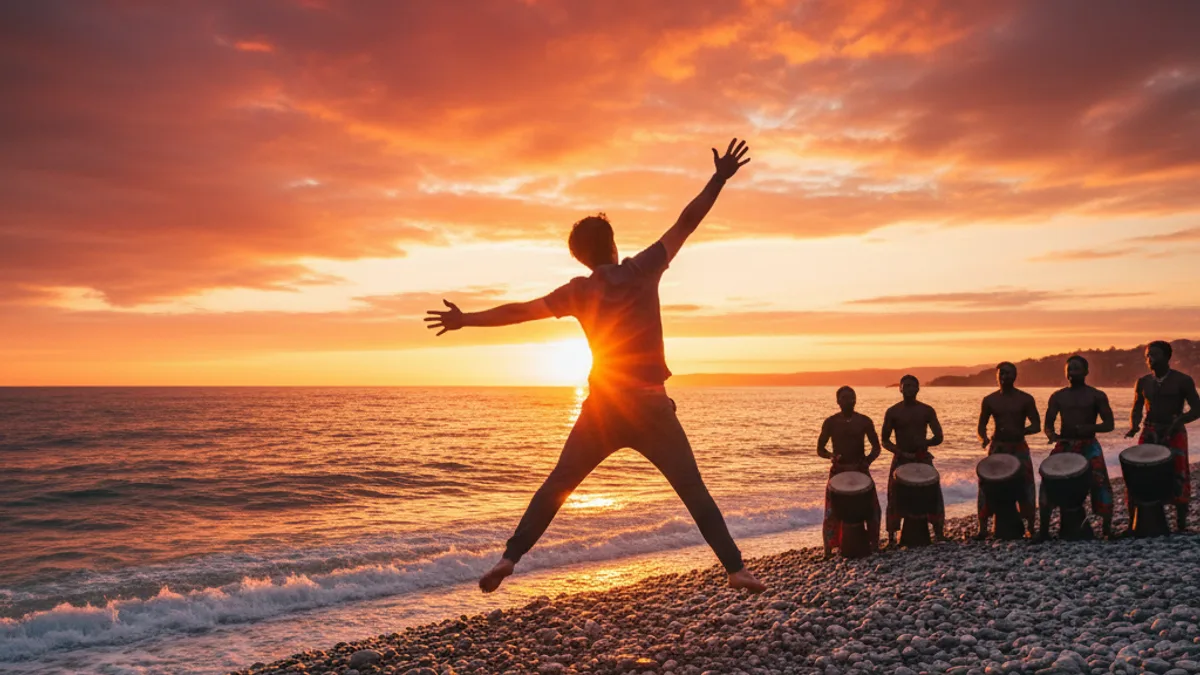
The Benirras jump. Summer Sunday, drum circle behind you, sun dropping behind Cap Bernat: jump with knees tucked and arms loose while your photographer holds burst mode. Out of twenty frames, one is perfect - that is the one. Remember the cove's weak signal means the upload waits until you climb back to the road, which is exactly the kind of moment worth staying in anyway.

The Formentera float. In the knee-deep shallows of Ses Illetes, float on your back with arms drifted wide and eyes closed while your photographer stands over you (or holds the phone high). Midday works here - the higher the sun, the more absurdly turquoise the water renders. A wet phone is the classic casualty of this shot; a cheap waterproof pouch pays for itself.

The bow moment. On the Formentera ferry or a sunset cruise, stand at the bow rail, arms out, and let the wind do the styling. Shoot from behind and low so the frame is all sea, horizon and you. Golden hour crossings turn this from a cliche into a keeper - and the deck is the one place on board where your hair is supposed to look like that.

The blue-door lean. Ibiza Town's lanes below Dalt Vila are lined with whitewashed walls, blue doors and overloaded bougainvillea. Lean one shoulder against the wall, cross your ankles, and look down the lane rather than at the camera. Morning light is soft here and the lanes are empty before ten - by noon you are sharing every doorway with four other photo shoots.
The island's official Catalan name is Eivissa - Ibiza is the Spanish form. UNESCO's 1999 listing covers both Dalt Vila's Renaissance walls and the Posidonia seagrass meadows between Ibiza and Formentera; one clonal patch of that seagrass is estimated at up to 100,000 years old, making it a candidate for the oldest living organism on Earth. And the hippy markets are not a marketing invention: Punta Arabi's Wednesday market has run since the early 1970s, a direct descendant of the counterculture wave that adopted the island.
The season has a rhythm: the International Music Summit (late April) kicks things off, the superclub opening parties stack up from late April through May, and closing parties land in the first half of October before the island exhales. Outside clubland, Eivissa Medieval turns Dalt Vila into a costumed market for a long weekend in early May, and Nit de Sant Joan (23 June) lights bonfires across the island's beaches and villages.
The love: nowhere else combines world-capital nightlife with coves this beautiful and a bohemian north where yoga retreats outnumber bars - two islands in one, forty minutes apart. The gripes are equally real: prices sting hard (water at a superclub costs what a full meal does elsewhere, entry can top 100 euros on big nights), July and August saturate the roads and beaches, and the dawn taxi scramble is a rite of passage nobody enjoys. The quieter truth is that the party reputation overshadows a genuinely lovely island - come in May, June or late September and you meet the version locals actually live in.
Patchy at best, on any network - the north's cliff-backed coves sit in coverage shadows. Download offline maps, drop a pin on your parking spot, and send the "we're here" message from the road above rather than the sand.
Outdoors at Ushuaia, generally yes; inside packed indoor venues, thousands of phones compete for the same cells and data crawls at peak moments. Screenshot your ticket QR and booking confirmations before you queue, and agree a meeting point in case messages stall.
No. Formentera uses the same Spanish networks, so a Spain or Europe plan carries straight across the 30-minute ferry ride. Just make sure your ferry e-ticket is downloaded before boarding, and check your phone supports eSIM before you travel.