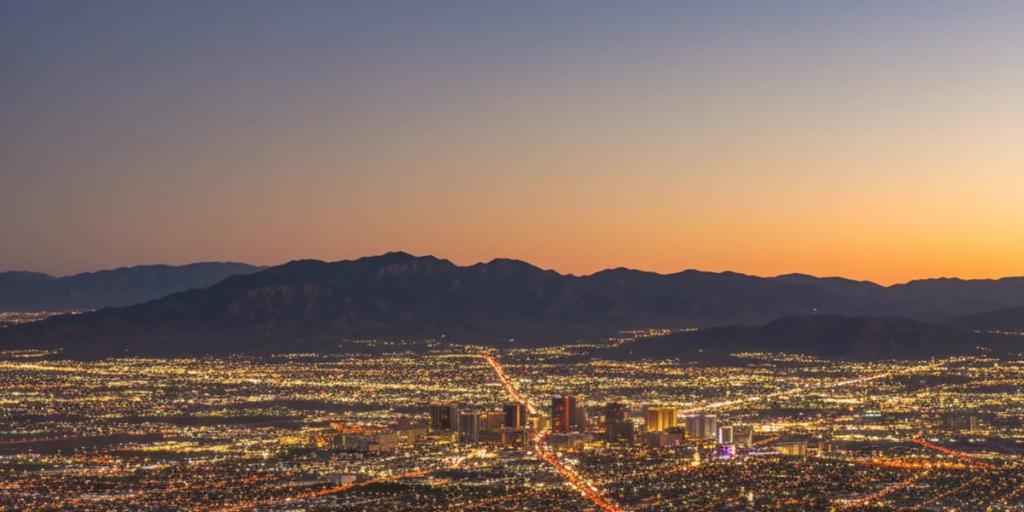
Las Vegas runs on your phone more than almost any city in America - room keys, show tickets, restaurant reservations, and rideshare pickups all live there. Travel eSIMs for the US typically ride T-Mobile or AT&T as the host network, and along the Strip, Downtown, and the suburbs all three big networks deliver fast 5G. The USA network comparison for tourists covers how they differ, but inside the valley the honest answer is: outdoors, you will be fine.
Indoors is another story. Casino resorts are concrete-and-steel canyons - windowless floors the size of city blocks, buried in the middle of buildings - and even with the in-building antennas the big properties install, signal can sag to a bar or two deep on a gaming floor. If a message will not send, walking towards an entrance usually fixes it. The other squeeze is event weeks: during CES in early January, well over 100,000 attendees hammer the same cells, and reporting from CES 2026 described connectivity that turned slow and unreliable across the convention centre, nearby hotels, and the Strip itself. If your visit overlaps a mega-convention, expect the network to feel like rush hour.
Outside the city, coverage falls off a cliff fast. Valley of Fire, Death Valley, and long stretches of I-15 towards Los Angeles have extended zero-signal sections on every network - download offline maps before any day trip, because the desert does not do "recalculating".
- Your hotel's app is half your room key. MGM, Caesars, and most big resorts push mobile check-in, digital room keys, dinner bookings, and show tickets through their apps - all of which want a live connection at the exact moment you are standing at a locked door.
- Rideshare pickups are a maze. Uber and Lyft do not stop at the casino curb; each resort routes you to a designated pickup zone, often a specific garage level, and you will be following the app's walking directions through a casino to find it.
- The Deuce - RTC's double-decker bus - runs the length of the Strip around the clock, with tickets in the rideRTC app. Underground, the Vegas Loop shuttles you between Convention Center stops and a handful of resorts (Resorts World, Westgate, Encore, Fontainebleau) in Teslas, with the network still expanding.
- Everything is booked online. Shows, nightclubs, brunch, even pool access at the hot resorts sell timed entry through apps and sites - walk-ups increasingly get told to scan a QR code and join the digital queue.
The airport sits absurdly close to the Strip - you can see your hotel from the runway - but rideshare pickups still mean following the app to the correct garage level. Taxis and the RTC bus cover the rest. Either way, the ten minutes between landing and your first "which tower is my hotel in" search is exactly when you want the eSIM already installed and working.
British Airways and Virgin Atlantic fly non-stop from Heathrow in about ten hours 40, and Manchester has flights of about 11 hours. Las Vegas is eight hours behind the UK - seven for a week from 25 October to 1 November 2026, and again from 14 to 28 March 2027, because the UK and US change clocks on different dates. From Terminal 1, RTC buses 108 and the Red Line leave from Level Zero. Hotels on the Strip add a 13.38% room tax to the bill (Clark County). You need an approved ESTA before you fly.
Your UK plan: EE charges £6 a day (£30 a week), O2 Travel £7, Vodafone £8 and Three £5 on most plans.
A Vegas trip is booking-heavy rather than navigation-heavy: resort apps, ticket QR codes, group chats coordinating where everyone is, and a steady stream of photos of things that light up. For most visitors 1GB per 2-3 days is comfortable; take headroom if you are working a convention (video calls plus a congested network mean retries) or filming everything for the feed. The USA eSIM overview compares plan sizes, and unlimited options exist if a conference week is the whole point of your trip.
Almost anything goes, with two exceptions: nightclubs and fine-dining rooms enforce dress codes (collared shirts and closed shoes for men; sportswear gets turned away), while casino floors genuinely do not care. Pack real walking shoes - Strip blocks are deceptively long, roughly a kilometre each, and "it's just next door" routinely means 25 minutes of walking. Summer needs a layer anyway: it is 43C outside and aggressively air-conditioned inside. Winter visitors underestimate the desert - days are mild, but nights drop towards freezing.
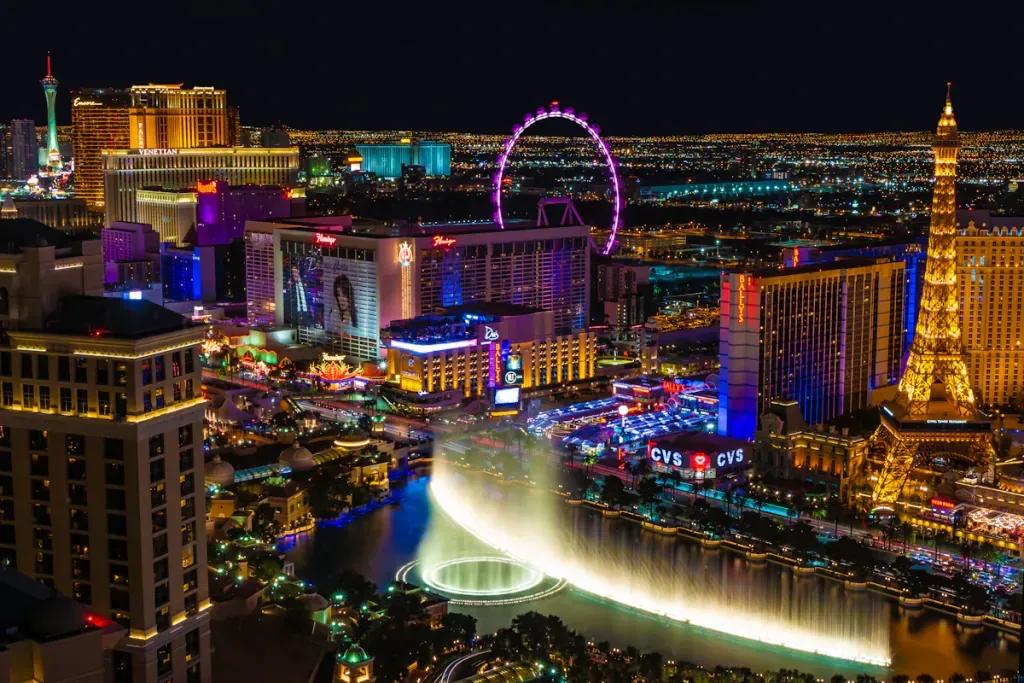
The Welcome to Fabulous Las Vegas sign has a formal queue in its car park; go at sunrise and you will have it nearly alone, with soft light instead of harsh glare. The Bellagio fountains photograph best from above - the Eiffel Tower Viewing Deck at Paris (ticketed, around $25-35) looks straight down on the show across the street. Downtown, the Fremont Street canopy runs its light shows hourly after dark - shoot straight up, wide. For nature, Valley of Fire's Fire Wave wants late golden hour. Leave the drone at home: the Strip sits under Harry Reid's airspace and Nevada law makes flying near the airport a misdemeanor, with fines that have run into five figures.
The Strip is mostly not in Las Vegas - nearly all of it sits in Paradise, an unincorporated town in Clark County, so the famous sign technically welcomes you to a city you are not entering. The valley holds around 150,000 hotel rooms, more than any other US city. And the Luxor's Sky Beam is often called the brightest beam of light in the world - pilots report seeing it from far out, though the "visible from space" line is marketing rather than measurement.
CES takes over early January, and hotel prices multiply several times over. March Madness and Super Bowl weekend fill every sportsbook whether or not the game is here. EDC packs the Motor Speedway in mid-May (May 15-17 in 2026), and the F1 Las Vegas Grand Prix closes the Strip itself for night racing November 19-21, 2026. Around all of it, headliner residencies keep the arenas busy year-round.
The love: nowhere else does spectacle at this scale, the food scene runs from £3 tacos to more celebrated fine dining per square mile than almost anywhere, and world-class desert nature (Red Rock, Valley of Fire, Death Valley) starts 30 minutes from the neon. The gripes are just as real: resort fees ambush your bill at $40-55 per night on top of the advertised rate, everything is engineered to keep you inside spending, July pavements at 45C are genuinely hostile, and longtime visitors grumble that the famous free-flowing perks - cheap buffets, drink service while you play - have thinned out. Know the maths going in and the spectacle still wins.
Casino floors are vast windowless spaces wrapped in concrete and steel - a hard environment for any radio signal, whatever your network. Resorts install indoor antenna systems, so it is usually usable rather than dead, but if something will not send, stepping towards an entrance or up to your room almost always fixes it.
Expect it to work but feel slow. When 100,000-plus attendees converge, the cells around the convention corridor and the Strip get saturated, and CES weeks are documented network-strain events. Load tickets and maps in advance, send big files from your hotel Wi-Fi, and be patient with anything real-time on the show floor.
Assume long dead zones. Valley of Fire, Death Valley, and stretches of the desert highways have no coverage on any network, so download offline maps before leaving the city. One more trap: Arizona does not observe daylight saving, so for half the year your phone's clock jumps an hour when you cross the state line near Hoover Dam - check tour times against the right zone, and install your eSIM before you fly so it is live from the moment you land.