Lanzarote runs on Movistar, Vodafone and Orange, and your eSIM rides one of them as its host. The Canaries are part of Spain and the EU for roaming purposes, so an EU or EEA SIM works on its home allowance - our Tenerife guide covers that question for the archipelago. Coverage on Lanzarote is good along the developed south and east, and the interesting thing about this island is not the network. It is that one man spent thirty years deciding what Lanzarote was allowed to look like, and largely won.
Lanzarote looks unlike any other Spanish resort island, and that is the result of deliberate rules rather than luck.
César Manrique was a Lanzarote-born artist who returned in 1966 after years in Madrid and New York, at the exact moment mass tourism was arriving in the Canaries. He had seen what was happening elsewhere on the Spanish coast and set out to prevent it here.
Nothing above four storeys. Manrique campaigned for height limits and they largely hold across the island - the exceptions are in Arrecife, the capital, and are conspicuous precisely because there are so few of them.
Billboards are banned. Roadside advertising is prohibited island-wide, which is startling once you notice it. You can drive across Lanzarote without being sold anything.
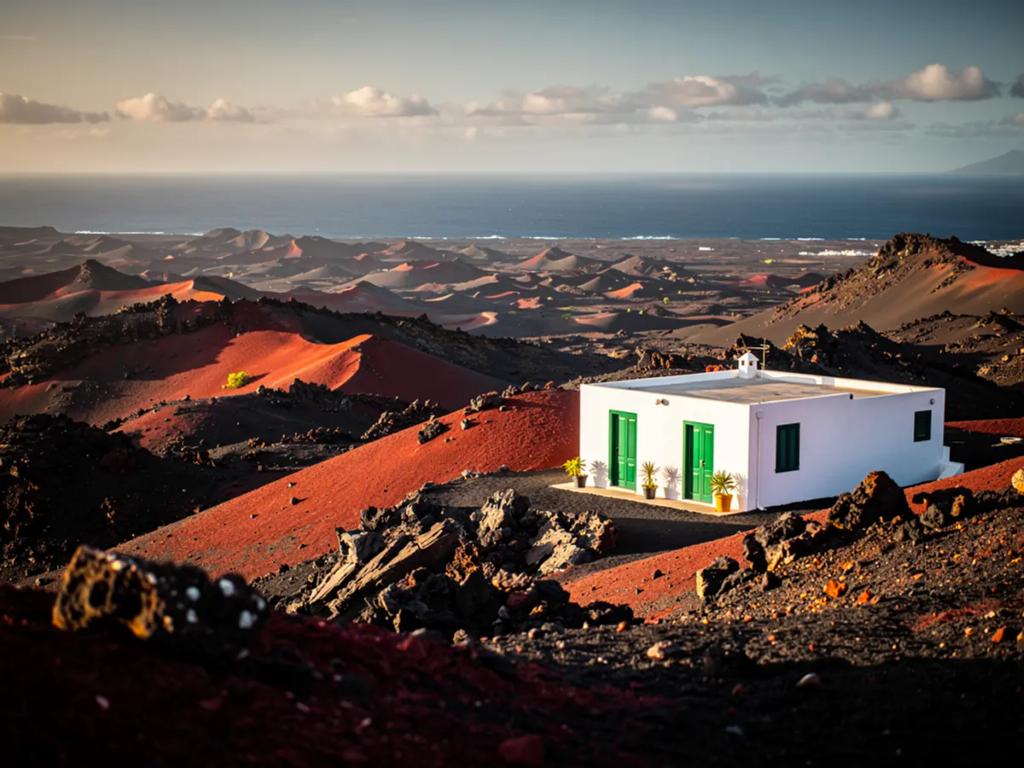
White houses, green or blue paintwork. Traditional Canarian colours were codified into planning practice: white walls, green shutters inland, blue on the coast.
Overhead cables were buried where possible, and the visual clutter that accumulates in most resort areas simply is not here.
He built the island's attractions himself, which is the unusual part - Jameos del Agua inside a lava tube, the Mirador del Río cut into a cliff, the Cactus Garden in an old quarry. They are art works, visitor sites and arguments for his approach at the same time.
The whole island became a UNESCO Biosphere Reserve in 1993, which locked much of this in.
Manrique died in a car crash in 1992, near the foundation he created in his own house, which is built inside a series of volcanic bubbles. The house alone is worth the trip.
The scenery here is young, and knowing how young changes how it looks.
Between 1730 and 1736 the island erupted more or less continuously. Not a single event - six years of it, which buried around a quarter of Lanzarote under lava and ash and destroyed the most fertile land.
Timanfaya National Park is that eruption field, and it is close to unaltered. The ground a few metres down is still hot enough that guides demonstrate it by pouring water into a borehole to produce a geyser, and by grilling food over an open pit.
You cannot walk freely in Timanfaya. Access is by coach tour on a fixed route, or on limited guided walks booked ahead, because the terrain is fragile and unstable. This surprises people who arrive expecting to hike it.
La Geria is the other half of the story. Farmers learned to plant vines in individual hollows dug into the volcanic ash, each sheltered by a low crescent wall against the wind, with the ash trapping overnight moisture. It looks like a field of craters and it produces genuinely good malvasía.
The island is desert. There is effectively no fresh water - Spain's first desalination plant opened here in 1964, and everything you drink comes from the sea.
The resort strip is well covered - Puerto del Carmen, Costa Teguise, Playa Blanca and Arrecife are all fine.
Timanfaya is the notable gap. Much of the park has little to no coverage, and the coach route crosses terrain with nothing. Since you cannot wander off it, this matters less than it might.
The north, around Haría and the Famara cliffs, thins on the roads and in the valleys.
Famara beach is covered at the village end and patchier along the sand under the cliffs.
La Graciosa, the small inhabited island off the north coast reached by ferry, has coverage in Caleta de Sebo and very little beyond it - and since it has no paved roads, that is most of it.
The interior tracks through the malpaís badlands are empty in every sense.
The trade winds blow almost constantly, which is why the island is comfortable at 26C and why the vines need their walls.
Famara and Costa Teguise are serious surf and windsurf destinations because of it.
It also means the beaches are breezier than the temperature suggests, and a windbreak is standard equipment for a day on the sand.
Ironman Lanzarote, held here each May, is widely considered the hardest of the series, and the wind is the reason.
Flights occasionally suffer in strong conditions, and the ferry to La Graciosa can be cancelled outright - do not plan that crossing for your last day.
- Maps with offline copies for the north and the interior tracks.
- A wind and surf forecast app, which is what half the island checks each morning.
- A car hire app or booking, because you will need a car - see below.
- A translation app is optional. Spanish throughout, English very widely spoken in the resorts, German common in Costa Teguise.
- Cards work everywhere. Contactless is standard.
César Manrique-Lanzarote Airport (ACE) is at Arrecife, close to the middle of the island's populated side and about ten minutes from Puerto del Carmen.
Car hire is effectively essential. Lanzarote is spread out, the sights are scattered across the island, and public transport is thin. Rates here are among the cheapest in Europe and booking ahead is worth it.
Buses connect the main resorts and Arrecife but not much else.
Ferries run from Playa Blanca to Fuerteventura in about half an hour, and from Órzola to La Graciosa in twenty minutes.
Lanzarote keeps UK time all year - no jet lag, and you change your clocks on the same weekends - and flights take about four hours from Stansted and four and a half from Manchester. From the airport, buses run to Arrecife and Playa Honda (lines 22 and 23) and to Puerto del Carmen and Playa Blanca (161 and 162).
What does change is your phone bill. The Canary Islands are in every big UK network's Europe zone, but most plans started since 2021 pay to use it: £2.72 a day on EE, £2.75 on Vodafone unless you have Euro Roam, £2 or £2.75 on Three; only O2 includes it on every plan. For a fortnight, that is where an eSIM earns its keep. The Foreign Office's beach warning applies here too: some beaches around the Spanish islands have strong undercurrents (gov.uk, updated 12 August 2026).
Little. EU visitors are on their home allowance, wifi is universal in the resorts, and the island is small. What matters here is offline maps rather than allowance - the north and the interior will drop you, and the road network is not always intuitive.
Layers against the wind, in every season. This is the single most useful packing note: 24C in a stiff trade wind wants a windproof shell.
Light clothes otherwise, all year.
Proper shoes for lava. The volcanic rock is abrasive and will destroy soft soles and bare feet - the malpaís is essentially broken glass at scale.
Swimwear and a windbreak for the beach.
Strong sun protection. You are at 29 degrees north with very little cloud and a cooling breeze that hides the strength of it.
Nothing formal. Lanzarote is relaxed and the good restaurants are casual.
La Geria's vine hollows, rows of black craters with green vines and crescent walls, in low afternoon light.
Timanfaya's Montañas del Fuego, the red and ochre cones, from the park route.
Jameos del Agua, Manrique's lava tube with its underground lagoon and blind albino crabs found nowhere else on earth.
Mirador del Río, the clifftop viewpoint cut into the rock at the north end, looking across to La Graciosa.
Playa de Papagayo, the sheltered golden coves in the far south.
Famara, the vast beach under a 600-metre cliff wall, at sunset.
The César Manrique Foundation, his house built into five volcanic bubbles with a fig tree growing out of one.
The wind toys, Manrique's kinetic sculptures on roundabouts across the island - free, and everywhere.
The 1730 eruption lasted six years and is one of the largest historical basaltic eruptions on record. Contemporary accounts by the local priest survive and are extraordinary reading.
The blind albino crabs at Jameos del Agua live nowhere else in the world, and are so sensitive that visitors are asked not to throw coins into their pool - the metal poisons them.
Lanzarote's wine is grown in ash. The picón technique traps dew and shelters roots, and it is the only significant viticulture of its kind anywhere.
There is no natural fresh water. Spain's first desalination plant was built here in 1964, and the island runs entirely on desalinated seawater.
Manrique designed the roundabout sculptures himself, and there are around thirty of them, all kinetic, all turning in the trade wind.
And José Saramago, the Portuguese Nobel laureate, spent his last eighteen years here and is buried on the island. His house in Tías is a museum.
Carnival, in February, with Arrecife's the largest on the island.
Ironman Lanzarote, in May, generally reckoned the toughest course in the series, entirely because of the wind and the climbs.
Fiestas de Los Dolores, in September, the island's patronal festival at Mancha Blanca, a pilgrimage that dates from the 1730s eruptions.
The wine harvest in La Geria, in July and August, which is earlier than almost anywhere in Europe.
There is no off season. Temperatures barely move, and the island is busiest in the northern European winter for exactly that reason.
The love: Lanzarote is the most visually coherent island in the Canaries and one of the strangest landscapes in Europe - black lava fields, white villages, no billboards, no high-rise, and a set of visitor attractions that are genuinely works of art rather than concessions. The weather is reliable to the point of monotony, the wine is interesting, the beaches in the south are excellent, and the whole thing is small enough to see properly in a week. It is also very easy: short flights, cheap car hire, EU roaming, and no language barrier in the resorts.
The complaints are consistent. It is barren, and visitors expecting tropical green find volcanic desert. The wind irritates people who came to lie still on a beach. You need a car, and without one the island shrinks to a resort strip. The resort towns themselves are ordinary - Puerto del Carmen in particular is a standard package strip, and the island's distinction lies outside it. Timanfaya cannot be walked, which disappoints hikers. And a few find the Manrique presence overbearing, since his name and hand are on a great deal of the island.
Come any month, hire a car on day one, drive La Geria and Timanfaya in the same morning, and take the ferry to La Graciosa if the wind allows.
Yes - the Canary Islands are part of Spain and the EU for roaming, so an EU or EEA SIM uses its domestic allowance. Our Tenerife guide covers the archipelago question in more detail. Note the clocks: the Canaries run an hour behind mainland Spain.
Largely not. Much of the national park has little to no coverage. Since access is restricted to a fixed coach route and booked guided walks rather than free hiking, this rarely causes a problem - but download offline maps before heading into the park or the northern interior.
Effectively yes. The sights are scattered across the island, buses connect only the main resorts and Arrecife, and the interior has no service at all. Car hire on Lanzarote is among the cheapest in Europe, and the roads are excellent and empty.
In Caleta de Sebo, the main village, yes. Beyond it, very little - the island has no paved roads and almost no development. It is a twenty-minute ferry from Órzola and worth a day, but treat it as a disconnected one and check the wind, because crossings are cancelled in rough conditions.