Malaga sits at the centre of the Costa del Sol, and Spain's three main networks - Movistar, Vodafone and Orange - treat it accordingly: strong 4G and widening 5G run the length of the coast, from the airport through the centre and out along the beach towns to Fuengirola. Your eSIM rides one of these hosts, so data just works, whether you are on the Muelle Uno waterfront, up at Gibralfaro or on a towel at La Malagueta.
The historic centre is the usual old-town story: streets around the Alcazaba and behind the cathedral narrow into shaded stone lanes where signal can dip for half a block before bouncing back at the next open square. Annoying, never trip-ruining. The real preparation case is the Caminito del Rey, the cliff-pinned gorge walkway about an hour inland: it threads a remote river canyon where coverage is unreliable on every network, and entry runs on timed tickets. Save the confirmation offline and download the area map before leaving Malaga, not at the gorge.
- The Cercanias C1 train is the spine of the coast, linking the airport, the city centre and the beach towns to Fuengirola - tap a contactless bank card or phone at the barriers and the fare is worked out from where you tap out.
- The metro and EMT buses are equally friction-free: metro Line 1 has reached Atarazanas by the old town since 2023 and takes contactless at the gates, and city buses accept card or phone tap onboard.
- Uber, Cabify, Bolt and FreeNow all operate in Malaga, so ride pricing is competitive; airport pickups and post-beach-dinner rides are when you will actually use them.
- Caminito del Rey tickets sell out days ahead in high season and are only sold with a date and time slot on the official portal - a booking you make from your phone mid-trip, not one you can wing at the entrance.
- Chiringuitos are the exception to app-everything: the beach grill shacks increasingly take cards, but smaller ones can be cash-first, and nothing about an espeto lunch is bookable online. Carry a little cash and just show up.
Malaga airport is one of Spain's easiest arrivals: the C1 platform is a short walk from the terminal, a bank-card tap opens the barrier, and you reach Maria Zambrano or Centro-Alameda in roughly 12 minutes - or head the other way down the coast to Torremolinos, Benalmadena and Fuengirola. That first ride is when accommodation directions, the landlord's WhatsApp and the "we landed" messages all fire at once, so having the eSIM live before wheels-down saves the airport Wi-Fi scramble.
British Airways flies Heathrow to Málaga three times a day in under three hours, and Manchester and Stansted flights take about three hours ten. From the airport, the Cercanías C1 train reaches María Zambrano station in eight minutes and the centre in twelve. Málaga is always one hour ahead of the UK.
Your UK plan: Spain is in every big UK network's Europe zone - included on O2, £2.72 a day on EE, £2.75 on Vodafone unless your plan has Euro Roam, and £2 or £2.75 on Three.
Malaga trips skew photo-heavy (the light here flatters everything) and navigation-moderate - the compact centre means most map use is coastal train logistics and day-trip planning. Around 1GB per 2-3 days covers a normal holiday; if you plan to tether a laptop or hotspot video calls, budget several times that. For picking between the Spanish host networks, our Spain network comparison covers how Movistar, Vodafone and Orange differ on the ground.
Malaga's second act is not just galleries. Google opened its Safety Engineering Center - a major cybersecurity hub - on the seafront in late 2023, built around VirusTotal, the security firm founded here, and enough tech companies have followed that you will hear the "Malaga Valley" nickname. For a visitor with a laptop that means a real cafe-work culture: specialty coffee places around Soho and the centre are used to a morning of laptops, and tethering through your eSIM covers calls when a cafe's Wi-Fi sags.
The Spanish rule applies with full force: swimwear and bare chests belong on the sand, and walking the old town in beach kit marks you out (and can be fined in some Costa del Sol municipalities). Evenings run smart-casual - malaguenos dress up for a paseo down Calle Larios - while an espeto lunch at a chiringuito is as casual as lunch gets. Winter days are t-shirt warm but evenings cool fast, so pack a light layer. On summer terral days, when the hot inland wind pushes temperatures past 40C, plan shade and sea, not sightseeing marches.
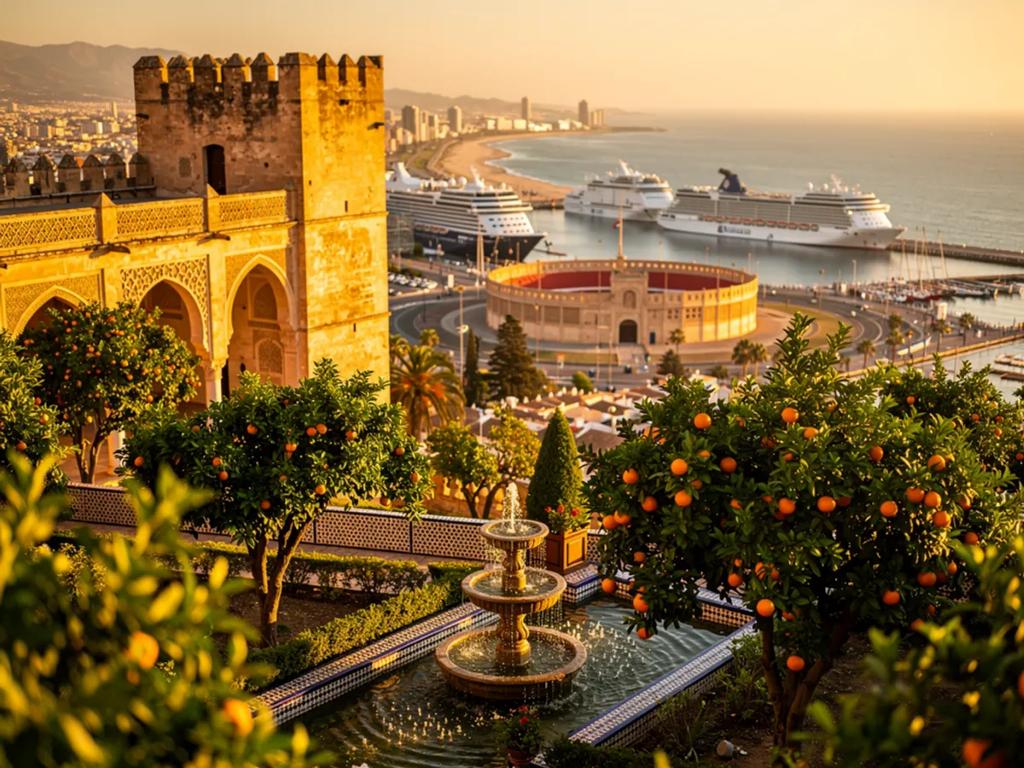
The postcard shot is from the Gibralfaro viewpoint: the port, the cathedral's one finished tower and the round bullring below, best in the last hour before sunset - walk up early enough to claim the railing. The Alcazaba's double-walled walkways want morning light instead, when the sun rakes through the horseshoe arches and crowds are thin. Down in the centre, Calle Larios' marble pavement shines at blue hour, just after the shop lights come on. Rooftop bars facing La Malagueta put the bullring and sea in one frame. On the Caminito del Rey day trip, the glass-bottomed balcony near the end of the route is the nerve-tester everyone queues for - shoot downward through the glass to show the drop.
Picasso was born here in 1881, on Plaza de la Merced, and the city holds both his birthplace museum and the Museo Picasso a few streets apart. The Alcazaba and Gibralfaro, linked by a walled corridor up the hillside, are often counted among Spain's best-preserved Moorish fortress pairs. And the espeto - sardines skewered on cane - is traditionally grilled over embers in old fishing boats filled with sand, a trick the chiringuitos have kept alive since the 19th century.
Feria de Malaga, in mid-August (15-22 August in 2026), is the week the city roughly doubles: daytime street feria in the centre, nighttime fairground, very little sleep. Semana Santa (movable, March or April) brings enormous processional thrones through the streets - hometown hero Antonio Banderas returns nearly every year as a steward of his fraternity's throne on Palm Sunday. The Malaga Film Festival in March is Spanish-language cinema's big spring showcase, and La Noche en Blanco (16 May in 2026) keeps museums open free into the small hours.
The case for Malaga is strong: real winter sun when the rest of Europe is grey, a port city that reinvented itself around art and food without losing its accent, an airport 12 minutes from the centre, and prices that undercut Barcelona for a comparable weekend. The case against is honest too: summer beaches get towel-to-towel, and the concrete resort strip west of the city is nobody's idea of romantic Spain, even if Malaga proper feels nothing like it. Feria week is glorious or unbearable depending on your appetite for noise, and on big cruise days the old town absorbs several ships' worth of tour groups by mid-morning. Come in May, June, September, October - or midwinter, the underrated move - and the ledger tilts firmly towards love.
Treat it as offline. The walkway runs through a remote gorge where coverage is patchy to absent on all networks, so download your timed ticket and an offline map before you set out. Signal returns around the access villages at either end.
Yes - Torremolinos, Benalmadena, Fuengirola and Marbella sit on the same national networks as Malaga city, with strong coverage along the whole strip. A single Spain eSIM on any recent compatible phone handles the full corridor, C1 train rides included.
Not really. Hotel and cafe Wi-Fi is fine, but between them - on the coastal train, at the beach, navigating the old town - you are on mobile data. Setting up an eSIM before you arrive means the airport train tap, the map search and the WhatsApp check-in all just work.