Movistar, Vodafone, Orange and Yoigo all cover Valencia, and your eSIM will use whichever is strongest. Spain is in the EU, so an EU or EEA SIM works on its home allowance, and coverage here is comprehensive. Our Madrid guide covers Spanish transport payments and metro signal, and our Alicante guide covers the gota fría - the autumn storm pattern that governs this whole coast. What is specific to Valencia is what the city did after the last time that pattern nearly destroyed it: it moved the river.
This is the single most interesting thing about the shape of Valencia, and you will walk through the result without necessarily realising what it is.
The Turia used to run through the middle of the city. On 14 October 1957 it flooded catastrophically, drowning the centre under several metres of water and killing dozens.
So they moved it. The Plan Sur diverted the river into a new channel south of the city, and by the 1970s the old bed through the centre was dry.
The plan was to pave it. The dry riverbed was earmarked for a motorway running into the heart of Valencia.
The city refused. A sustained public campaign under the slogan el llit del Túria és nostre i el volem verd - the riverbed is ours and we want it green - defeated the motorway.
What exists now is a nine-kilometre linear park curving through the city where the water used to be: gardens, football pitches, running tracks, palm groves and playgrounds, crossed by the old stone bridges that now span grass.
It is the best thing about Valencia. It is how locals commute, exercise and spend their evenings, and it puts the city's two ends - the old town and the City of Arts and Sciences - at either end of a single green walk.
And in October 2024 the decision was tested. A catastrophic DANA storm devastated towns in the metropolitan area to the south, with very large loss of life. The diverted channel is widely credited with sparing the city centre the same fate. Our Alicante guide explains the weather pattern itself; here it is enough to say that the 1957 decision is not an abstraction to anyone living in Valencia.
A small thing that says a great deal about this region.
Every Thursday at noon, outside the Apostles' Door of Valencia Cathedral, eight elected farmers in black smocks convene the Tribunal de las Aguas.
They settle irrigation disputes among the farmers of the huerta, the market gardens around the city, which have been watered by the same canal network since the Moorish period.
It is the oldest continuously functioning judicial institution in Europe, and it is on the UNESCO intangible heritage list.
Proceedings are oral, in Valencian, and take minutes. There are no written records, no lawyers and no appeal.
It is free to watch, it happens every week, and almost no visitors know about it.
Valencia's festival is not a parade. It is a controlled demolition with a crowd.
Fallas runs 15 to 19 March, and it is on the UNESCO list.
Enormous satirical sculptures - fallas, some several storeys high, made over the preceding year by professional workshops - are installed across the city's neighbourhoods.
On the final night they are all burned. Simultaneously. In the streets where they stand. The fire brigade attends as a matter of routine.
The mascletà is the part nobody warns you about. Every day at two in the afternoon during the festival, in the Plaza del Ayuntamiento, a rhythmic firecracker display is set off that is designed to be felt rather than watched. It is astonishingly loud - a physical percussion in the chest - and it lasts several minutes.
Bring ear protection if you have sensitive hearing, and open your mouth during it, which is what locals do.
The city is completely full. Accommodation books out months ahead and prices multiply.
If you dislike crowds and explosions, avoid mid-March entirely. There is no partial version of Fallas.
The city is comprehensively covered, metro and tram included.
In the Turia park, coverage is fine along its length - it is a park in a city, not a wilderness.
The Albufera, the freshwater lagoon and rice paddies ten kilometres south, thins out among the fields and on the boat trips at sunset.
Inside the Lonja de la Seda and the cathedral, thick stone does the usual.
Along the coast north towards Sagunto and south to Cullera, coverage follows the road.
The interior mountains towards Requena and the wine country have gaps in the valleys.
Not a connectivity matter, but you will get this wrong otherwise.
Paella is Valencian, specifically from the rice fields of the Albufera, and Valencians are unbending about it.
The original is paella valenciana: rice, chicken, rabbit, green beans, garrofó beans, tomato, saffron. Sometimes snails. Not chorizo, not onion, and emphatically not both.
Seafood paella is a legitimate coastal variant, and it is a different dish rather than the same one with prawns added.
It is a lunch dish, cooked to order, eaten at midday and usually shared. A restaurant offering paella at nine in the evening from a warmer is cooking for tourists.
Go to El Palmar or the Albufera villages for the real thing, or to one of the specialist arrocerías in the city.
Horchata and fartons are the other local obsession - a chilled drink made from tiger nuts, with sweet elongated pastries to dip. Alboraya is where it comes from.
- The MetroValencia and EMT apps for the metro, tram and buses.
- Valenbisi, the bike share, which is genuinely the best way to use the Turia park.
- Maps, with offline copies only if you are heading inland.
- A translation app is optional. Spanish is universal; Valencian is co-official and appears on all signage, and it is closely related to Catalan rather than a dialect of Spanish.
- Cards work everywhere and contactless is standard.
Valencia Airport (VLC) is about 8 km west, and the metro runs from the terminal into the city in around 20 minutes on lines 3 and 5. It is cheap and simple.
High-speed rail reaches Madrid in around an hour and three quarters, which makes a combined trip easy, and there are direct services along the coast.
The port handles Balearic ferries - Ibiza, Mallorca and Menorca are overnight or fast-ferry connections.
In the city, the metro, trams and bikes cover everything, and the centre is walkable. Valencia is notably flat, which is why the bike share works so well.
Very little. Wifi is widespread, the city is compact and flat, and EU visitors are on their home allowance. A light plan is ample - the only thing worth downloading is offline mapping if you are driving into the interior.
Light clothing in summer, which is hot and more humid than Madrid because of the coast.
A jacket for winter evenings, though the climate here is genuinely gentle.
Comfortable shoes. The city is flat and very walkable, and the Turia is nine kilometres end to end.
Something for the beach, which is in the city - Malvarrosa is at the end of a tram line.
Ear protection in March, for the reason above.
Valencia dresses casually compared with Madrid, and dinner rarely requires anything special.
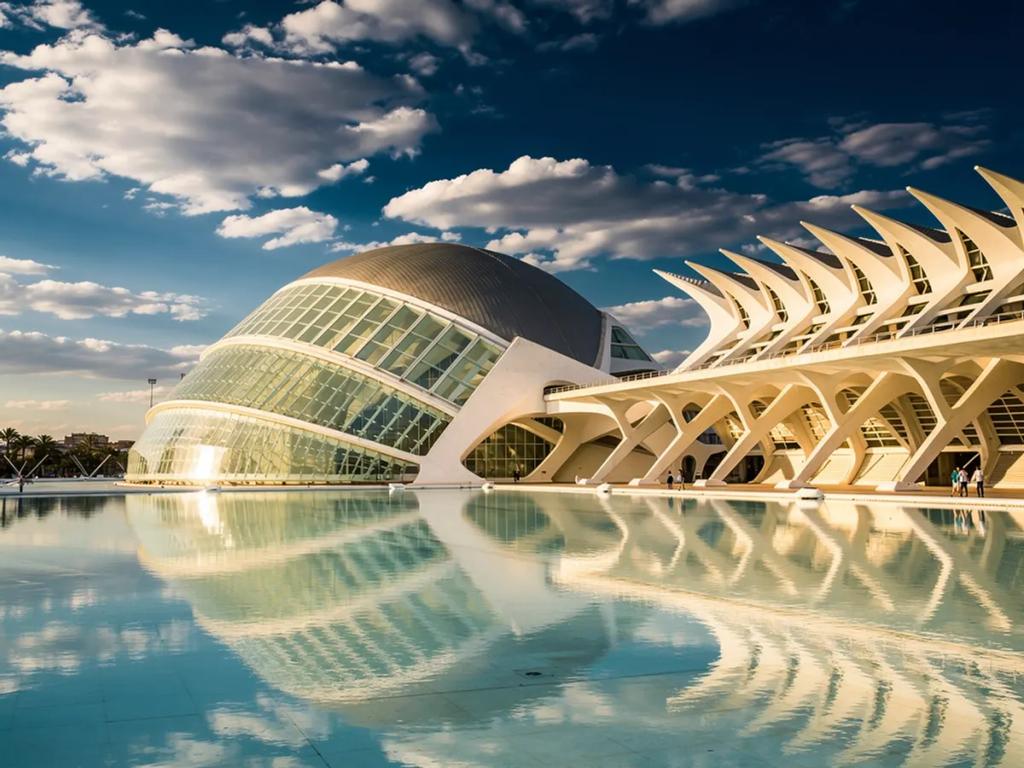
The City of Arts and Sciences at either end of the day, when the white shells reflect in the pools - Calatrava was born here, and this is his home-city project.
The Turia park from one of the old bridges, looking down at football pitches where the river used to be.
La Lonja de la Seda, the UNESCO-listed silk exchange, whose twisted stone columns are among the finest late Gothic interiors in Europe.
The Mercado Central, one of the largest covered markets in Europe, under its tiled dome.
The Water Tribunal at the cathedral door on a Thursday at noon.
Albufera at sunset, from a flat-bottomed boat among the rice fields.
A mascletà, during Fallas, though the photograph will not convey it.
The Barrio del Carmen's street art, in the old town lanes.
Valencia moved its river. After the 1957 flood the Turia was diverted around the south of the city, and the old bed became a nine-kilometre park instead of the motorway that was planned for it.
The Tribunal de las Aguas is the oldest continuously operating court in Europe, meeting every Thursday at the cathedral door, and it is UNESCO-listed.
Valencia Cathedral claims to hold the Holy Grail - an agate cup that some scholars date to the right period and region. The claim is taken seriously enough that popes have used it.
Paella comes from the Albufera rice fields outside the city, and the argument about what belongs in it is a genuine cultural position rather than a joke.
Fallas burns a year's work in one night, every March, across the entire city simultaneously.
And the City of Arts and Sciences sits in the dry riverbed, which is why it is below street level and surrounded by water features - a deliberate echo of what used to run there.
Fallas, 15 to 19 March, described above and unmissable or unbearable depending on temperament.
The Tomatina, in nearby Buñol on the last Wednesday of August, which is the tomato fight - ticketed and limited now.
Easter week in the Marítim district, which has its own distinct maritime processions.
The Formula 1 and MotoGP at the Ricardo Tormo circuit at Cheste.
May, June, September and October are the best months: warm, sunny, and without either the summer humidity or the March chaos.
The love: Valencia is the most liveable major city in Spain by a wide margin, and visitors keep noticing it. It has a beach in the city, one of Europe's great markets, a nine-kilometre park through its middle, a genuinely magnificent Gothic old town, Calatrava's architecture at one end, and prices well below Barcelona or Madrid. It is flat, cyclable, sunny and unhurried, and the food is a serious regional cuisine rather than a variation on Spanish.
The complaints are consistent. It is quieter than Barcelona and visitors wanting a big-city buzz find it provincial. Summer humidity is heavier than inland Spain. The beach is functional rather than beautiful. Fallas makes mid-March impossible for anyone who did not come for it. And the city has become much more popular with remote workers and second-home buyers, with the rent pressures that brings, which locals will tell you about.
Come in May or October, walk or cycle the length of the Turia, eat paella at lunch in El Palmar, and be at the cathedral door on Thursday at noon.
Yes, without qualification - Spain is in the EU and the eurozone, so an EU or EEA SIM uses its domestic allowance. Coverage across the city, the metro and the tram is comprehensive. Our Madrid guide covers Spanish transport ticketing and our Alicante guide covers the autumn storm pattern that affects this coast.
The old bed of the River Turia. After the 1957 flood the river was diverted south around Valencia, and a public campaign stopped the dry channel being turned into a motorway. It is now a nine-kilometre linear park running through the centre, crossed by the original stone bridges, and it is the best way to move around the city on foot or by bike.
The October 2024 DANA devastated towns in the metropolitan area south of the city with very large loss of life. The city centre was largely spared, which is widely attributed to the diverted river channel. Our Alicante guide explains the weather pattern; if you are travelling in autumn, follow AEMET warnings and take them seriously.
Only deliberately. From 15 to 19 March the city is full, expensive and extremely loud - the daily mascletà is a firecracker display designed to be felt in your chest, and on the final night hundreds of sculptures are burned in the streets simultaneously. It is extraordinary, and it is not a quiet city break.