Quebec City sits in the well-covered Windsor-Quebec corridor, and staying online here is easy: Canada's big three national networks (Rogers, Bell, Telus) all run strong 4G and 5G across the city, and Quebec's own Videotron adds a fourth dense network that blankets the province. Your travel eSIM rides one major host network, and in Vieux-Quebec, Saint-Roch, Sainte-Foy and along the riverfront that means fast, reliable data. Our Rogers vs Bell vs Telus guide compares the host networks in detail.
Outdoors, almost nowhere - the walled Old Town is compact and well served, and you will not lose signal wandering the cobblestones of Petit-Champlain or the Plains of Abraham. The honest exceptions are indoors: Old Quebec's 300-year-old buildings have thick stone walls, so inside a vaulted restaurant cellar or a lower-floor room of a heritage hotel you may drop a bar or two - step towards a window and it comes back. The other one is seasonal and it is not the network, it is your battery: at Carnaval-season temperatures of -15 to -25 C, a cold-soaked phone can shut itself off with plenty of charge left. Keep it in an inside pocket, carry a power bank, and remember that in February a dead phone means no maps, no tickets and no translation - the connection is fine, the lithium is not.
- RTC runs the buses - there is no metro. The frequent Metrobus lines (800/801) are the spine, and the RTC Nomade app handles routes and real-time arrivals; mobile fares and the OPUS card cover payment, so check current options in the app before boarding.
- French comes first. Quebec City is the most French-speaking major city in North America, and outside the tourist core, menus, signs, parking terminals and museum labels are often French-only. Camera-translate on a live connection is the single most useful thing your data plan does here.
- Uber operates in Quebec City, alongside local taxis - handy for the hill between the Lower and Upper Town in winter.
- Tap-to-pay is universal in Canada; a contactless card or phone covers cafes, shops and the Quebec-Levis ferry, whose ticket is also buyable from your phone.
From Jean Lesage airport (YQB), most arrivals take a flat-rate taxi (around CAD $40 to downtown) or an Uber; city bus service to the airport is limited, so do not plan around it. Out of town is where coverage planning matters more than in it: Montmorency Falls, fifteen minutes away, is fully covered, but if you drive Route 138 into Charlevoix towards Baie-Saint-Paul and La Malbaie, expect solid signal in the towns and thinner, patchy stretches between them - and near-nothing in the backcountry of the national parks. Download offline maps before leaving the city.
More than a typical European city break, mostly because of translation: camera-translating menus and signs, plus map-heavy wandering in the old town's lanes, pushes usage up. For most travellers 1GB per 2 days is comfortable; add headroom if you video-call home or spend evenings streaming while snowed in. Plans top up from your dashboard, and the wider-country picture - including the honest truth about remote coverage - is in our best eSIM for Canada guide.
Winter here is not a style question, it is engineering: an insulated parka, thermal base layers, a hat that covers your ears, and waterproof boots with real grip - streets alternate between packed snow and ankle-deep slush, and the Old Town's hills turn icy. Summer is easy, light clothes for 20-25C days, but bring a layer for evenings that cool fast off the river. In spring and fall, waterproof shoes earn their keep; the shoulder seasons are wet and changeable.
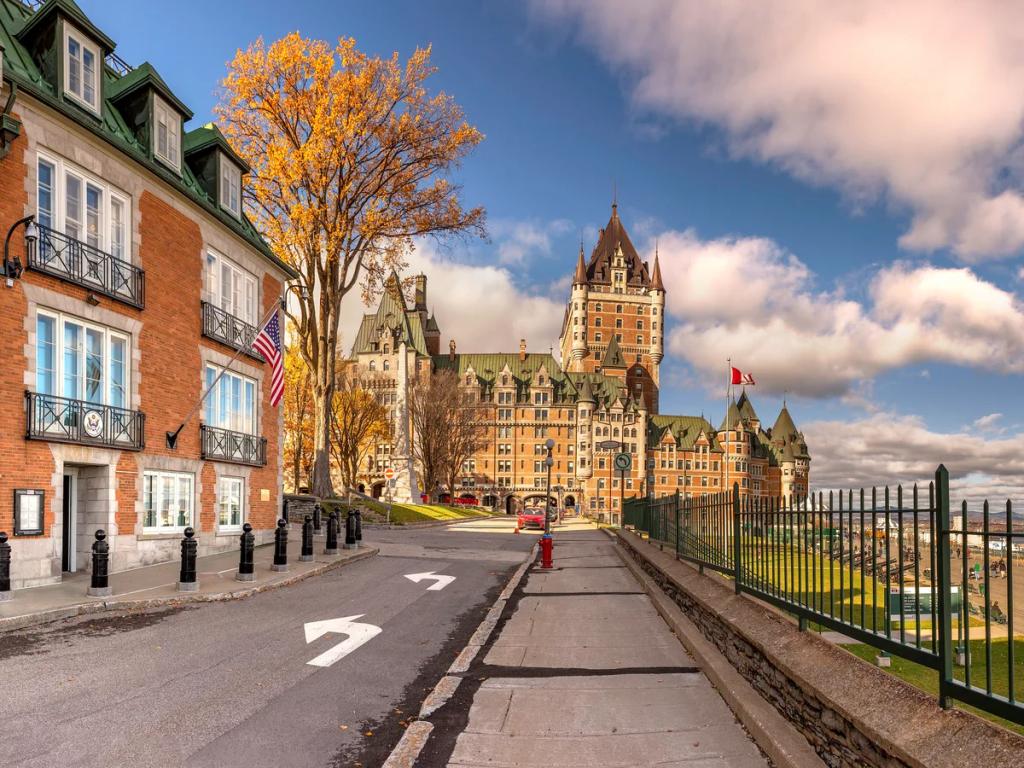
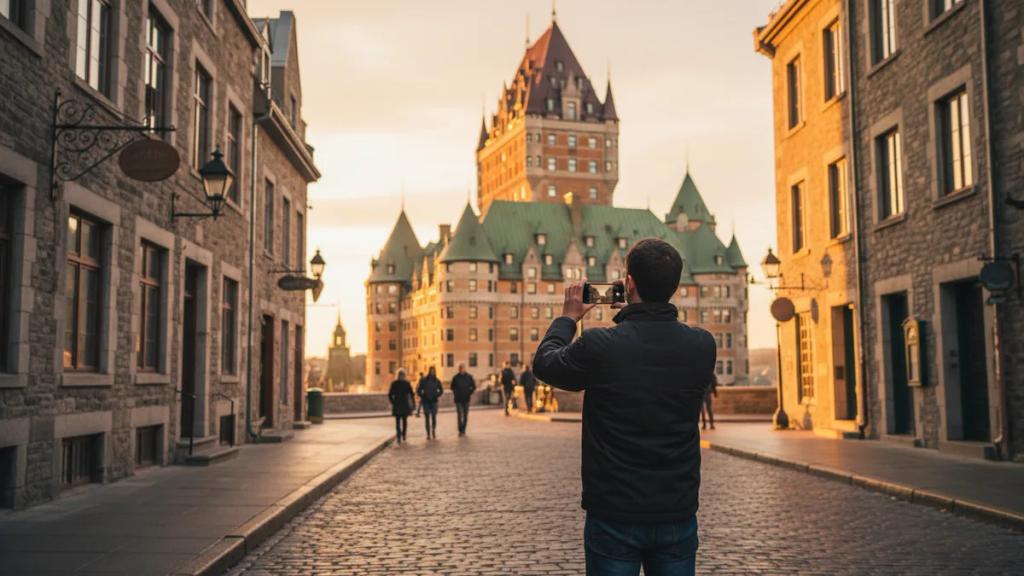
The Chateau Frontenac shot has two classic angles: close-up from Dufferin Terrace at golden hour, when the brick turns copper, or the full skyline from the deck of the Quebec-Levis ferry - the short crossing is cheap and doubles as a floating photo platform. For rue du Petit-Champlain, skip street level: stand at the top of the Breakneck Stairs (Escalier Casse-Cou) and shoot downward along the staircase into the lane, early morning before the crowds. At Montmorency Falls, the suspension bridge puts you directly over the 83-meter drop. Casual drone flying over dense Old Quebec is effectively off-limits under Transport Canada rules.
Quebec City is the only walled city north of Mexico in North America whose fortifications still stand - the core reason UNESCO listed the historic district. The Chateau Frontenac has long claimed the title of most photographed hotel in the world. And Bonhomme, Carnaval's snowman ambassador, gets a full ice palace built for him every winter.
Carnaval de Quebec (late January to mid-February) is one of the world's great winter carnivals - night parades, ice canoe races across the half-frozen St. Lawrence, and Bonhomme's ice palace. Festival d'ete de Quebec fills eleven days in July with one of Canada's biggest music festivals, headliners playing to huge crowds on the Plains of Abraham. The Fetes de la Nouvelle-France in early August dresses the old city in 17th-century costume (August 6-9 in 2026).
The love is real: this is the closest thing to a European walled city without crossing the Atlantic, and winter here is magic rather than misery - snow-draped rooftops, Carnaval, the toboggan run on Dufferin Terrace. The complaints are just as real: the cold is genuinely brutal for months and shortens both your walks and your battery life, the constant hills and staircases between Lower and Upper Town punish tired legs, Old Town restaurants charge tourist prices for forgettable food (locals eat in Saint-Roch), and the warm season is short. Come for the season you actually want, not the postcard.
Not necessarily - a travel eSIM connects to one major Canadian host network (Rogers, Bell or Telus, depending on the roaming agreement) and does not hop between networks. All of them overlap with deep coverage here, so whichever host you land on, Quebec City is not a place you will notice the difference.
The network will; your battery might not. Lithium batteries lose capacity fast below about -10 C and phones can shut down early in the deep cold of Carnaval season. Keep the phone warm in an inner pocket, bring a power bank, and screenshot tickets and directions so a sudden shutdown does not strand you.
This is the one Canadian city where the answer leans strongly yes. Hospitality staff in the tourist core speak English, but everyday signage, menus and machines operate in French, and live camera translation needs a connection. Install your eSIM before you fly so it is working from the taxi ride in.